Reading Time 5 mins

So, I often pride myself on my ability to multitask.
Picture the scene: I’m standing in the kitchen on a hectic Tuesday evening. I have a frying pan sizzling on the hob, my mobile clamped precariously between my shoulder and my ear while booking a last-minute dentist appointment, and I’m simultaneously replying to an urgent work email on my laptop using only my left hand.
For a second, I truly feel like an absolute modern-day She-Ra warrior. I am the epitome of efficiency—a master juggler manipulating the space-time continuum.
Then reality bites.
I accidentally type the name of the pasta sauce into the email, tell the receptionist I love them instead of confirming the time, and the kitchen smoke alarm starts shrieking because the garlic has burnt to a crisp.
We have all been there.
Modern life demands that we become human octopuses, processing infinite streams of digital data while managing our physical lives.
We wear our ability to "multitask" like a badge of absolute honour on our CVs.
But if we pull back the curtain and look at the hard, cold data of clinical neurobiology, science drops a rather devastating truth bomb: your brain cannot actually multitask.
In fact, I recently learned that trying to do so is the cognitive equivalent of intentionally throwing a handful of sand directly into a beautifully engineered sports car engine.
The Ultimate Neurobiological Illusion
How can science claim multitasking is a myth when you clearly manage to walk down the street while chewing gum, or listen to the radio while driving your car to work?
To understand this, we have to look at how the brain assigns its processing hardware.
It turns out our brain is capable of doing two things at once if—and only if—one of those tasks is completely automated.
Walking, chewing gum, and tracking a familiar driving route are handled by deep, subconscious structural networks like the basal ganglia and cerebellum.
They run quietly in the background like software updates on your phone.
The moment you try to perform two tasks that require conscious, deliberate focus, you hit an absolute biological bottleneck.
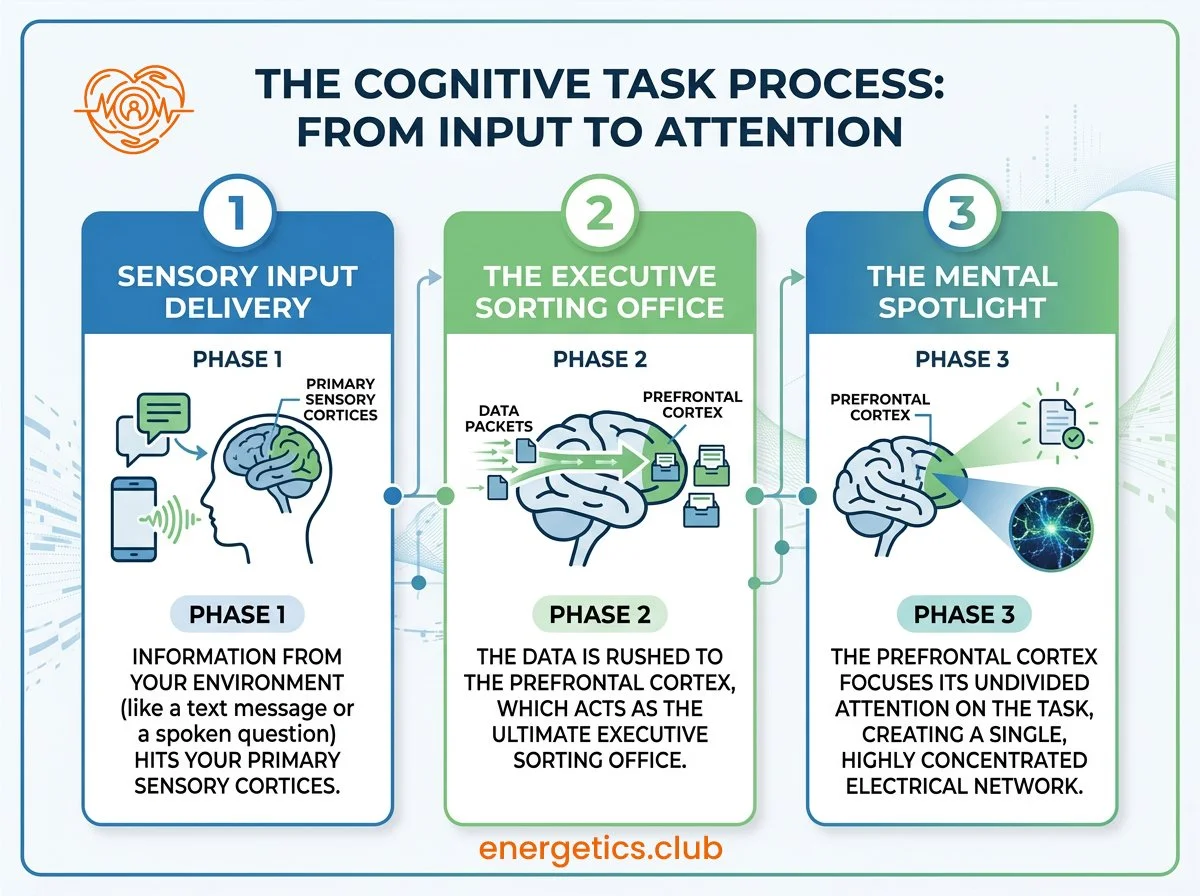
Because the prefrontal cortex operates with a single mental spotlight, it cannot illuminate two conscious tasks at the same millisecond.
When you think you are multitasking, you are actually performing what neuroscientists call task-switching.
Your brain is frantically turning the spotlight back and forth between the email, the phone call, and the sizzling pan, shutting down one neural network to spin up another.
It happens rapidly—often in fractions of a second—which creates a highly convincing illusion of simultaneous productivity. But beneath the surface, your neurons are desperately screaming for a break.
The Extravagant Cost of the "Switch Tax"
Every single time your brain forces itself to switch between tasks, you pay a steep, unavoidable biological penalty known as the switch tax or cognitive switching cost.
When you drop a half-written report to glance at a "quick" WhatsApp notification, your brain doesn't just instantly transition.
It has to dissolve the neural assembly dedicated to the report actively, load the rules and context for the text message, read it, dissolve that network, and then try to rebuild the original report framework from memory.
[Focus: Project Budget]
➔ 🛑 Dissolve Network
➔ ⚙️ Load Rules for Text Message
➔ [Focus: Text Message]
➔ 🛑 Dissolve Network
➔ ⚙️ Rebuild Budget Framework
Clinical research shows that this clunky, high-energy process causes three distinct performance drops:
1. The Time Deficit
Research from the American Psychological Association (APA) demonstrates that task-switching wastes an astronomical amount of time.
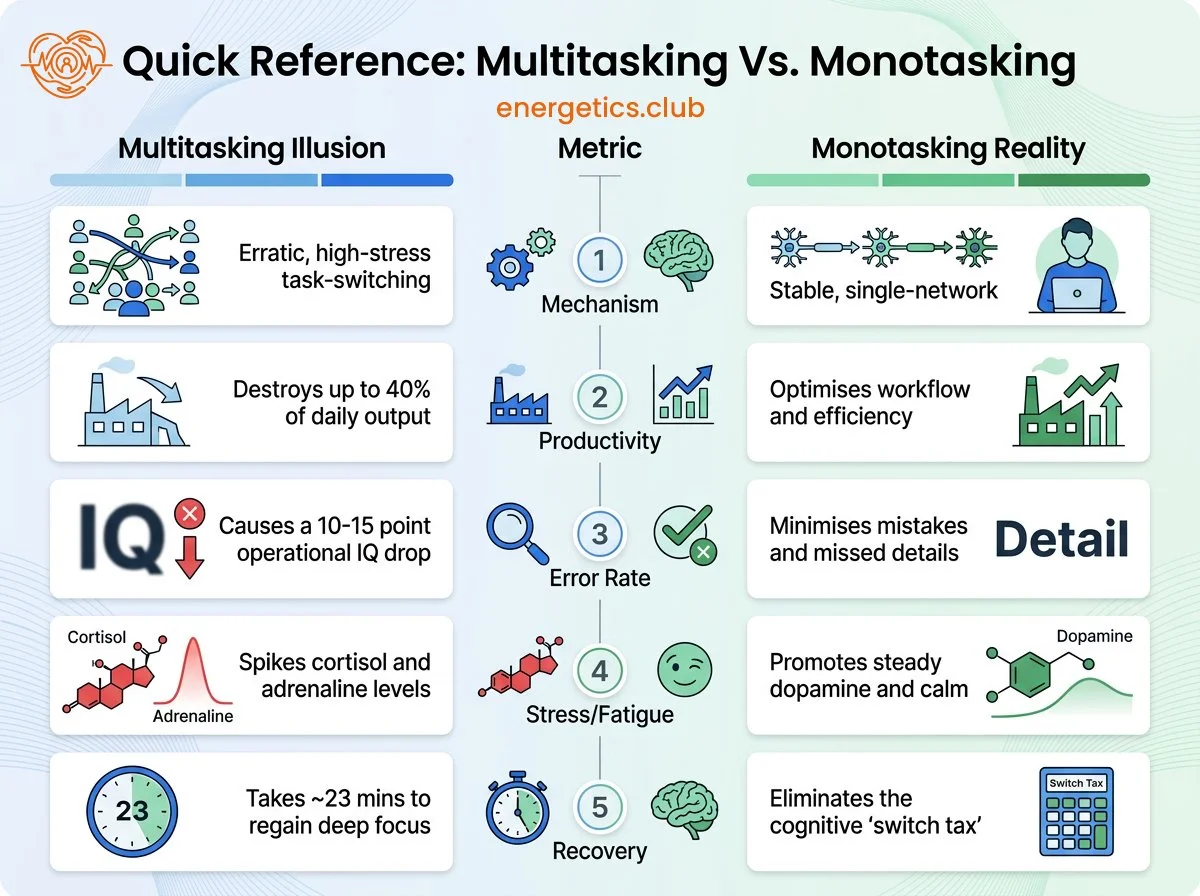
For simple tasks, the delay might seem trivial, but when toggling between complex mental challenges, the switch tax can destroy up to 40% of your daily productivity.
It takes your brain an average of 23 minutes and 15 seconds to return to deep, uninterrupted focus after a single, minor distraction.
2. The Flood of Mistakes
When your brain is frantically loading and unloading rules, things get dropped.
A famous study by the University of London revealed a terrifying metric: workers lost in a loop of constant multitasking experienced a drop in their operational IQ of 10 to 15 points.
To put that into perspective, that is a cognitive deficit worse than the effects of smoking cannabis, and equivalent to pulling an absolute all-nighter.
3. Chronic Metabolic Fatigue
Task-switching is an absolute energy hog. It rapidly burns through your brain's fuel reserve of glucose and oxygen.
By forcing your prefrontal cortex to shift focus endlessly, you trigger an overproduction of cortisol (the stress hormone) and adrenaline.
This chemical cocktail leaves you feeling wiped out, brain-fogged, and utterly exhausted by 2:00 PM, even if you haven't accomplished anything substantial.
To find out what your brain is actually made of, read this.
Neural Plasticity: Training the Wrong Muscle
The most alarming aspect of chronic multitasking is how it actively reshapes your physical brain anatomy through the laws of neuroplasticity.
Your brain is an incredibly adaptive organ; it physically moulds itself around your daily behaviours.
If you consistently treat your mind like an erratic, hyperactive pinball machine, your brain concludes that this fragmented state is your preferred way of operating.
Using structural fMRI scans, researchers at the University of Sussex discovered that individuals who regularly consumed multiple media streams simultaneously (like texting while watching TV and browsing the web) had lower grey-matter density in the anterior cingulate cortex (ACC).
The ACC is the precise region responsible for emotional regulation, empathy, and cognitive control.
By practicing distraction, you are literally training your brain to lose its capacity for deep, meaningful focus, turning yourself into a chronically distracted individual who cannot sit through a single movie or read a chapter of a book without a twitching urge to check a screen.
Conclusion: Reclaiming the Power of One
It’s hard not to believe that multitasking is a superpower of the modern elite. In our busy lives, I used to believe that multitasking demonstrated the pinnacle of proactive productivity. Boy, was I wrong. Science confirms it’s actually a stress-inducing waste of time.
True cognitive cleverness, deep creative brilliance, and professional mastery do not come from doing many things poorly at once; they come from doing one single thing with a laser-like focus.
If you can remember this, your work will improve, your stress levels will drop, and, more importantly, your dinner will stop burning to a crisp.
Embrace the quiet power of doing one thing at a time—and doing it well.
Which neatly brings us to the next question: is it fact or myth? Do we really use only 10% of our brain? Read the answer next, here.

Bibliography & Further Readings
American Psychological Association, 2006. Multitasking: Switching costs. [online] Available at: https://www.apa.org/topics/research/multitasking
Read This Next


Disclaimer: This article is for general informational purposes only and does not address individual circumstances, substitute for professional advice, or serve as a basis for decision-making. You should always seek the guidance of a physician or qualified healthcare provider regarding a medical condition, and never disregard or delay seeking professional medical advice due to this content. Any action taken based on this information is entirely at your own risk and responsibility; Energetics, its staff, and its medical advisors disclaim all liability for any inaccuracies, errors, or any personal or professional loss incurred as a direct or indirect consequence of using this content.