Reading Time 5 mins

I find the brain fascinating, and I find teenage brains even more intriguing.
If you ever spent a few minutes watching a group of teenagers or young adults in their early twenties hang outside a local chip shop, you have probably witnessed a fascinating sociological phenomenon.
They are often bright, highly articulate, and perfectly capable of passing complex university exams or navigating complex gaming software.
Yet, that very same evening, they might confidently decide that sliding down a steep concrete handrail on a borrowed supermarket trolley is an excellent, low-risk way to spend a Tuesday night.
For generations, it seems that society chalked this bizarre developmental mismatch up to simple teenage rebellion, raging hormones, or pure, unadulterated short-sightedness.
But as modern neuroimaging exploded in the late 1990s and early 2000s, scientists discovered a more compelling, mechanical reason behind this youthful chaos.
It turns out the human brain does not simply balloon up to its adult size in childhood and call it a day.
-In fact, it is the slowest-maturing organ in the entire body.
Apparently, the structural construction site inside your skull keeps its scaffolding firmly in place long past your legal 18th birthday, long past university graduation, and well into your mid-to-late twenties.
If you are looking for a definitive, scientifically backed age at which the structural blueprint is finally complete, the magic number circles around age 25.
For me, understanding this timeline completely reframes how we look at human maturity, mental health vulnerability, and the daily mechanics of decision-making.
The Neurobiological Assembly Line: Back to Front
The most crucial concept to grasp about brain development is that it does not happen uniformly.
The brain matures in a slow, predictable wave that moves systematically from the back of the skull to the very front.
[Occipital Lobe (Vision)] ➔ [Parietal Lobe (Movement/Space)] ➔ [Prefrontal Cortex (The Executive Manager)]
The very first areas to declare themselves "fully developed" are the primitive, survival-focused structures at the base of the brain—the brainstem and the cerebellum—followed swiftly by the sensory processing hubs at the back, such as the occipital lobe (responsible for vision).
The absolute last region to receive its final coat of evolutionary paint is the prefrontal cortex (PFC), the massive slab of grey matter sitting directly behind your forehead.
The prefrontal cortex is the seat of human executive function. It is your internal, clear-headed manager, responsible for:
Long-term planning and impulse control.
Anticipating the future consequences of current actions.
Calming emotional storms generated by deeper, primitive brain networks.
Balancing risk versus reward.
When a 19-year-old is in a high-stakes, dangerous situation and decides to forge ahead anyway, it is often because their prefrontal cortex is still a work-in-progress.
The engine of their emotional drives is fully built and running at peak performance, but the neurological brakes are still being wired at the factory.
To learn about what the brain is made of, read here.
2 Biomechanical Processes: How the Brain Matures
The transition from an adolescent brain to a fully developed adult brain at age 25 is driven by two brutal, highly coordinated mechanical processes that fundamentally change how information travels through your skull.
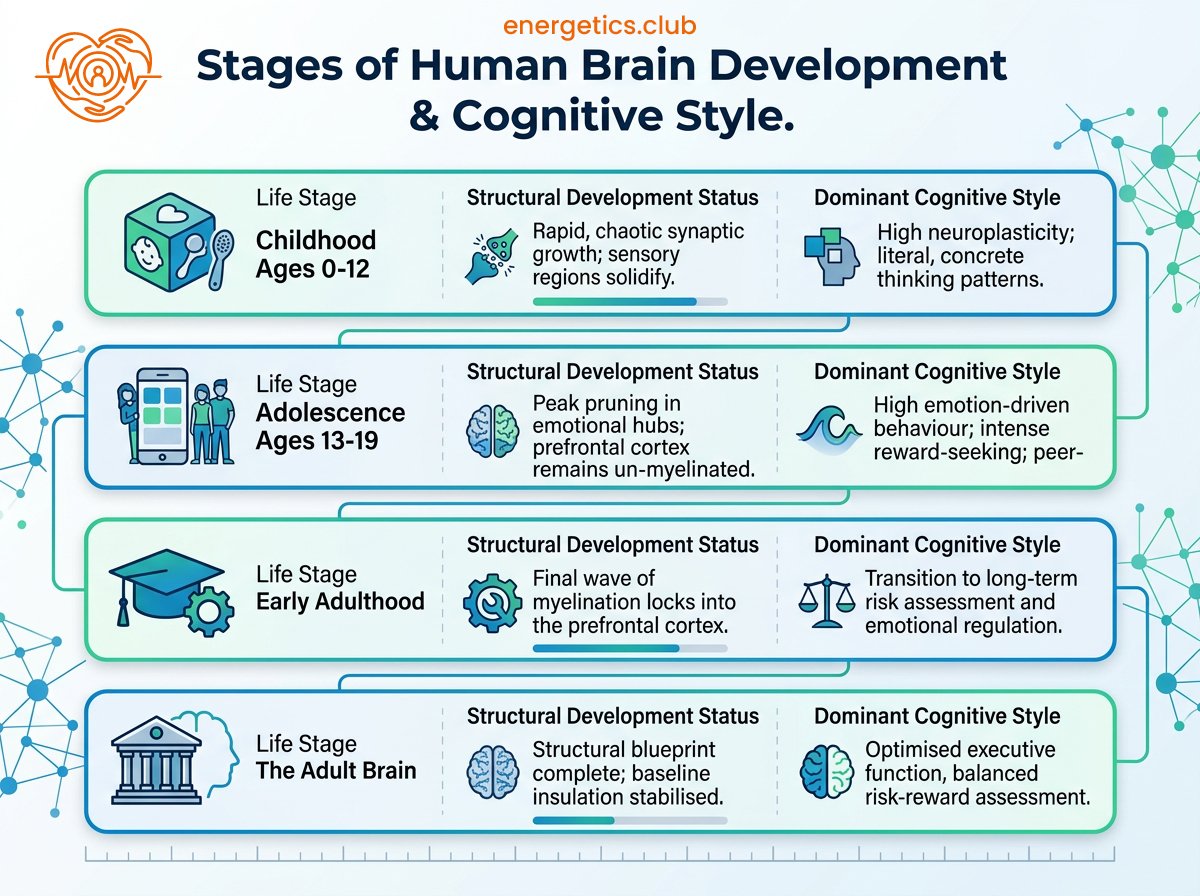
1. The Great Cellular Pruning (Grey Matter Loss)
During childhood, your brain behaves like an over-enthusiastic gardener, building billions of random, chaotic synaptic connections.
It builds far more than it could ever possibly use. As you enter adolescence, the brain initiates a cut-throat cleanup operation known as synaptic pruning.
Operating on a strict "use it or lose it" policy, the brain systematically decommissions and dismantles any pathways that are not being consistently stimulated by your environment, while reinforcing the ones that are.
Because of this, the total volume of grey matter (the processing cells) actually decreases as you age, thinning out to create a leaner, highly optimised, and incredibly efficient cognitive machine.
2. The White Matter Upgrade (Myelination)
While grey matter is being ruthlessly pruned away, white matter is experiencing a massive, high-speed upgrade. The long, wire-like axons that connect neurons are systematically wrapped in a thick, fatty sheath of myelin.
As we explored in previous articles, myelin acts exactly like the high-grade rubber insulation on an electrical cable. Unmyelinated teenage pathways transmit data at a relatively sluggish pace.
Once wrapped in lipid-dense myelin, electrical signals can jump down the axon up to a hundred times faster.
In early adulthood, this wave of insulation finally reaches the prefrontal cortex, locking in lightning-fast communication between your logical mind and your emotional core.
Conduction Speed Myelinated ≈ 100 × Conduction Speed Unmyelinated
The Evolutionary Genius of the Delayed Brain
It is easy to look at this delayed development as a bit of a design flaw.
Why would evolution leave us structurally incomplete and prone to terrible decision-making during the exact years we are meant to be entering the workforce and navigating the world?
The answer is a beautiful concept known as neuroplasticity.
By leaving the prefrontal cortex soft, malleable, and unmyelinated until age 25, evolution granted humans an extraordinary superpower: the ability to adapt to virtually any environment, culture, or social structure on Earth.
If our brains were completely locked in and rigid by age 12, we would only be capable of surviving in the exact circumstances we grew up in.
The prolonged development window means that your early twenties are a critical, high-stakes period of cultural and intellectual specialisation.
Your brain is literally sculpting its final form around the exact habits, skills, languages, and career demands you expose it to during these formative years.
The Dual-Edged Sword of Mental Health Vulnerability
I think it’s good to understand that because the brain is undergoing such radical, structural remodelling between the ages of 15 and 25, this decade represents the single most vulnerable window for mental health challenges in an individual's lifetime.
The deeper, primitive emotional centre of the brain—the limbic system—matures early, supercharged by the surge of pubertal hormones.
It’s not surprising to learn that this region craves novelty, dopamine, and peer approval.
When this hyperactive emotional engine is paired with a prefrontal cortex that is still missing its structural insulation, the brain can easily become unstable.
Psychological stress, toxic environments, social media addiction, or chronic substance misuse during this critical 10-year window can permanently disrupt the pruning and myelination process.
It’s interesting to learn that the vast majority of chronic mental health conditions—from severe anxiety and major depressive disorders to bipolar disorder and schizophrenia—typically manifest their very first clinical symptoms before an individual hits their 25th birthday.
Conclusion: Honouring the Work-In-Progress
If you are under 25, it is a gentle reminder to be kind to yourself. Your current emotional responses, habits, and coping mechanisms are not set in stone; you are still cooking. Your brain is receiving its final structural updates.
If you are well past 25, relax; you can look back on some of your dodgy and questionable life choices with a heady mixture of understanding, forgiveness… joy and horror!
Embrace the neural developmental timeline.
I like to think of it as your brain requires this time because it is building something meant to last a lifetime.
If you are interested in learning why the idea that we only use 10% of our brain is rubbish, read here!

Bibliography & Further Readings
Read This Next




Disclaimer: This article is for general informational purposes only and does not address individual circumstances, substitute for professional advice, or serve as a basis for decision-making. You should always seek the guidance of a physician or qualified healthcare provider regarding a medical condition, and never disregard or delay seeking professional medical advice due to this content. Any action taken based on this information is entirely at your own risk and responsibility; Energetics, its staff, and its medical advisors disclaim all liability for any inaccuracies, errors, or any personal or professional loss incurred as a direct or indirect consequence of using this content.