Reading Time 5 mins
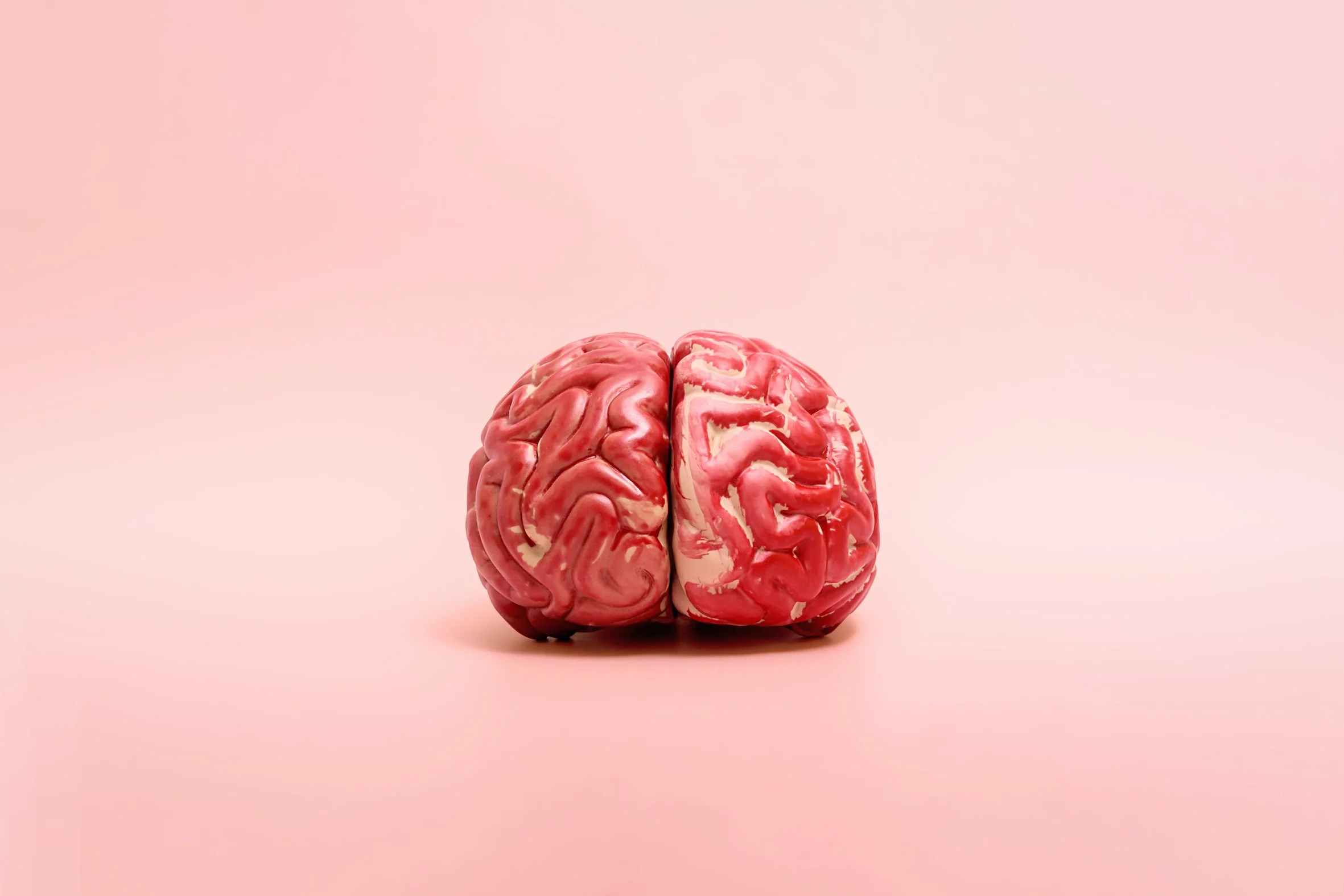
At the occasional dinner party, when the age-old question, 'If you had any superpower, what would it be?' got rolled out, I would always smugly reply with a well-rehearsed answer: 'I would like to be able to use 100% of my brain, unlike the normal 10% we all use.'
I thought this showed brilliant intellect because if I could turn my brain into a supercomputer, well, anything would be possible.
I would speak Mongolian by Tuesday, make a million on the stock exchange by Wednesday, and graduate as a brain surgeon by Friday. Easy.
So imagine my dismay when I did some research and realised that my smug answer reflected ignorance rather than intellect.
As far as I was aware, the 10% factoid was true- whilst the remaining 90% was a dark, dormant supercomputer waiting for a magic pill, a specific frequency of binaural beats, or a sudden, dramatic bonk on the head to unlock telekinesis, perfect photographic memory, and fluent Mandarin.
(If you are interested in the amazingness that is binaural beats) read this.
It is a beautiful, highly flattering concept.
It whispers that our current limitations aren't permanent, and that we are all secretly unawakened geniuses waiting for a software update.
There is only one slight snag: from a neurological, evolutionary, and metabolic standpoint, this claim is absolute rubbish.
In reality, apparently you use virtually every single part of your brain over the course of a normal day.
The 10% myth is the scientific equivalent of looking at a bustling city at night, seeing that only 10% of the streetlights are illuminated at any one precise millisecond, and concluding that the rest of the city is completely abandoned and lacks electricity.
It is time to turn the lights on and look at what is actually happening inside your skull.
The Origin Story of a Pseudo-Scientific Myth
How did we manage to insult our own anatomy so spectacularly?
This myth feels like a game of historical Chinese whispers, where genuine scientific caveats were systematically stripped of their nuance and replaced with marketing gold.
From what I can find, many cultural historians trace the rumour back to the late 19th and early 20th centuries, pointing fingers at the brilliant American psychologist William James.
In his 1907 text, The Energies of Men, James wrote that the average human lives "far within his limits" and utilises "only a small part of his possible mental and physical resources."
He was speaking abstractly about psychological resilience and untapped personal drive—not physical brain matter.
However, when the legendary self-help guru Dale Carnegie wrote the foreword to his 1936 mega-bestseller How to Win Friends and Influence People, he slapped a very specific number on that abstract thought, asserting that the average person "develops only 10% of his latent mental ability."
Early neuroscientists inadvertently fuelled the fire.
When pioneers like Wilder Penfield mapped the cerebral cortex in the 1930s using electrical probes, they discovered vast swathes of the brain that did not muscle-twitch or flash a sensory response when stimulated.
They labelled these regions the "silent cortex."
We now know these areas are the association cortices—the sophisticated processing hubs responsible for language, abstract thought, planning, and empathy.
But to early commentators, "silent" meant "empty," and the 10% myth was officially born, packaged, and distributed to a public hungry for self-improvement.
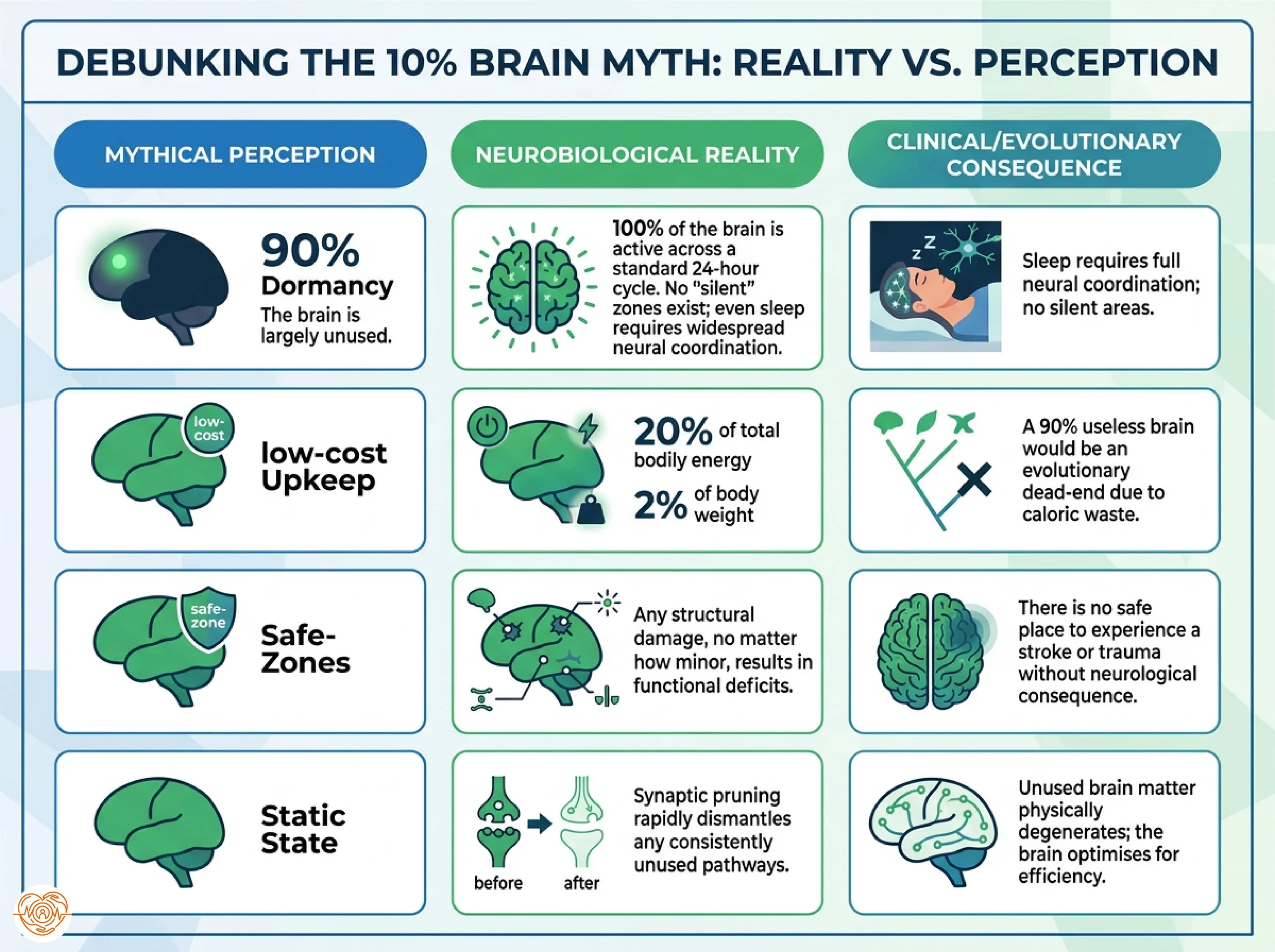
4 Scientific Pillars that Shatter the 10% Myth
If you ever find yourself next to someone at a dinner party who confidently claims that we use a tenth of our brainpower, you can gently dismantle their position with four incontrovertible pillars of modern neurobiology:
1. The Heavy Metabolic Tax of Neural Upkeep
The human brain is a greedy, gluttonous organ. Structurally, it accounts for a mere 2% of our total body weight, yet it aggressively consumes roughly 20% of our daily energy expenditure in glucose and oxygen.
Ebrain≈0.20×Etotal
From an evolutionary perspective, this is an astronomical expense.
Our ancestors frequently faced starvation; if 90% of our brain were truly useless baggage, natural selection would have ruthlessly shrivelled our skulls down to the size of a lemon to save calories.
A hominid carrying around a massive, resource-heavy organ that was 90% redundant would have been out-competed, outrun, and wiped out of the gene pool millions of years ago.
Evolution does not build or maintain expensive luxury apartments that sit empty for eternity.
2. The Unforgiving Reality of Clinical Neurology
If 90% of the brain were completely dormant, it would stand to reason that a person could suffer an injury or a stroke in those "unused" areas and walk away completely unscathed.
Ask any clinical neurologist or neurosurgeon, and they will tell you that no area of the brain can undergo damage without a corresponding, often devastating, loss of function.
Whether it is a minor blockage in the brainstem, a lesion in the parietal lobe, or trauma to the temporal regions, the consequences are immediate and visible—affecting everything from speech production and motor control to spatial awareness and emotional regulation.
Even minor damage to tiny, deep-brain structures like the substantia nigra can fundamentally disrupt a person's entire physical existence.
3. The Revelation of Functional Neuroimaging
The advent of functional Magnetic Resonance Imaging (fMRI) and Positron Emission Tomography (PET) scans effectively drove a silver stake through the heart of the 10% myth.
These technologies monitor blood flow and metabolic activity in real-time.
When you slide a human being into an fMRI scanner, the display lights up like a vibrant firework display.
Even when someone is lying completely still in a dark room, or fast asleep, their brain is humming with activity.
The default mode network (DMN)—a complex circuit of interconnected regions—is highly active during daydreaming, memory consolidation, and self-reflection.
True, you do not light up every single neuron simultaneously (which would trigger a massive epileptic seizure), over the course of a day, every square millimetre of your brain is actively engaged.
4. Neural Darwinism and the "Use It or Lose It" Law
The central nervous system operates on a strict, cut-throat policy known as synaptic pruning. Your brain is an incredibly plastic organ that constantly optimises its resources based on environmental demands.
If a group of neurons or a specific pathway is left unstimulated and unused, the brain does not let it sit there quietly collecting dust. It systematically decommissions the real estate.
Through a process of cellular house-cleaning, those idle synapses are dismantled, and the metabolic resources are redirected to parts of the brain that are actually working.
If you truly spent your life using only 10% of your brain, the remaining 90% would physically wither away and degenerate through pure, unadulterated muscle atrophy.
The Concept of Efficiency Over Volume
So, if we are using the entire brain, why does it sometimes feel like we are firing on a remarkably low percentage?
Why do we experience brain fog, memory lapses, or the distinct inability to remember where we left our car keys?
The answer lies in understanding that cognitive brilliance is not about volume; it is about efficiency and connectivity
When you are learning a brand-new skill—whether it is juggling, solving complex calculus, or driving a manual car—your brain has to work incredibly hard.
Vast networks light up as you consciously process every single micro-movement and piece of data.
It is highly inefficient and metabolically exhausting.
However, as you practise and achieve mastery, your brain undergoes structural changes.
It builds insulated, lightning-fast myelin pathways that allow the information to travel with minimal resistance.
An expert's brain actually shows less widespread activation than a novice's brain when performing the same task.
True intellectual growth and capability do not come from turning on "dormant" sections of the brain; they come from streamlining, synchronising, and refining the pathways you are already using every single day.
Conclusion: Reclaiming Your Full Potential
The 10% myth may be a comforting piece of fiction, but the biological reality is infinitely more inspiring.
The brain titan that is you is already wide awake and working every second of every day, tirelessly keeping you thinking, moving, breathing, feeling, and traversing this wildly multifaceted existence.
When you misplace your car keys, forget your first-born child's birthday, or badly miscalculate a restaurant tip, your brain is not letting you down. It is simply handling a colossal, multivariable logistical process behind the scenes.
Rather than wishing for an extra 90% of brain tissue to play with, focus on supporting the breathtakingly complex and brilliant instrument we already possess.
If we prioritise great sleep to clear metabolic waste, fuel ourselves with healthy food, and consistently challenge our minds with novel experiences, we provide our brain with the perfect environment to optimise its connections.
You are already using 100% of your neural architecture—and that is more than enough power to accomplish something truly extraordinary.
If you are interested in how to stop a fraying mind, read this next.

Scientific References & Bibliography
Boyd, R., 2008. Do people only use 10 percent of their brains? Scientific American
Read This Now



Disclaimer: This article is for general informational purposes only and does not address individual circumstances, substitute for professional advice, or serve as a basis for decision-making. You should always seek the guidance of a physician or qualified healthcare provider regarding a medical condition, and never disregard or delay seeking professional medical advice due to this content. Any action taken based on this information is entirely at your own risk and responsibility; Energetics, its staff, and its medical advisors disclaim all liability for any inaccuracies, errors, or any personal or professional loss incurred as a direct or indirect consequence of using this content.