Reading Time 5 mins

Often, after spending a gruelling few hours sitting at my desk, furiously hammering away at a financial spreadsheet or reading research papers, I end up feeling dog-tired.
I haven't lifted anything heavier than a biro, and my physical movement has been strictly limited to the occasional reach for a mug, but I still feel completely shattered.
My muscles ache, and my eyes are heavy.
My smartwatch activity tracker tells me that I’ve done diddly-squat over the past few hours, which is demoralising.
However, when this happens, I now remind myself that my smartwatch is merely measuring the mechanical energy spent moving my skeleton across the earth. Great work—but the watch is entirely blind to the ravenous, resource-hungry furnace running inside my skull: the brain.
The human brain is a gluttonous, high-maintenance biological diva.
It might sit quietly in a dark room, wrapped in a squishy cushion of fluid, but it is constantly running an astronomical metabolic tab.
When it comes to energy consumption, I recently learnt that your brain is the ultimate gas-guzzling sports car of the animal kingdom.
(To see how this fits into our complete guide to optimal brain, you can read our master directory.)
The Macroscopic Budget: The 2% Glutton
To truly appreciate the absurdity of your brain's energy consumption, we have to look at the sheer disproportion of its metabolic budget.
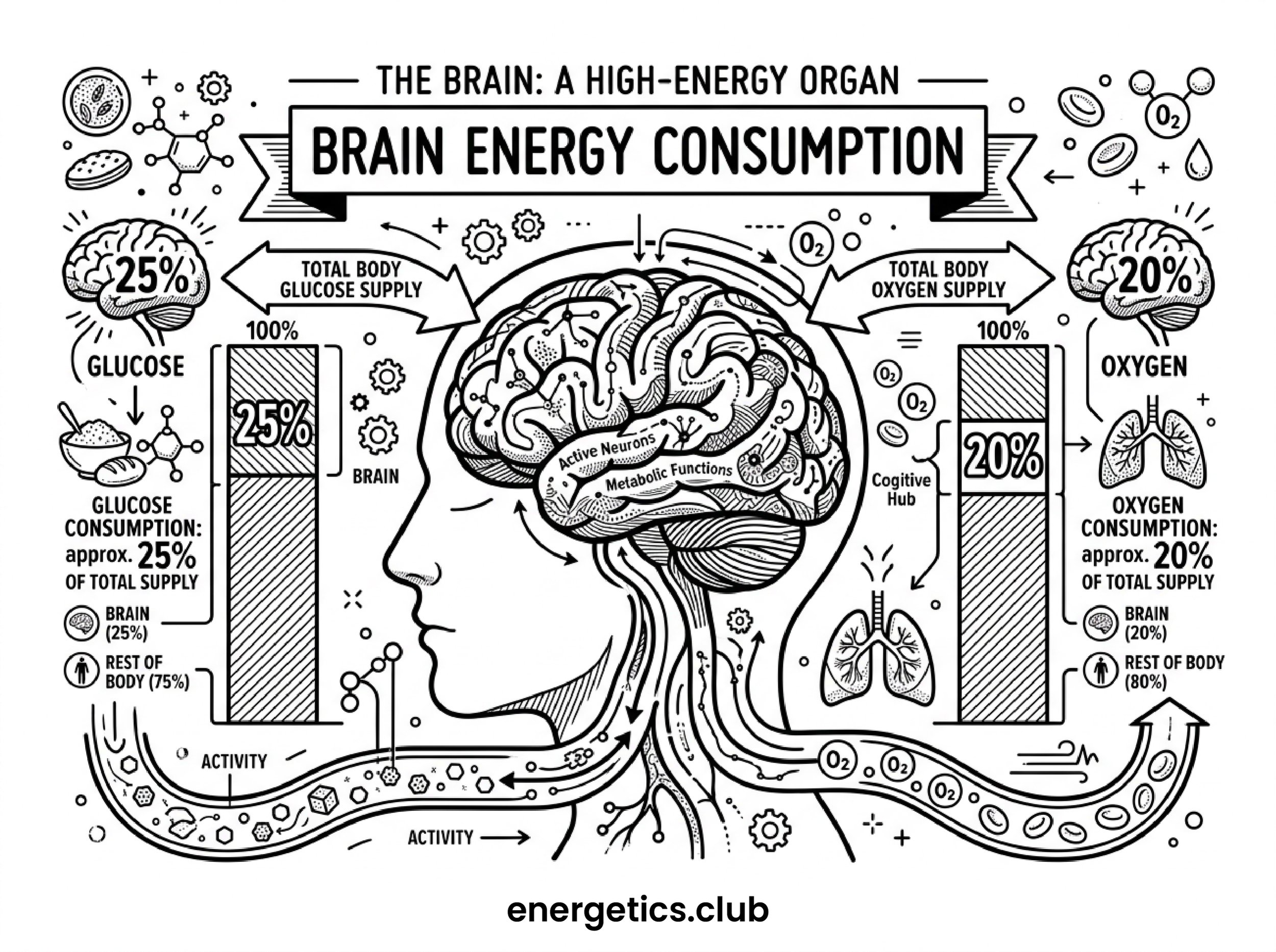
Structurally, the adult human brain is a relatively small organ. It weighs an average of about 1.4 kilograms, which accounts for a mere 2% of your total body weight.
Yet, in a state of complete rest, this quiet little lump of tissue aggressively commandeers roughly 20% of your body's entire daily energy expenditure.
Ebrain≈0.20×Etotal
Every single day, out of the roughly 2,000 calories you consume, about 400 calories are immediately diverted to the skull.
That is more energy than is consumed by your entire skeletal muscle system while at rest, despite your muscles outweighing your brain by a massive margin.
Because the brain is so metabolically greedy, it demands a constant, non-negotiable supply of resources.
It consumes about 25% of the body's total glucose supply and 20% of its oxygen.
If the blood supply to your legs is restricted for a few minutes, you get a bit of pins and needles.
If the oxygen supply to your brain is cut off for a mere six seconds, you instantly lose consciousness.
Your brain simply does not do "standby mode".
Where Is the Energy Actually Going?
What on earth is the brain doing with all those calories?
It isn't like it is physically moving things around or lifting weights.
If you were to peer inside a working neuron, you would see that the majority of this energy is spent running a microscopic, high-voltage electrical grid.
The brain's primary energy expense comes down to two major microscopic infrastructure projects:
1. Running the Sodium-Potassium Pumps (The 0.5V Grid)
As we discovered in previous articles, your brain is an electrochemical organ.
Every thought, memory, and perception is driven by electrical action potentials cascading down nerve pathways.
To be ready to fire at a millisecond's notice, every single one of your 86 billion neurons must maintain a permanent negative electrical charge across its cell membrane (roughly −70 mV).
To maintain this battery-like charge, neurons rely on millions of microscopic protein engines called sodium-potassium pumps.
These pumps work tirelessly around the clock, aggressively pushing sodium ions out of the cell while pulling potassium ions inside.
This single, mechanical housekeeping task consumes a staggering half of the brain's total energy budget. Your brain is essentially spending 10% of your entire body's daily calories just keeping its internal batteries charged and ready to go.
2. Synaptic Maintenance (The Post-Office Fee)
The remaining energy is spent at the synapses—the microscopic junctions where neurons talk to one another.
Manufacturing chemical neurotransmitters, packing them into microscopic vesicles, recycling them after they are fired, and maintaining the structural receptors on the receiving cells is an incredibly resource-intensive operation.
The Thinker’s Paradox: Does Hard Thinking Burn More Calories?
This brings me to one of the most famous debates in cognitive science: if the brain is so power-hungry, can you burn more calories simply by thinking harder?
Can you study your way into a smaller waistline?
The answer is a fascinating, slightly disappointing piece of biological nuance.
When you transition from daydreaming about your next holiday to solving a brutally difficult, high-stakes mathematical problem, the local metabolic activity in specific regions of your prefrontal cortex does spike.
Your brain selectively redirects blood flow, rushing extra glucose and oxygen to the areas working overtime.
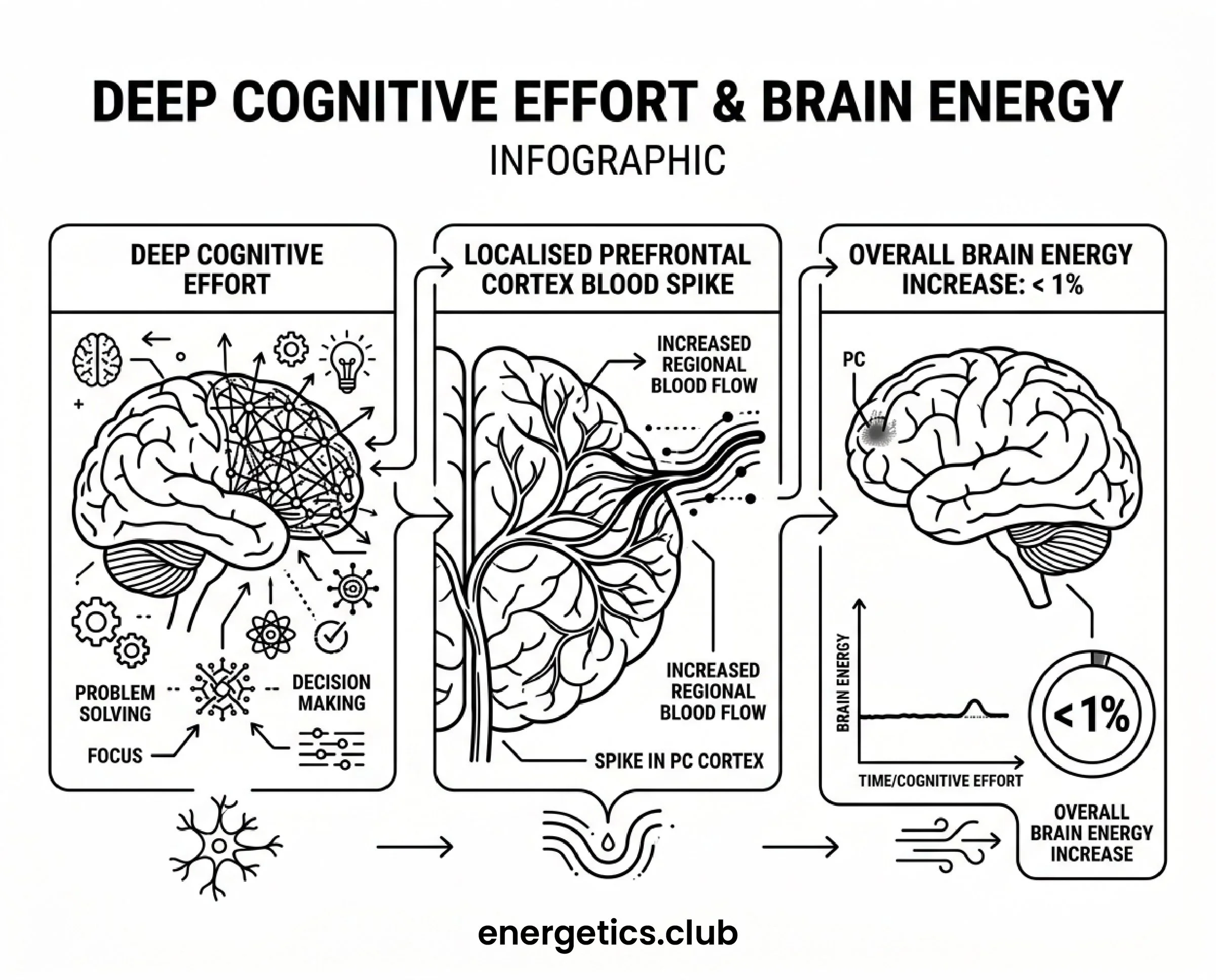
However, while the local increase in energy usage in that specific brain region can be significant, the overall increase in the brain's total energy consumption is practically negligible—usually less than 1%.
Why? Because your brain's baseline "idling" speed is already so incredibly high.
The energy required to keep the lights on, keep the cellular batteries charged, and maintain basic survival functions is so vast that the extra energy required for conscious abstract thought is just a drop in the ocean.
So, while that gruelling spreadsheet will absolutely drain your mental stamina and leave you feeling physically exhausted due to the accumulation of metabolic waste products like adenosine, it unfortunately won't burn off that mid-afternoon chocolate biscuit!
If you are interested in finding out how to turn on and optimise your genius brain frequencies, read this here.
Conclusion: Respecting the Engine
So now, whenever I finish a long day of deep, intellectual focus and find myself slumped on the sofa feeling completely ruined and wanting to stare at the TV in a vegetative state, I give myself a bit of grace.
I haven't been lazy; I have been running one of the most complex, high-performance electrochemical networks in the known universe.
What I’ve learnt is to prioritise high-quality sleep to flush out the metabolic debris left behind by the brain's high-energy operation. I make sure to stay hydrated, and I fuel myself with clean, stable nutrition (plus chocolate) to give my inner diva the exact resources it needs to keep the lights on.
Treat your extraordinary internal engine with the respect it deserves, and let it keep doing something truly remarkable behind the scenes tonight.
To learn about the age at which the brain finally finishes developing, read this brilliant article next.

Scientific References & Bibliography
Read This Now




Disclaimer: This article is for general informational purposes only and does not address individual circumstances, substitute for professional advice, or serve as a basis for decision-making. You should always seek the guidance of a physician or qualified healthcare provider regarding a medical condition, and never disregard or delay seeking professional medical advice due to this content. Any action taken based on this information is entirely at your own risk and responsibility; Energetics, its staff, and its medical advisors disclaim all liability for any inaccuracies, errors, or any personal or professional loss incurred as a direct or indirect consequence of using this content.