Reading Time 5 mins

My mother turned 72 years old recently. She has an IQ higher than Einstein's, is fit, sharp as a tack, and a picture of health.
That said, now and then you can see that she experiences a bit of a brain fart—she often calls the grandkids the dog's name and has no idea what she did last Tuesday.
When we tell her some vital information, you can see that it pours in one ear and out the other with remarkable speed. Remembered swiftly, then forgotten forever.
No, she is not senile. She is just like a lot of us: we have busy lives and full brains.
Whenever she realises that a brain fart has just occurred, she always says, "Well, it's not my fault. I'm 72—there is only so much storage in a brain; it's now probably at capacity, and often the wrong items are getting dumped and cleared to make space."
When she says this to me, I've always nodded sagely in agreement... that is, until now. After a little bit of research, it's actually amazing to learn the magnificent capacity of human memory storage.
(To see how this fits into our complete guide to optimal brain, you can read our master directory.)
The Digital Translation: From Synapses to Petabytes
For decades, scientists tried to calculate the brain's storage capacity using a very simple, slightly flawed mathematical model: one synapse equals one digital bit of data (a 0 or a 1).
Because the human brain contains roughly 100 trillion synapses, early estimates suggested our storage capacity was around a few hundred gigabytes.
If that were true, your brain would have run completely out of storage space somewhere around your sixteenth birthday.
Fortunately, recent breakthroughs in computational biophysics have revealed that our internal wiring is infinitely more sophisticated.
Neurons do not just switch "on" or "off" like a basic light switch. Instead, synapses can adjust their size and strength dynamically across a massive scale.
Researchers at the Salk Institute discovered that synapses can size themselves into at least 26 distinct categories. In digital terms, this means each single synapse can store roughly 4.7 bits of information.
Total Storage Estimate ≈ 100 Trillion Synapses × 4.7 Bits ≈ 2.5 Petabytes
When you do the macro-math across the entire brain, the estimated storage capacity rockets up to a staggering 2.5 petabytes.
To put 2.5 petabytes into perspective, that is 2,500 terabytes, or roughly 2,500,000 gigabytes.
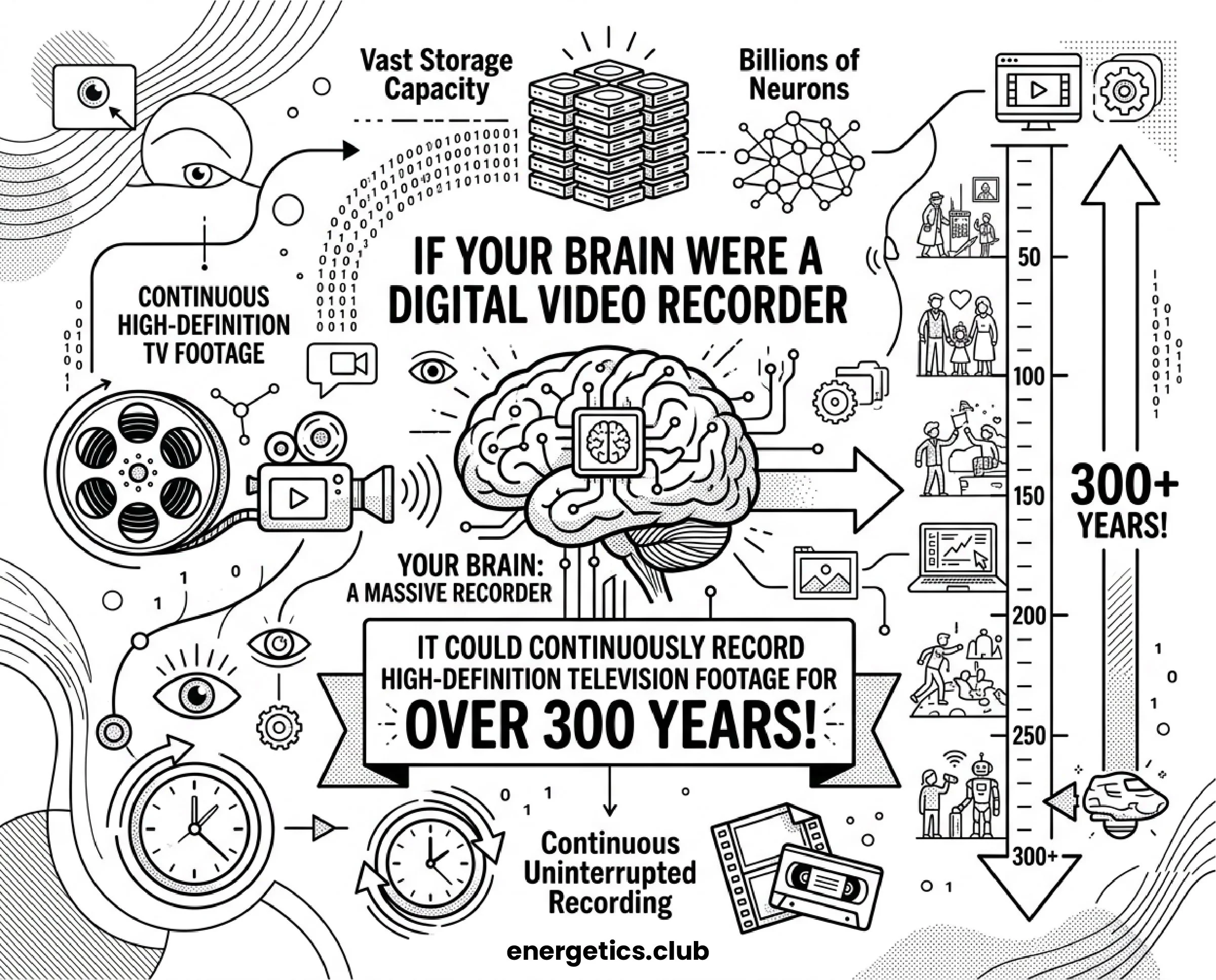
If your brain were a digital video recorder, it could continuously record high-definition television footage for over 300 years without stopping.
You could watch the entire catalogue of every streaming service on Earth back-to-back, and your brain would still have plenty of room left over to remember where you left your car keys this morning.
The Dynamic Hard Drive: Why We Don't Fill Up
If our storage space is so astronomically vast, why do we still walk into a room and completely forget why we went in there? Why does it feel like learning a new telephone number forces an old friend's birthday straight out of our ears?
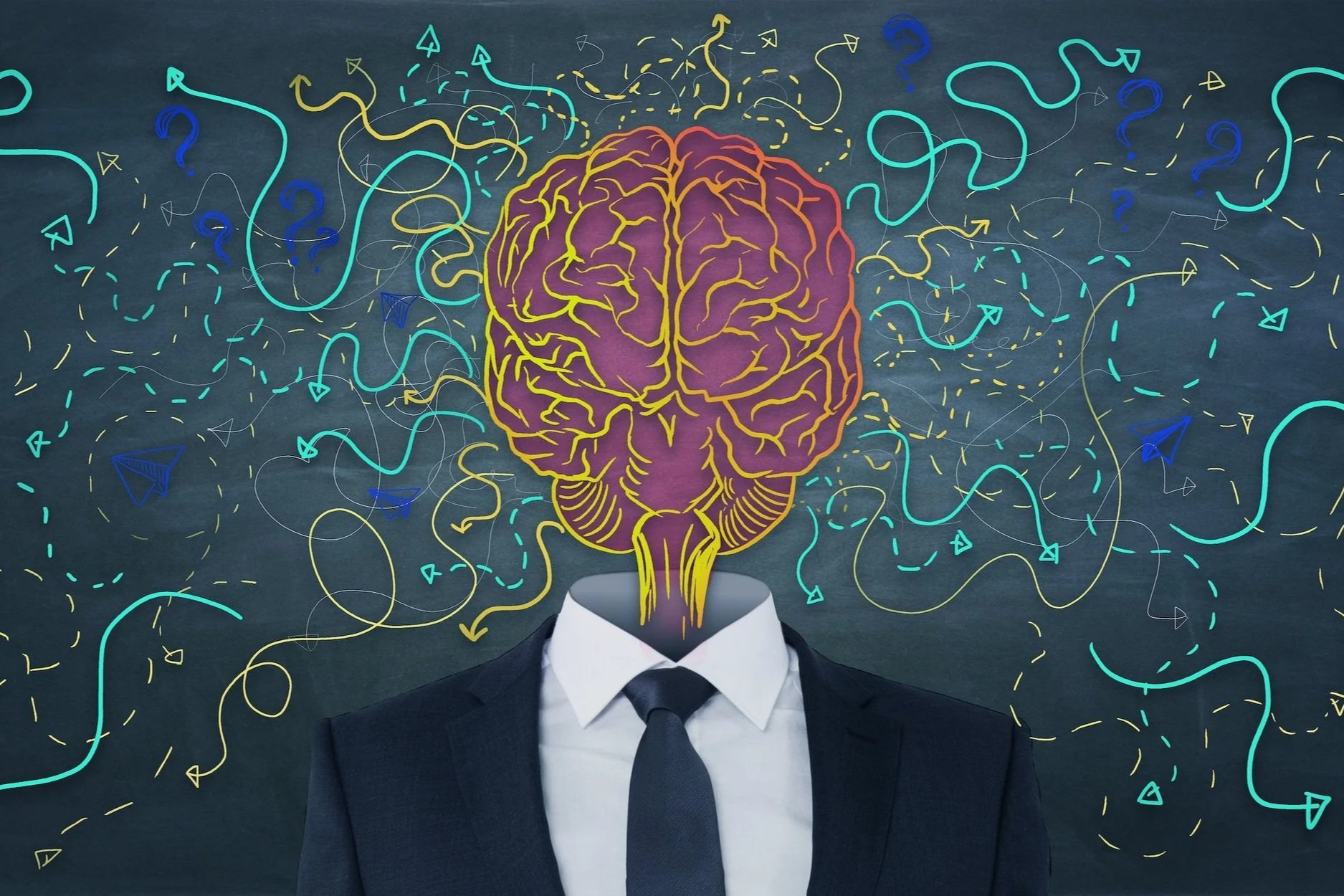
The secret lies in the fact that your brain is not a static, digital solid-state drive. It is a living, breathing, neuroplastic network.
When a digital computer saves a file, it writes data to a specific, permanent block on a disk. If the disk fills up, the computer stops.
Your brain, however, uses a brilliant evolutionary strategy called synaptic pruning and dynamic allocation. It doesn't store memories as isolated files; it stores them as interconnected patterns of pathways.
If you haven't thought about high school algebra for twenty years, the brain doesn't keep that data sitting around on a pristine shelf.
It systematically weakens those specific synaptic connections, effectively compressing the file or turning it into low-resolution background data.
It prioritises what is useful for your survival right now, letting the unused pathways fade away into the cognitive archives.
Your brain doesn't run out of space; it simply tidies up the attic so you don't trip over old junk.
The Chemistry of Upgrading Your Storage
What makes a memory stick around for a lifetime while another vanishes into the ether within five minutes?
It all comes down to how much structural physical change a thought can trigger at the synaptic level:
1. The Short-Term Scratchpad (RAM)
When you are trying to remember a verification code texted to your phone, your brain utilises Long-Term Potentiation (LTP) on a very temporary basis.
Electrical signals zip through a temporary circuit in your hippocampus, holding the data like a computer's short-term RAM.
If you get distracted by a loud noise, that temporary electrical current disrupts, and the code vanishes forever.
2. The Long-Term Archive (The Hard Drive)
To move that data into your permanent 2.5-petabyte vault, the brain must physically manufacture new proteins and structurally reshape the synapses—a process called synaptic consolidation.
This requires emotional relevance, repetition, or focused attention.
When these factors align, the hippocampus slowly transfers the pattern up to the cerebral cortex during deep sleep, etching it permanently into your biological hardware.
If you are interested in what your brain is actually made of, read this.
Conclusion: Tapping Into the Vault
The brain is hungry for more and thrives on complexity. With a digital computer, the more data you add, the slower it runs. With the human brain, the exact opposite is true.
Isn’t that amazing?
Because memories are built on associations, the more you learn, the more hooks you create for new information to latch onto. Learning a second language actually makes it easier to learn a third; studying a new subject makes your entire neural network more adaptable.
So, if you ever find yourself worrying that your mind is getting a bit too full of life's daily chaos, give your brain some credit. Get a good night's sleep. Drink lots of water. And then get out there and maybe learn or experience something new.
We possess the most sophisticated, self-expanding data vault in the known universe—so don't be afraid to keep downloading new adventures, exploring new concepts, and filling your brilliant brain with the things that truly matter.
To learn about how to stop your brains memory from fraying, read this next.
Bibliography & Further Readings
Read This Next

Disclaimer: This article is for general informational purposes only and does not address individual circumstances, substitute for professional advice, or serve as a basis for decision-making. You should always seek the guidance of a physician or qualified healthcare provider regarding a medical condition, and never disregard or delay seeking professional medical advice due to this content. Any action taken based on this information is entirely at your own risk and responsibility; Energetics, its staff, and its medical advisors disclaim all liability for any inaccuracies, errors, or any personal or professional loss incurred as a direct or indirect consequence of using this content.