Reading Time 5 mins

This is a slightly weird little story to divulge, but bear with me—it’s relevant.
We all know that if you put your hand near a flame or a hot ring, you immediately jerk your fingers back. It’s pure instinct.
However, when I was in my late teens, I was out at a nightclub and got stabbed in the left cheek of my bum with a penknife. It was an unprovoked attack by a stranger. I was wearing a maxi dress at the time. He simply walked over with his friend, stabbed me, then walked off.
When it happened, it just felt like a hard punch—nothing overly painful at first. Initially, I was more concerned with the new hole in my lovely dress and the shock of someone whacking me so hard. It was only when the blood started to pour out that I realised I had actually been stabbed. And then it really started to hurt. Literally bloody painful.
I don’t know what ever happened to the guy, and my bum healed quickly enough... but the point of the story is the delay. The brain’s lag in acknowledging deep tissue pain is a clear demonstration of how different nerve fibres send signals at vastly different speeds.
I like to think of our minds as sleek, futuristic quantum supercomputers humming away in perfect harmony.
But the reality is far more humbling.
Nerves are not pristine copper fibre-optic cables; they are a messy, brilliant, sticky combination of organic biology, salty water, and squishy chemistry.
Neurological data has some very strict, highly surprising speed limits—and a few built-in evolutionary toll booths that explain why it may take a swift minute to realise your bum cheek has just been stabbed.
The Neurobiological Grid: Speed Ranges
Ask a neuroanatomist to give a single, definitive speed limit for a brain signal -they would chuckle and walk away.
That is because your nervous system doesn't operate a single unified highway; it runs a tiered network that ranges from an absolute rocket ship to a total Sunday driver.
In the human body, neural conduction velocities range anywhere from a sluggish 0.5 metres per second (a casual 1 mile per hour) to an astonishing 120 metres per second (a blistering 270 miles per hour).
Velocity Range=0.5 m/s to 120 m/s
To put that top speed into perspective: a signal tearing down your motor nerves at 270 mph travels faster than a Formula 1 car on a straightaway, easily clearing the length of a football pitch in less than a single second.
This massive variation in speed is an absolute evolutionary masterpiece of budget management.
Building high-speed neural pathways is incredibly expensive from a metabolic standpoint, so your brain reserves its premium, top-tier speeds only for data that keeps you from dying.
The Two Co-Founders of Neural Speed
What makes one brain signal travel like a bullet while another plods along like it's stuck in bank holiday traffic? It comes down to two major structural variables:
1. The Myelin Turbocharger (The Insulation Factor)
The absolute king of neural speed is myelin—the glistening, lipid-dense protective sheath wrapped around nerve fibres (axons).
If an axon is unmyelinated, the electrical signal has to crawl continuously down the entire length of the cellular membrane, like a slow-burning fuse on a cartoon stick of dynamite.
But when an axon is heavily myelinated, the insulation is interrupted every millimetre or so by tiny, microscopic gaps called the Nodes of Ranvier.
Instead of crawling, the electrical charge literally teleports, jumping boundingly from one open node to the next in a high-speed process called saltatory conduction (from the Latin saltare, meaning "to leap").
This simple upgrade accelerates the signal's velocity by up to a hundredfold.
2. Axon Diameter (The Highway Width)
The second variable is pure physics: the physical thickness of the nerve fibre itself.
Just as a wide, four-lane motorway allows traffic to flow much faster than a narrow, winding country lane in Devon, a thicker axon offers far less internal electrical resistance.
The wider the axon diameter, the faster the electrical wave can cascade down the line.
To learn more about what your brain is actually made of, read this.
The Tiered Highway System: Who Gets Top Priority?
To see this biological design in action, let's look at how your brain prioritises different types of incoming and outgoing data across its networks:
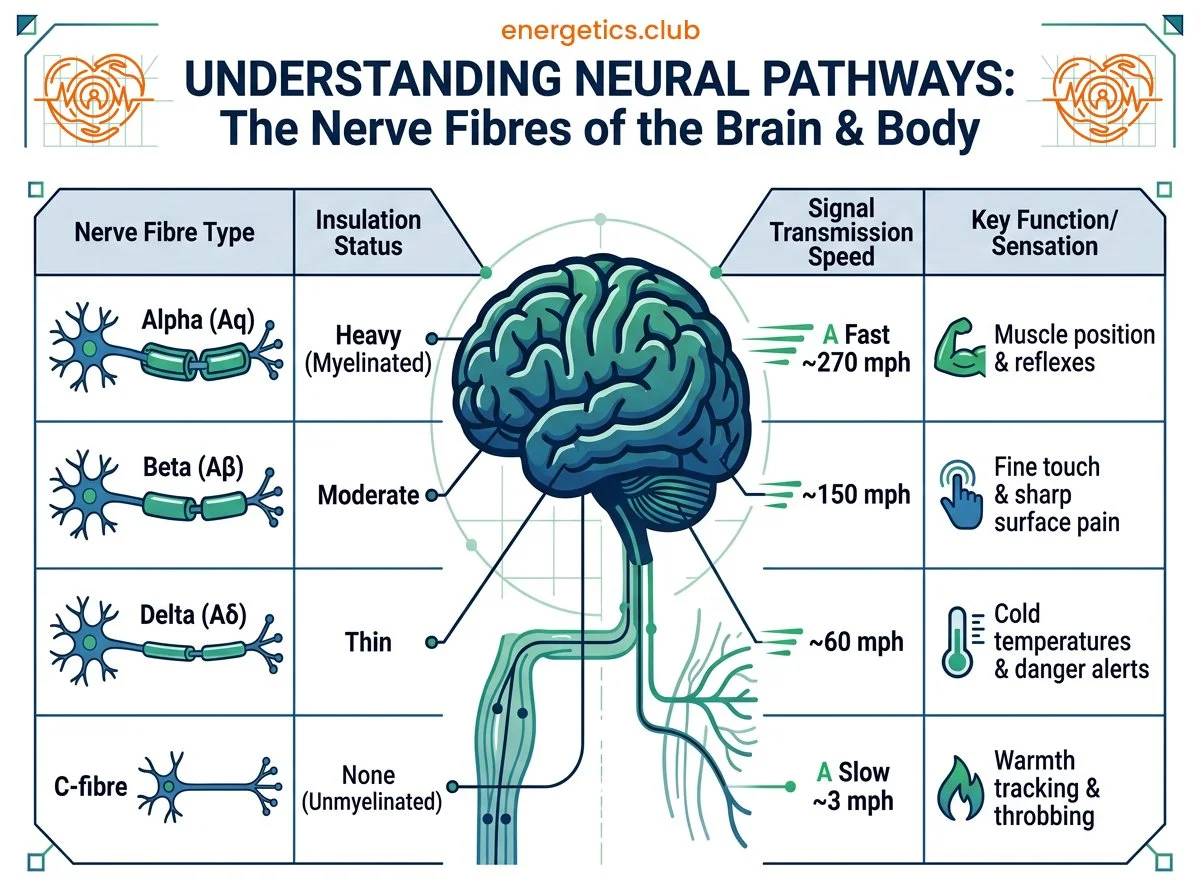
Tier 1: Proprioception and Motor Control (200–270 mph): Driven by thick, heavily myelinated fibres.
Your brain must know exactly where your limbs are in three-dimensional space at any given millisecond to prevent you from face-planting into the pavement.
If these signals were slow, you wouldn't even be able to walk up a flight of stairs without tripping over your own feet like a newborn giraffe.
Tier 2: Sharp Touch and Pressure (70–150 mph): Handled by medium-thickness, moderately insulated fibres.
This handles the immediate sensation of texture, firm pressure, and sharp, localised pain (like the initial impact of hitting your thumb with a hammer).
It lets you know instantly that a physical boundary has been breached.
Tier 3: Temperature and Chronic Pain (1–4 mph): Relies upon thin, completely uninsulated fibres.
This handles deep, throbbing aches, burning sensations, and gradual temperature shifts.
Because a dull ache in your lower back doesn't require a split-second martial arts reflex to survive, evolution saves its energy, letting these signals amble along at a literal walking pace.
This is exactly why you feel the hard thud of a stubbed toe instantly, but the sickening, throbbing ache takes a few agonising seconds to catch up… Or in my case, a stabbed bum cheek!
The Chemical Speed Bump: The Synaptic Delay
If our electrical signals can travel at a blistering 270 mph down a nerve corridor, why does it still take us a fraction of a second to slam on the brakes when a rogue delivery driver cuts us off?
The bottleneck isn't the length of the highway; it is the toll booths along the way. Your nervous system is not a single, continuous copper wire. It is broken up into billions of individual cells separated by microscopic gaps called synapses.
When an electrical signal reaches the end of a neuron, it hits a literal dead end.
It cannot jump the gap electrically.
It must pause, pull over, and convert its electrical energy into chemical energy, triggering the release of neurotransmitters that float lazily across the fluid-filled chasm to dock with receptors on the next cell.
This chemical transition takes roughly 0.5 to 2 milliseconds per synapse. If a thought pathway requires crossing dozens of consecutive synapses, these tiny chemical speed bumps add up, creating the baseline processing lag that defines human reaction times.
Conclusion: Reclaiming the Power of Your Network
So, there you have it: we have different speeds for different needs. My delayed bum ache makes total sense to me now.
Once again, the sheer brilliance of the human body is on full display. Our nervous system doesn't send every signal at top speed because it would waste metabolic energy. Fast, myelinated fibres handle immediate threats—like pulling your hand off a hot hob—while slower, unmyelinated fibres process long-term repair and deep tissue aching once the immediate danger has passed.
Understanding that your neural pathways require physical infrastructure—myelin insulation, healthy axon pathways, and balanced neurotransmitters—makes me celebrate the human body even more.
We are amazing. You are amazing. My bum is amazing... and also, as it turns out, perfectly wired for a fashionably late response to pain.
To learn about how to optimise your brain using binaural beats, read this next.

Scientific References & Bibliography
Read This Now





Disclaimer: This article is for general informational purposes only and does not address individual circumstances, substitute for professional advice, or serve as a basis for decision-making. You should always seek the guidance of a physician or qualified healthcare provider regarding a medical condition, and never disregard or delay seeking professional medical advice due to this content. Any action taken based on this information is entirely at your own risk and responsibility; Energetics, its staff, and its medical advisors disclaim all liability for any inaccuracies, errors, or any personal or professional loss incurred as a direct or indirect consequence of using this content.