Why am I not happy even when everything is going well?
Reading Time 4 mins

Let’s be entirely honest: there is a specific brand of quiet panic that sets in when your life looks absolutely immaculate on paper, yet you feel completely flat inside.
You look around and see a checklist flawlessly executed—the career is stable, the relationship is supportive, your bank balance isn't screaming, and you have finally acquired that lovely, grown-up sofa you spent years wishing for.
By all accounts, you should be floating on a cloud of permanent, sparkling gratitude.
Instead, you are sitting on your premium sofa, staring at the wall, and feeling about as emotionally vibrant as a damp piece of celery.
Cue the immediate, heavy wave of psychological guilt: “What on earth is wrong with me? I have absolutely no right to feel like this.”
You feel like an ungrateful fraud who has won the cosmic lottery but forgotten how to smile.
This internal disconnect is one of the most common paradoxes in modern psychology.
We are culturally conditioned to believe that happiness is a simple math equation: Right Circumstances = Right Mood.
When that equation fails, we assume our internal mechanics are fundamentally broken.
However, behavioural science and neurobiology reveal a very different truth.
Feeling numb when life is going well isn’t a sign of a defective brain; it is often the natural byproduct of how the human nervous system is wired to process achievement, safety, and purpose.
It may also be a sign of quiet burnout. To read more about this, click here.
1. The Arrival Fallacy and the Horizon Line
Coined by positive psychologist Dr Tal Ben-Shahar, the Arrival Fallacy is the cognitive illusion that once we attain a specific destination or goal, we will reach a permanent plateau of peace and happiness.
   THE ARRIVAL PARADOX

   [ The Climb ] ────────► [ The Summit ] ────────► [ The Reality ]
   Fueled by purpose                          "I have arrived!"                              The baseline resets.
   & high dopamine.                          Brief emotional spike.                             "Now what?"
During the years you spent striving—building a career, saving for a home, or stabilising your life—your brain was anchored by a clear, unifying sense of purpose.
This "climb" kept your dopaminergic pathways highly engaged; you were in active pursuit.
The moment you reach the summit and look around, the brain's orientation changes.
The anticipation ends, the dopamine stabilises, and the mind is suddenly forced to confront a quiet, static reality.
The Arrival Fallacy trips us up because we mistake the end of a struggle for the presence of joy.
2. Hedonic Adaptation: The Universal Emotional Thermostat
Why doesn't the joy of a good life last indefinitely?
The blame lies with a powerful biological survival mechanism known as Hedonic Adaptation (or the hedonic treadmill).
Human beings possess an incredibly stable emotional baseline.
Whether we experience a massive positive event (like buying a dream car) or a negative setback, our psychological thermostat eventually pulls us back to our default settings.
From an evolutionary standpoint, contentment is a dangerous design flaw.
An early human who felt permanently satisfied after finding a single patch of fruit would sit down, stop foraging, and eventually starve.
We evolved to adapt to comfort rapidly so that we would remain hungry, alert, and driven to survive.
When everything in your life is going well, your brain quickly treats that safety as the new "zero," leaving you feeling neutral rather than ecstatic.
3. The Shift from Survival to Significance
When you are actively navigating a crisis—struggling with finances, managing a chaotic relationship, or working gruelling hours to establish yourself—your nervous system is operating in a functional survival mode.
You do not have the cognitive luxury to ask deep existential questions because you are too busy putting out daily fires.
Paradoxically, it is only when life calms down and things begin to go well that the deeper layers of the psyche find the safety to speak up.
The Safety Paradox: Emotional safety does not automatically generate euphoria; it generates a vacuum.
With survival needs met, the mind naturally shifts its focus to deeper questions of meaning, authenticity, and alignment.
If your "immaculate" life was built around societal expectations rather than your authentic values, the arrival of safety is precisely when that misalignment will make itself felt.
Quick Reference: The Happiness Paradox Matrix
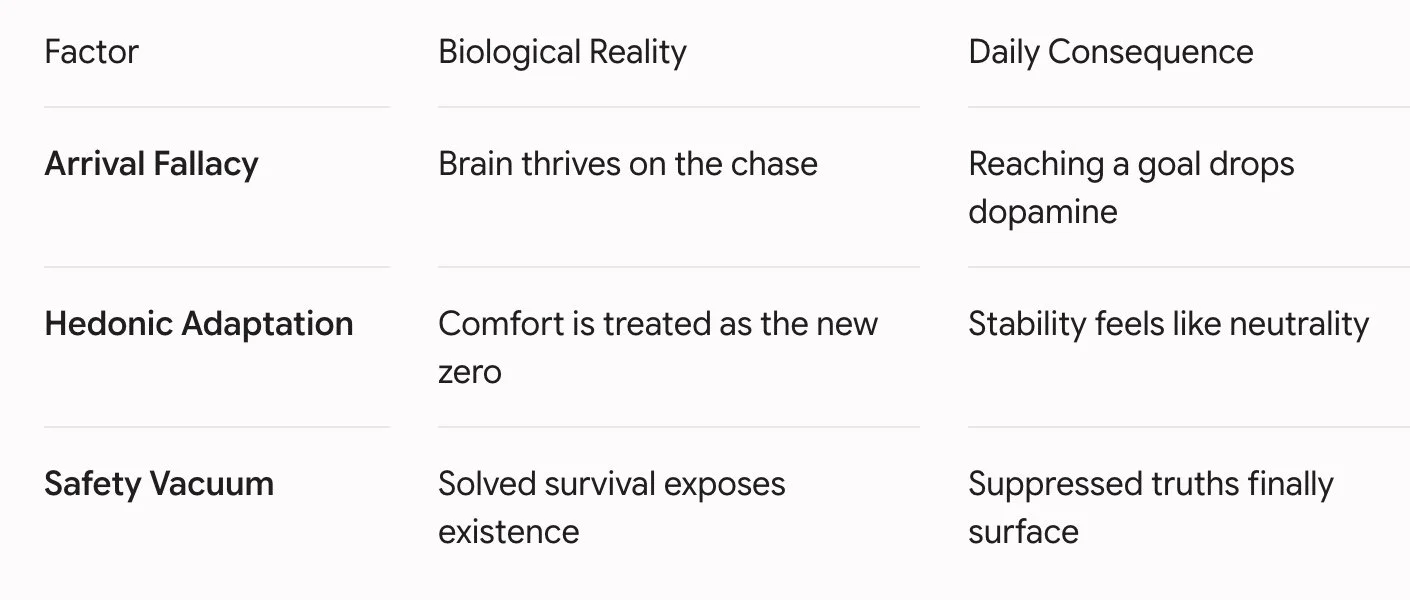
Moving Beyond the Checklist
If you find yourself caught in this paradox, the path forward requires changing how you view your emotional landscape.
You cannot cure hedonic numbness by adding more tokens to the material checklist, nor can you shame yourself into genuine gratitude.
Instead, behavioural health suggests two foundational shifts:
Pivot from Striving to Presence: When the dopamine of the chase fades, we have to learn to cultivate serotonin and oxytocin—the chemicals of arrival and connection.
This means trading the pursuit of more for the deep, sensory appreciation of what is (micro-dosing attention on the small, daily rhythms of life).
Audit for Authenticity: Ask yourself honestly: Whose life did I build?
If you built a life designed to look excellent to external observers, the underlying numbness might be a healthy compass signalling that it is time to inject genuine creative autonomy, play, or raw vulnerability back into your routine.
Conclusion: Giving Your Sofa (and Yourself) a Break
So, the next time you find yourself slumped on that beautiful new sofa, feeling utterly uninspired by your textbook-perfect existence, do not panic and do not start drafting a guilt-tripping lecture to yourself.
You haven't failed at being happy; you have just successfully managed to survive long enough for your brain to stop frantically running away from imaginary sabre-toothed tigers.
Stability isn't a magical, sparkling destination where the credits roll and everyone lives happily ever after; it's simply a remarkably safe, solid launching pad.
Your inner diva is just looking around, realising the basic survival bills are paid, and asking for a bit more genuine flavour, play, and authentic meaning.
Give yourself a massive dose of psychological grace, put down the societal checklist, and allow yourself to be a wonderfully complex, beautifully adaptive human being.
Pop the kettle on, accept the comfort for what it is—a lovely, secure harbour—and gently decide which little piece of mischief, creativity, or true connection you want to explore next.
Which neatly leads to another very good question: do more choices make us happier? Read this.
Read This Next





Disclaimer: This article is for general informational purposes only and does not address individual circumstances, substitute for professional advice, or serve as a basis for decision-making. You should always seek the guidance of a physician or qualified healthcare provider regarding a medical condition, and never disregard or delay seeking professional medical advice due to this content. Any action taken based on this information is entirely at your own risk and responsibility; Energetics, its staff, and its medical advisors disclaim all liability for any inaccuracies, errors, or any personal or professional loss incurred as a direct or indirect consequence of using this content.