Does money buy happiness?
Reading Time 4 mins

Picture the scene: you wake up tomorrow morning, stretch your arms, and casually check your phone, only to discover that an anonymous billionaire has accidentally transferred £50 million into your current account.
After checking that it isn't an elaborate phishing scam or a cruel banking error, a glorious wave of pure, unadulterated euphoria washes over you.
You instantly start drawing up a shopping list: a sleek luxury electric vehicle, a sprawling estate in the Cotswolds, a solid-gold toaster, and an immediate, incredibly satisfying resignation letter to your boss.
For the first few weeks, you are living in a state of absolute bliss.
But let’s fast-forward six months.
You are sitting in your Cotswolds mansion, looking at your solid-gold toaster, and you suddenly realise something deeply unsettling: you are bored.
The premium leather seats in your supercar have just become "the seats"; the sprawling garden feels like a logistical headache to maintain; and you are currently having a minor existential crisis because the local artisanal bakery has run out of your favourite sourdough.
This is the great financial paradox that has kept psychologists, economists, and philosophers up at night for centuries.
We are conditioned by modern society to believe that cash is the ultimate shortcut to joy.
Yet, history is littered with miserable lottery winners, stressed-out tech moguls, and wealthy heirs who seem entirely immune to the joys of their bank balances.
So, if we strip away the marketing fluff and look at the hard data, what is the actual biological and psychological exchange rate between pounds and peace of mind?
The Logarithmic Reality: The Salk and Princeton Collapsed Ceiling
For over a decade, popular psychology comforted us with a very specific magic number.
In 2010, a famous study by Nobel laureates Daniel Kahneman and Angus Deaton suggested that emotional well-being plateaus completely at an annual income of roughly $75,000 (around £60,000 in UK terms).
Anything earned above this threshold, they argued, bought zero additional daily happiness.
It was a lovely, comforting thought for the rest of us: the wealthy were no happier than a comfortable middle-class manager.
However, in 2023, a high-stakes "adversarial collaboration" between Kahneman and fellow researcher Matthew Killingsworth updated this narrative with far more precise data.
They discovered that for the vast majority of people, happiness actually continues to rise with income, extending well into the hundreds of thousands of pounds.
But there is a major catch.
The relationship between money and happiness is not linear; it is logarithmic.
Happiness ∝ log (Income)
This simple formula means that as your income increases, you require progressively larger financial leaps to experience the same psychological boost.
If you earn £20,000 a year, a £10,000 pay rise is life-altering; it eliminates food insecurity, pays off toxic debt, and completely transforms your daily stress levels.
But if you already earn £200,000 a year, that same £10,000 bonus is practically unnoticeable.
To get the same emotional high that the lower earner got, you would need your income to double or triple.
Money keeps buying happiness, but the return on investment becomes drastically worse the richer you get.
The Unhappy 20% and the Hedonic Treadmill
The 2023 data revealed an even more fascinating nuance: there is a specific group of people for whom money is completely useless at buying joy.
The researchers called them the "unhappy minority"—roughly 20% of the population.
For these individuals, if they are suffering from clinical depression, deep-seated trauma, heartbreak, or a profound lack of purpose, increasing their wealth does absolutely nothing to improve their mood.
If you are deeply miserable and your income rises from £30,000 to £100,000, your suffering simply becomes modernised.
You are no longer miserable in a cramped flat; you are now miserable in a beautiful penthouse suite with underfloor heating.
Money can alleviate financial suffering, but it cannot cure psychological pain.
This inability to stay happy is driven by a powerful biological mechanism known as hedonic adaptation (or the hedonic treadmill).
Your brain is an absolute master at establishing a new normal.
When you get a financial upgrade, your dopamine receptors fire wildly at first.
But within a matter of months, your baseline expectations shift.
That luxury holiday or expensive restaurant meal stops being a rare, thrilling treat and simply becomes your new minimum standard.
You have to run faster and spend more just to maintain the same level of satisfaction.
The Two Currencies: Day-to-Day Mood vs Life Evaluation
To truly understand how money interacts with your mind, behavioural scientists split happiness into two distinct categories:
1. Experienced Well-Being (The Daily Weather)
This is your actual, moment-to-moment emotional state. How often do you laugh, feel stressed, experience joy, or feel anxious on an average Tuesday?
Money influences this primarily by acting as a buffer against misery.
Cash allows you to outsource things you hate (like cleaning or sitting in traffic), lets you buy high-quality nutrition, and ensures you aren't panicking when the boiler breaks down.
It doesn't fill your day with constant ecstasy, but it systematically removes the friction points that cause daily anger and anxiety.
2. Evaluative Well-Being (The Life Audit)
This is how you feel when you sit back, reflect, and evaluate your life as a whole.
It is your sense of status, achievement, and security.
Interestingly, evaluative well-being is incredibly sensitive to income.
Because human beings are intensely tribal, we use our income as a metric for where we stand in the social hierarchy.
A higher income makes you feel like you are winning the game of life, even if your day-to-day mood remains relatively ordinary.
To learn about which chemicals in your brain make you feel happy, read this.
Quick Reference: The Financial Well-Being Matrix
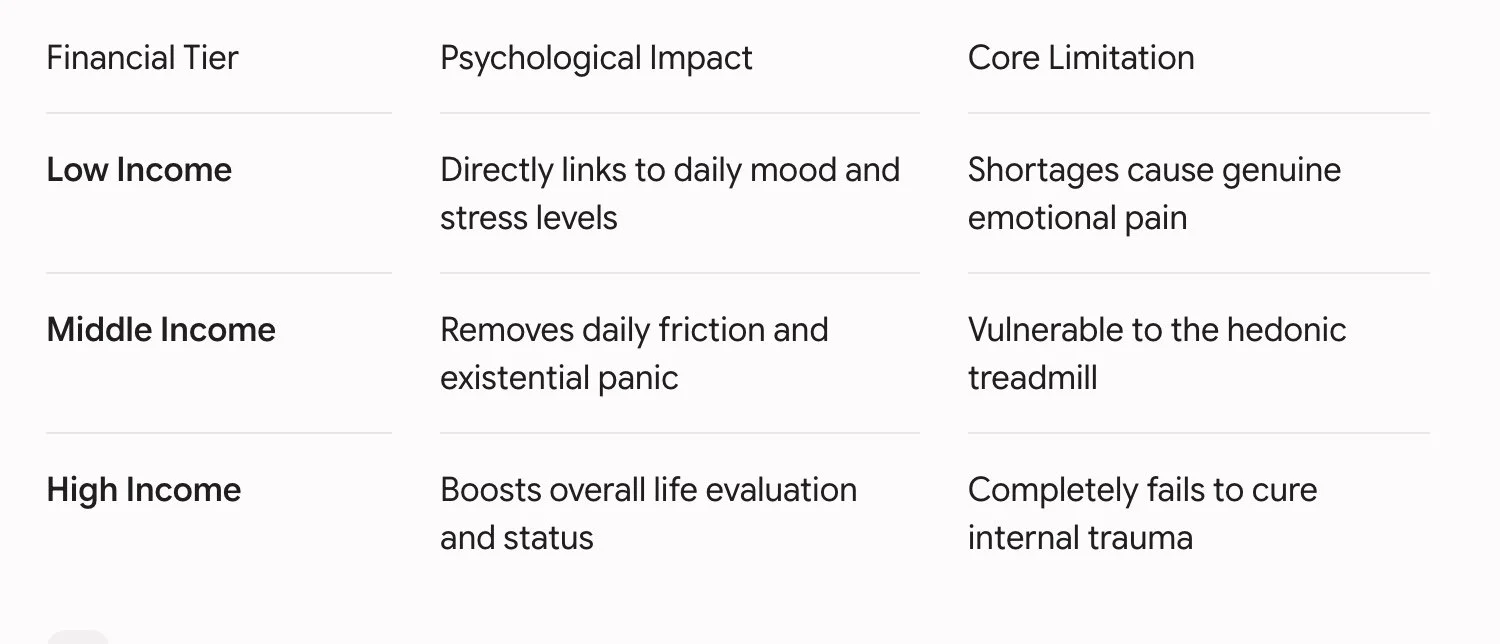
Conclusion: Spending for True Return on Investment
Ultimately, the science shows that money does buy happiness—but only if you know exactly how to convert currency into genuine human value.
If you spend your money chasing material possessions to impress neighbours you don't even like, you are trapping yourself on an endless, unfulfilling treadmill.
If you want to maximise the psychological return on your cash, the data suggests prioritising three specific avenues:
Buying Time (Autonomy): Using your money to buy back your hours.
Choosing a shorter commute, working fewer hours, or paying for housekeeping frees up your cognitive energy for relationships, creative pursuits, and rest.
Investing in Experiences: Spending money on travel, learning a new skill, or sharing a beautiful meal with friends.
Unlike material goods, experiences don't lose their lustre; they convert into long-term mental assets that populate your 2.5-petabyte memory vault for decades.
Prosocial Spending: Giving money away.
Neurological scans show that spending money on others triggers a massive spike in the brain's reward centres—an evolutionary mechanism that rewards us for supporting our community.
Money is an extraordinary tool, but it is a terrible master.
By recognising that its true value lies in securing your autonomy, protecting your health, and deepening your connection to others, you can stop chasing a hollow number on a screen.
Fuel your life, secure your safety, and use your resources to build a reality that feels genuinely wealthy from the inside out.
To learn about whether you can choose to be happy, read this next.
Bibliography
D. Kahneman, & A. Deaton, High income improves evaluation of life but not emotional well-being, Proc. Natl. Acad. Sci. U.S.A. 107 (38) 16489-16493, https://doi.org/10.1073/pnas.1011492107 (2010).
M.A. Killingsworth, D. Kahneman, & B. Mellers, Income and emotional well-being: A conflict resolved, Proc. Natl. Acad. Sci. U.S.A. 120 (10) e2208661120, https://doi.org/10.1073/pnas.2208661120 (2023).
Dunn, E.W., Gilbert, D.T. and Wilson, T.D., 2011. If money doesn't make you happy, then you probably aren't spending it right. https://www.sciencedirect.com/science/article/pii/S1057740811000209
Read This Next





Disclaimer: This article is for general informational purposes only and does not address individual circumstances, substitute for professional advice, or serve as a basis for decision-making. You should always seek the guidance of a physician or qualified healthcare provider regarding a medical condition, and never disregard or delay seeking professional medical advice due to this content. Any action taken based on this information is entirely at your own risk and responsibility; Energetics, its staff, and its medical advisors disclaim all liability for any inaccuracies, errors, or any personal or professional loss incurred as a direct or indirect consequence of using this content.