What is the "secret" to long-term happiness?
Reading Time 4 mins

If you were to ask a hundred random people on the high street to name the ultimate secret to lifelong fulfillment, you would likely be met with a very predictable shopping list.
Most would point towards a sprawling mortgage-free property, an enviable investment portfolio, pristine physical health, a glamorous career title, or perhaps a sudden, miraculous windfall on the National Lottery.
We are culturally conditioned to view sustained joy as a high-stakes scavenger hunt, a prize won only after successfully ticking off every single milestone on society's master checklist.
But if you actually sit down with the people who have managed to acquire the dream mansion, the executive corner office, and the unshakeable bank balance, you often discover a beautifully comforting secret: none of those things actually keep the emotional baseline elevated over the long haul.
In fact, if human history teaches us anything, it is that humans are astonishingly brilliant at achieving everything they ever wanted, only to look around and ask, "Is this it?"
So, if the classic material checklist is a biological dead end, what actually keeps the human spirit afloat across a lifetime?
Thankfully, science does not have to guess.
We happen to possess the single longest, most comprehensive study on human life ever conducted—and its conclusions completely dismantle everything we think we know about the pursuit of joy.
The 85-Year Answer: The Harvard Study of Adult Development
In 1938, researchers at Harvard Medical School embarked on an unprecedented scientific journey.
They began tracking the physical and emotional health of 724 men.
The cohort was intentionally split into two drastically different worlds: a group of privileged Harvard undergraduate students, and a group of teenage boys from Boston’s most impoverished, inner-city neighbourhoods.
For over eighty-five years, researchers meticulously followed these individuals from adolescence all the way into deep old age.
They didn't just send out occasional questionnaires; they walked into their living rooms, interviewed their children, reviewed their medical records, scanned their brains, and drew their blood.
The men grew up to become bricklayers, doctors, factory workers, lawyers, and—in the case of John F. Kennedy—the President of the United States.
Some climbed the social ladder from the slums to the pinnacle of wealth; others made the same journey in reverse.
When the mountain of data was finally synthesised by the study's current directors, Robert Waldinger and Marc Schulz, they looked for the single biggest predictor of who would grow into a healthy, joyful octogenarian.
It wasn't their cholesterol levels, their income, their fame, or even their genetic pedigree.
The definitive secret to long-term happiness is social fitness.
Relational Wealth vs. The Isolation Epidemic
The overarching conclusion of the Harvard study can be boiled down to three simple words: relationships keep us happier and healthier.
It turns out that human beings do not possess an optional social switch; we are biologically hardwired for connection.
The study revealed three critical insights into how our bonds dictate our longevity:
1. Loneliness is Literally Toxic
The data showed that individuals who were more isolated than they wanted to be from family, friends, and community were markedly less happy, experienced an earlier decline in brain function, suffered poorer physical health, and lived shorter lives.
The physiological toll of chronic loneliness is so severe that researchers estimate it is as damaging to your lifespan as smoking fifteen cigarettes a day or struggling with chronic obesity.
2. Quality Trumps Quantity
You do not need an exhausting roster of hundreds of superficial acquaintances, nor do you need to be the loudest, most popular person in the room.
You can be lonely in a crowd, and you can certainly be lonely in a marriage.
The secret lies entirely in the quality of your close relationships. Living in the midst of high-conflict, toxic environments is actively hazardous to your health, whereas living in the midst of warm, secure, and supportive connections acts as a protective psychological shield.
3. Protection for the Brain
Secure attachments do not just protect our physical hearts; they protect our minds.
The study discovered that being in a securely attached relationship in your eighties provides a massive cognitive buffer.
Memory stayed sharper for significantly longer in individuals who felt they had a partner they could genuinely count on in times of absolute crisis.
With all this talk of the brain: if you would like to know what it is made of, read this fascinating article.
Quick Reference: The Capital Matrix of Longevity
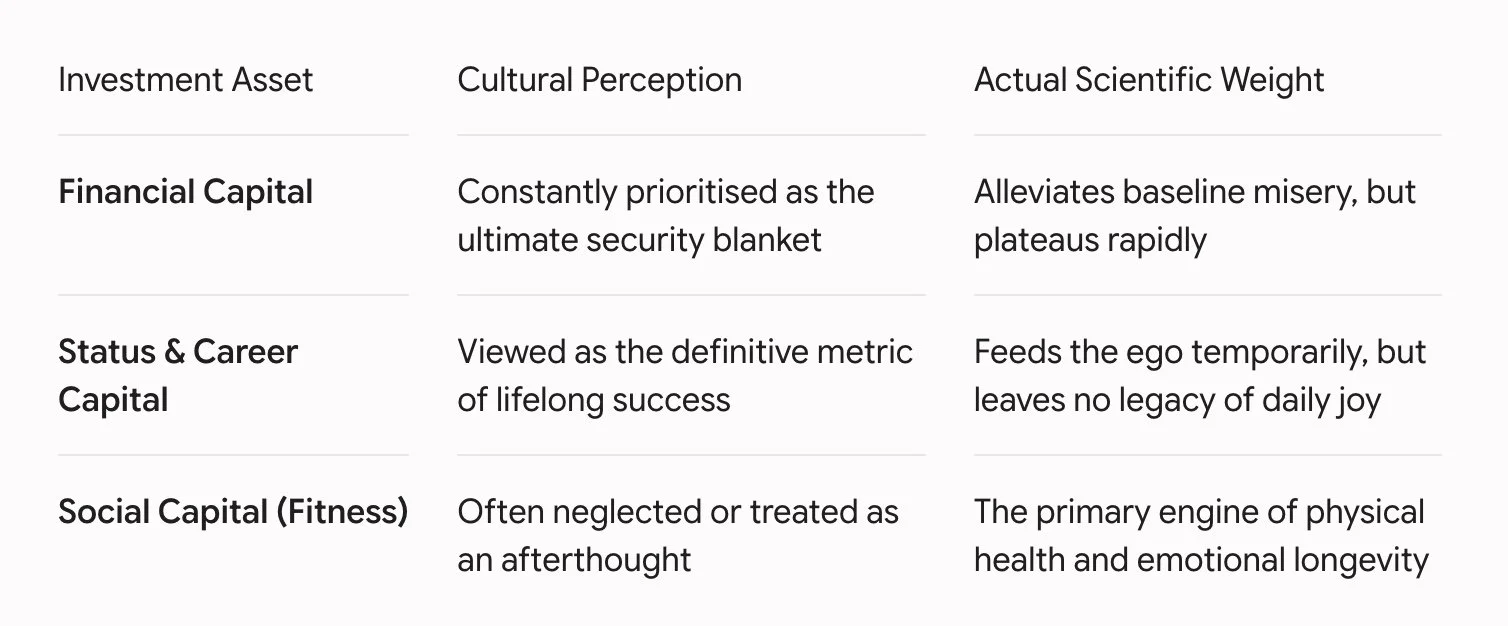
The Dynamic Engine of Social Fitness
So, how do we actually practice social fitness?
Just like physical fitness, you cannot go to the gym once in January and expect to remain in peak condition for the rest of the year. Relationships are living systems that require consistent, active maintenance.
Behavioural science highlights three distinct habits of the socially fit:
The Micro-Dose of Attention: Sending a casual text to an old friend just to say you are thinking of them, or putting your smartphone completely face down on the table when your partner is speaking.
Long-term bonds are built entirely on the compound interest of tiny, daily moments of undivided attention.
Radical Vulnerability: Moving past shallow, surface-level small talk about the local weather or football scores, and opening up about what is genuinely keeping you awake at night.
True intimacy is forged when we allow ourselves to be seen in our messy, imperfect reality.
Community Integration: Actively joining groups where you share a mutual purpose, whether that is a local running club, a community choir, a volunteering circle, or a neighborhood association.
These spaces create "weak ties"—those casual, daily interactions with acquaintances that provide a profound sense of tribal safety and belonging.
Conclusion: Tearing Up the Spreadsheet for a Cup of Tea
At the end of the day, when you look back at your life from the comfort of a rocking chair in your eighties, you won't be scrolling through your old spreadsheet data, admiring your immaculate pension pot, or fondly remembering that Tuesday you spent replying to emails until midnight.
You will be thinking about the people who made you laugh until your stomach ached, the friends who sat silently with you in the hospital waiting room, and the comforting warmth of a cup of tea shared with someone who knows your entire story and loves you anyway.
Long-term happiness isn't a complex cryptographic puzzle that requires an advanced degree to solve, nor is it a luxury item reserved for the ultra-wealthy.
It is simply the beautiful, unglamorous work of keeping your heart open, picking up the phone, and investing your energy into the human beings standing right in front of you.
Turn off the computer, ignore the relentless notifications for an hour, and go make a proper connection—your neural pathways, your heart, and your future self will thank you for it.
If you would like to know about the chemicals that make you feel happy, read this next.
References
Read This Next





Disclaimer: This article is for general informational purposes only and does not address individual circumstances, substitute for professional advice, or serve as a basis for decision-making. You should always seek the guidance of a physician or qualified healthcare provider regarding a medical condition, and never disregard or delay seeking professional medical advice due to this content. Any action taken based on this information is entirely at your own risk and responsibility; Energetics, its staff, and its medical advisors disclaim all liability for any inaccuracies, errors, or any personal or professional loss incurred as a direct or indirect consequence of using this content.