Can you choose to be happy?
Reading Time 4 mins

Let’s be entirely honest: if someone tells you to simply "choose joy" when you have just spent forty-five minutes hunting for your car keys, discovered the milk is sour, and stubbed your big toe on the edge of the kitchen island, your instinct isn't to meditate.
It is to gently launch a coffee mug across the room.
We live in an era of relentless, sparkling toxic positivity where we are constantly told that happiness is a simple, conscious daily decision—as if swapping out a bad mood is as straightforward as picking a different pair of socks.
But if you have ever tried to aggressively "will" yourself into a state of absolute bliss during a heavy wave of Monday morning exhaustion, you already know that your brain does not take direct orders from motivational posters.
This tension creates a major psychological debate.
Are we merely passive passengers driven by our biological wiring and life circumstances, or do we truly hold the steering wheel when it comes to our emotional state?
By diving into neurobiology and behavioural science, we can strip away the fluffy wellness slogans and look at the actual percentage of control we possess over our internal baseline.
The 40% Formula: The Anatomy of the Happiness Set Point
For years, positive psychology leaned heavily on a landmark framework known as the Sustainable Happiness Model, developed by researchers Sonja Lyubomirsky, Kennon Sheldon, and David Schkade.
Their research attempted to slice human happiness into a clean, percentage-based pie chart to determine exactly how much control we have over our mood.
According to their original calculation, the breakdown of what determines your long-term well-being follows a specific ratio:
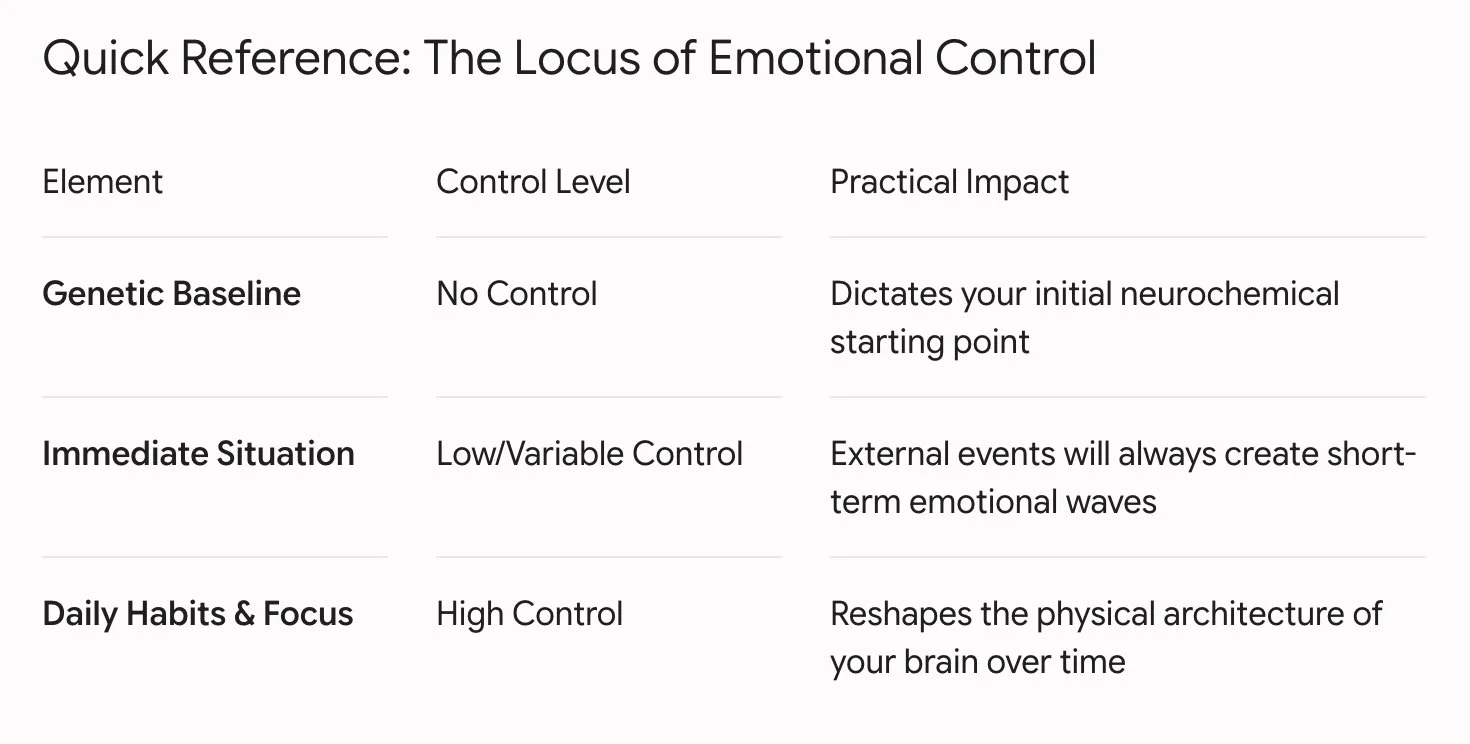
50% Genetic Set Point: Your biological baseline, inherited from your parents.
This dictates your default neurochemistry, including how efficiently your brain produces and processes dopamine and serotonin.
10% Life Circumstances: The structural elements of your reality—where you live, your marital status, your income, and your health status.
40% Intentional Activity: The deliberate choices, behaviors, and cognitive patterns you practice every single day.
Total Happiness Variance=
50% (Genetics)+10% (Circumstances)+40% (Intentional Action)
While recent genetic studies suggest that the split between nature and nurture is far more fluid and interconnected than a rigid chart implies, the core takeaway remains scientifically sound.
You cannot change your DNA, and you cannot always instantly alter your external life circumstances.
However, a massive portion of your emotional real estate remains entirely up for grabs, dictated purely by your daily, intentional habits.
You cannot choose your biological starting point, but you can absolutely choose how you train the network you were given.
If you are interested in learning whether more choices make you happier, read this.
The Cognitive Illusion: Why Direct Choice Fails
If forty percent of our emotional well-being is determined by intentional activity, why can't we wake up and command ourselves to feel happy?
The answer lies in an evolutionary quirk of the brain: happiness is an evanescent byproduct, not a direct destination.
When you actively pursue happiness as a specific goal, you inadvertently activate a comparison mechanism in your mind.
You constantly monitor how you feel, notice the gap between your current mood and absolute bliss, and ultimately end up feeling frustrated, anxious, or disappointed.
Psychologists refer to this paradox as the hedonic trap of direct pursuit.
Instead of treating happiness like a switch you flip, neurobiology shows it must be treated like a garden you tend.
You don't choose the emotion itself; you choose the specific conditions that allow the emotion to organically flourish.
Your brain cannot register a command like "be happy now," but it reacts instantly to changes in your physiological state, your focus, and your community connections.
The Dynamic Toolkit: How to Influence Your Emotional Environment
Since we cannot command our neurochemistry to shift on demand, we must look at the specific, evidence-based practices that systematically reshape our baseline over time.
Behavioural science highlights three distinct pillars of intentional activity:
1. Attentional Control and Cognitive Reframing
Your reality is not what happens around you; it is what you choose to pay attention to.
The human brain possesses a built-in negativity bias, an evolutionary survival mechanism designed to make us focus on threats, criticisms, and failures rather than wins.
You cannot stop a negative thought from entering your mind, but you can choose how long it stays there.
Practising cognitive reframing allows you to consciously challenge automatic negative assumptions, breaking the looping neural circuits that feed chronic stress.
2. Somatic and Physiological Anchors
We often treat the mind and body as completely separate entities, but your emotional state is deeply rooted in your physical biology.
When you experience chronic stress, your nervous system gets trapped in a sympathetic "fight or flight" loop, flooding your system with cortisol.
You can choose to down-regulate this stress response using targeted somatic tools—such as deep, diaphragmatic breathwork, regular movement, and prioritising restorative sleep.
By changing your physical physiology, you send an immediate signal up the vagus nerve telling your brain that it is safe to relax.
3. Deliberate Micro-Connections
Human beings are inherently tribal creatures; our nervous systems are wired to co-regulate with others. Loneliness triggers the same inflammatory and stress pathways in the body as physical pain.
Choosing to invest your energy into deep, authentic social connections—even just a brief, meaningful conversation with a colleague or friend—spikes your oxytocin levels and provides a profound sense of safety and belonging.
Conclusion: Trading the Checklist for a Little Grace
So, can you genuinely choose to be happy?
No, not if you mean flipping a biological switch whilst your entire day goes up in smoke.
True mental resilience doesn't require you to smile through a root canal or pretend that sitting in gridlocked traffic on the M20 is a profound spiritual awakening.
It just means realising you aren't completely helpless against your internal weather.
You can't choose your DNA, and you can't stop life from throwing the occasional curveball, but you can choose to put down the self-critical whip, step out into the sunlight, and give your nervous system a moment to breathe.
Stop pressuring yourself to achieve a state of permanent, Instagram-worthy enlightenment.
Just focus on making those tiny, daily micro-choices that keep your brilliant neural network ticking over—and if all else fails, just remember that the sour milk and the stubbed toe will look infinitely better after a proper, uninterrupted night of deep sleep.
If you are interested in learning about what the secret to long-term happiness is, read this next.
References
Lyubomirsky, S., Sheldon, K.M. and Schkade, D., 2005. Pursuing happiness: The architecture of sustainable change. https://greatergood.berkeley.edu/images/uploads/Pursuing_Happiness-_The_Architecture_of_Sustainable_Change.pdf
Schooler, J.W., Ariely, D. and Loewenstein, G., 2003. The pursuit and assessment of happiness can be self-defeating. https://www.cmu.edu/dietrich/sds/docs/loewenstein/PursuitAssessmentHappiness.pdf
Read This Next





Disclaimer: This article is for general informational purposes only and does not address individual circumstances, substitute for professional advice, or serve as a basis for decision-making. You should always seek the guidance of a physician or qualified healthcare provider regarding a medical condition, and never disregard or delay seeking professional medical advice due to this content. Any action taken based on this information is entirely at your own risk and responsibility; Energetics, its staff, and its medical advisors disclaim all liability for any inaccuracies, errors, or any personal or professional loss incurred as a direct or indirect consequence of using this content.