Does having more choices make us happier?
Reading Time 4 mins

Imagine standing in the middle of a brightly lit supermarket aisle, completely frozen in place, as you try to pick a single jar of honey from a selection that looks roughly the size of a small library.
You don't just choose "honey" anymore; you have to mentally battle your way through raw organic wildflower blends, cold-pressed Manuka variants, local Kentish clover pots, squeezy fair-trade orange blossom syrups, and multi-buy artisanal jars from hives located on the other side of the planet.
You stare at the shelves for ten exhausting minutes, your brain completely locked in a state of terminal analysis, only to grab the same plastic bottle you’ve bought for the last seven years.
You walk away feeling mildly annoyed, oddly drained, and quietly convinced that whatever you just put in your basket is definitely the wrong option.
We are relentlessly told by modern consumer culture that freedom is entirely synonymous with choice—and that the wider the buffet of options, the happier we will inevitably be.
This tension creates a major psychological debate.
Is an infinite array of paths the ultimate hallmark of human liberation, or is it secretly driving us completely out of our minds?
By diving into behavioural economics and neurobiology, we can strip away the marketing myths and look at the actual physiological cost of having far too many options.
1. The Paradox of Choice and the Jam Experiment
The foundation of how choice interacts with human psychology was completely rewritten by a simple grocery store display involving fruit jam.
In 2000, psychologists Sheena Iyengar and Mark Lepper set up a tasting booth at a premium gourmet food market, alternating between two different setups:
          THE JAM EXPERIMENT

              [ Tasting Booth A ]                                                                  [ Tasting Booth B ]
                24 Jam Flavours                                                                        6 Jam Flavours
 ───────────────────                 ───────────────────
          • 60% of shoppers stop                                                      • 40% of shoppers stop
              • 3% actually buy                                                                  • 30% actually buy
The results were absolutely staggering.
While the massive, twenty-four-flavour display managed to attract a larger crowd of curious onlookers, it completely backfired when it came to actual decision-making.
People facing the limited, six-flavour table were ten times more likely to make a final purchase than those drowning in options.
This landmark study exposed what is now known as choice paralysis.
When the brain is confronted with an excessive number of variables, the cognitive load becomes too heavy to process.
Instead of feeling liberated, our internal operating system simply freezes up and defaults to total inaction.
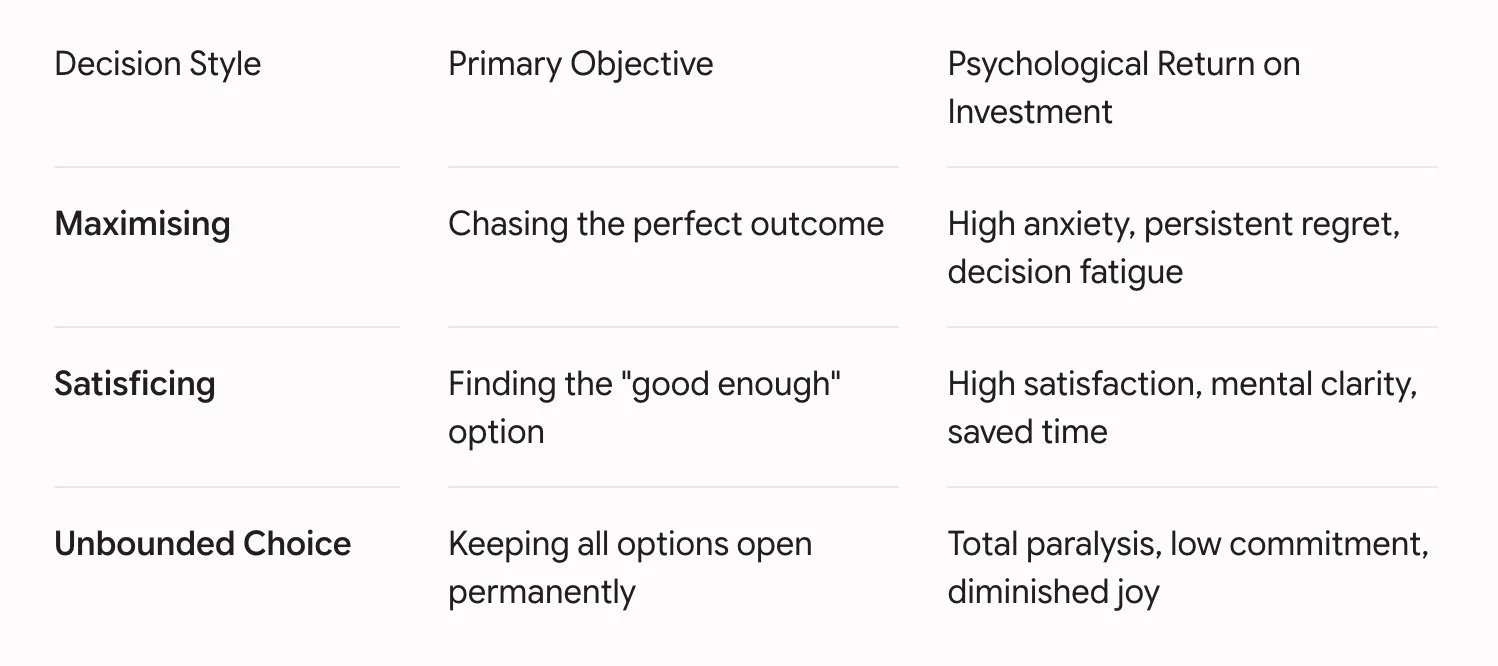
2. Maximisers vs. Satisficers
To understand why choice hurts our daily well-being, behavioural economist Herbert Simon split decision-makers into two distinct psychological camps:
Maximisers
These individuals are on a relentless, exhausting quest to make the absolute best possible decision.
Before booking a weekend holiday or buying a simple pair of running shoes, a maximiser will spend weeks reading three hundred reviews, comparing prices across twenty tabs, and consulting expert forums.
Satisficers
These individuals operate on a clean, threshold-based system.
They identify their specific criteria first (e.g., "I need a black coat that is under £100 and completely waterproof").
The moment they find an option that successfully ticks those specific boxes, they buy it and completely stop looking.
The data shows that while maximisers occasionally manage to secure slightly better objective outcomes (like a marginally cheaper flight), they score significantly lower on every metric of psychological well-being.
They suffer from chronic buyer's remorse, experience higher rates of anxiety, and find themselves trapped in an endless cycle of comparing their reality to the infinite alternatives they left behind.
3. The Triad of Choice Anxiety
Psychologist Barry Schwartz identifies three specific mechanisms that systematically destroy our serotonin and dopamine levels when we are faced with an abundance of options:
Opportunity Cost: Every time you choose option A, you are forced to consciously reject options B, C, D, and E.
The more options you have, the more attractive features you have to pass up.
The mental weight of what you are missing out on rapidly outweighs the joy of what you actually chose.
Escalation of Expectations: When there is only one type of jeans available, and they fit poorly, the fault lies entirely with the world.
But when there are fifty styles available, your expectations skyrocket.
If you buy a pair and they aren't absolutely flawless, you blame yourself for making the wrong choice.
The Regret Vacuum: Having an escape hatch actually makes us less satisfied.
A famous study showed that when consumers were told they could exchange a piece of art within thirty days, they liked it significantly less over time than individuals who were told their choice was completely final.
Total finality forces hedonic adaptation to kick in, making us love what we have.
If you would like to do a deeper, fascinating dive into whether more choices make you happier, read this article.
Quick Reference: The Decision Architecture Matrix
Conclusion: Putting Up the Fences for Total Peace of Mind
So, does having more choices make us genuinely happier?
Absolutely not, unless you happen to derive a strange, masochistic pleasure from spending your precious weekends agonising over which brand of premium compost will make your geraniums slightly happier.
True freedom isn't about having a million open doors; it’s about having the absolute confidence to walk through one, slam the door shut behind you, and never look back through the keyhole.
You don't need to optimise every single micro-decision of your life to achieve a state of permanent, textbook-perfect enlightenment.
Save your precious cognitive energy for the things that actually matter—your family, your deep creative projects, and the people who know your whole story.
Give your beautiful, overworked brain a massive break: pick a decent option, declare it "good enough," and allow yourself to happily ignore the rest of the supermarket aisle.
Put the kettle on, trust your first instinct, and remember that life is infinitely sweeter when you stop treating every tiny purchase like a high-stakes exam you are desperately trying not to fail.
That said, if you are interested in learning some simple exercises to keep your vagal tone and HRV happy, read this next.
Read This Next





Disclaimer: This article is for general informational purposes only and does not address individual circumstances, substitute for professional advice, or serve as a basis for decision-making. You should always seek the guidance of a physician or qualified healthcare provider regarding a medical condition, and never disregard or delay seeking professional medical advice due to this content. Any action taken based on this information is entirely at your own risk and responsibility; Energetics, its staff, and its medical advisors disclaim all liability for any inaccuracies, errors, or any personal or professional loss incurred as a direct or indirect consequence of using this content.