What chemical makes you feel happy?
Reading Time 4 mins
Let’s be entirely honest: most of us tend to treat our brains like a sort of emotional vending machine.
We expect that if we just insert the correct token—whether that token is a massive promotion, a double espresso, a new pair of shoes, or an aggressively fast scroll through social media—the machine should instantly drop a shiny, neatly wrapped package of pure joy into our laps.
When we feel unaccountably miserable on a random Tuesday afternoon, we assume our internal mechanics are simply broken.
But if you have ever tried to cure a profound wave of existential dread by eating an entire block of premium cheddar, you already know that your internal biology isn't a simple coin-operated slot machine.
This tension creates a major psychological debate.
Are we truly the master captains of our own souls, or are we just meat suits controlled by a chaotic, swirling soup of microscopic neural hormones?
By diving into neurobiology and behavioural science, we can strip away the fluffy wellness jargon and look at the actual quarterly board of directors running your brain: a specific quartet of chemicals affectionately known as the D.O.S.E. molecule club.
The Molecular Board: Breaking Down the D.O.S.E. Quartet
Your brain does not possess a single, monolithic "happiness lever". Instead, your emotional state is dictated by a beautifully complex, real-time chemical balancing act.
When you feel a surge of satisfaction, peace, or excitement, your brain is actually experiencing the targeted release of four distinct neurotransmitters, each running a completely different department of your mental well-being.
1. Dopamine: The Engine of Anticipation
Popular culture often mischaracterises dopamine as the chemical molecule of pleasure itself—the reward you get when you hit the jackpot.
However, neuroimaging studies show that dopamine actually fires before you get the prize. It is the chemical of anticipation, motivation, and pursuit.
Dopamine is evolutionary currency.
It is the neurotransmitter that whispered to our ancestors, "Go climb over that dangerous ridge; there might be some delicious berries on the other side."
In the modern landscape, this chemical is ruthlessly hijacked by smartphone apps.
Every time you pull down to refresh a feed or check your notifications, your brain releases a microscopic spike of dopamine, keeping you locked in an endless loop of seeking.
To cultivate clean, sustainable dopamine without the exhausting digital crash, neurobiology suggests focusing on the compound interest of small, incremental wins:
Micro-Goals: Splitting a massive, overwhelming project into tiny, laughably achievable sub-tasks.
Crossing an item off your physical checklist triggers a healthy, natural dopamine release.
The Joy of Craft: Engaging in activities where the satisfaction is built directly into the process—such as knitting, woodworking, gardening, or writing.
2. Serotonin: The Mood Governor and Status Shield
If dopamine is the thrilling high of the chase, serotonin is the warm, comfortable satisfaction of arrival.
It is your ultimate mood stabiliser, responsible for feelings of safety, pride, satisfaction, and overall social confidence.
Interestingly, serotonin is profoundly linked to our perception of status and safety within our social tribe.
When you feel respected, valued, and appreciated by your peers, your serotonin levels naturally flourish.
Conversely, when you feel excluded, criticised, or socially vulnerable, your serotonin drops, triggering the ancient brain circuits that link isolation to physical danger.
To naturally support your serotonin infrastructure, you can utilise two powerful biological levers:
The Tryptophan and Gut Connection: Approximately ninety per cent of your body's serotonin receptors are located in your gut.
Feeding your microbiome complex fibres, fermented foods, and nutrients rich in tryptophan (like eggs, oats, and poultry) provides the literal building blocks your body requires to synthesise this crucial neurotransmitter.
Sunlight and the Retinal Reset: Stepping outside into natural daylight within the first hour of waking up.
Sunlight hitting your eyes sends an immediate signal down the optic nerve, regulating your circadian rhythm and boosting daytime serotonin production.
3. Oxytocin: The Relational Glue
Oxytocin is affectionately known as the cuddle hormone or the bonding molecule.
It is the neurochemical foundation of trust, intimacy, empathy, and social safety.
Whenever you hug a loved one, share a deep look with a close friend, stroke a pet, or collaborate on a meaningful team project, your brain floods your system with oxytocin.
This chemical is nature’s ultimate antidote to stress.
When oxytocin spikes, it systematically down-regulates the amygdala (the brain's alarm center), lowers your heart rate, and surpasses the production of cortisol.
It is the chemical that signals to your nervous system: "You are safe. You are surrounded by your tribe."
4. Endorphins: The Biological Shield Against Pain
Endorphins are essentially your brain's internal manufacture of morphine.
Evolutionary biologists note that endorphins did not evolve to make us happy; they evolved to help us survive.
If an early human was running away from a predator and twisted their ankle, a massive surge of endorphins would temporarily mask the physical agony, allowing them to keep sprinting to safety.
In everyday modern life, endorphins are released in response to physical discomfort, acute stress, or rigorous exertion. It is the primary driver behind the legendary "runner's high."
You don't have to run a grueling marathon to unlock this internal shield; you can stimulate endorphin production through lighthearted means:
Genuine Belly Laughter: The physical contractions of a deep, tears-in-your-eyes laugh strain your muscles just enough to trigger a beautiful wave of endorphins.
Somatic Temperature Shocks: A brisk, thirty-second blast of cold water at the end of your morning shower provides a brief physiological shock that stimulates immediate endorphin and noradrenaline release.
To hack your brain and its happy hormones using a holistic technique called binaural brainwaves, read this.
Quick Reference: The D.O.S.E. Chemical Matrix
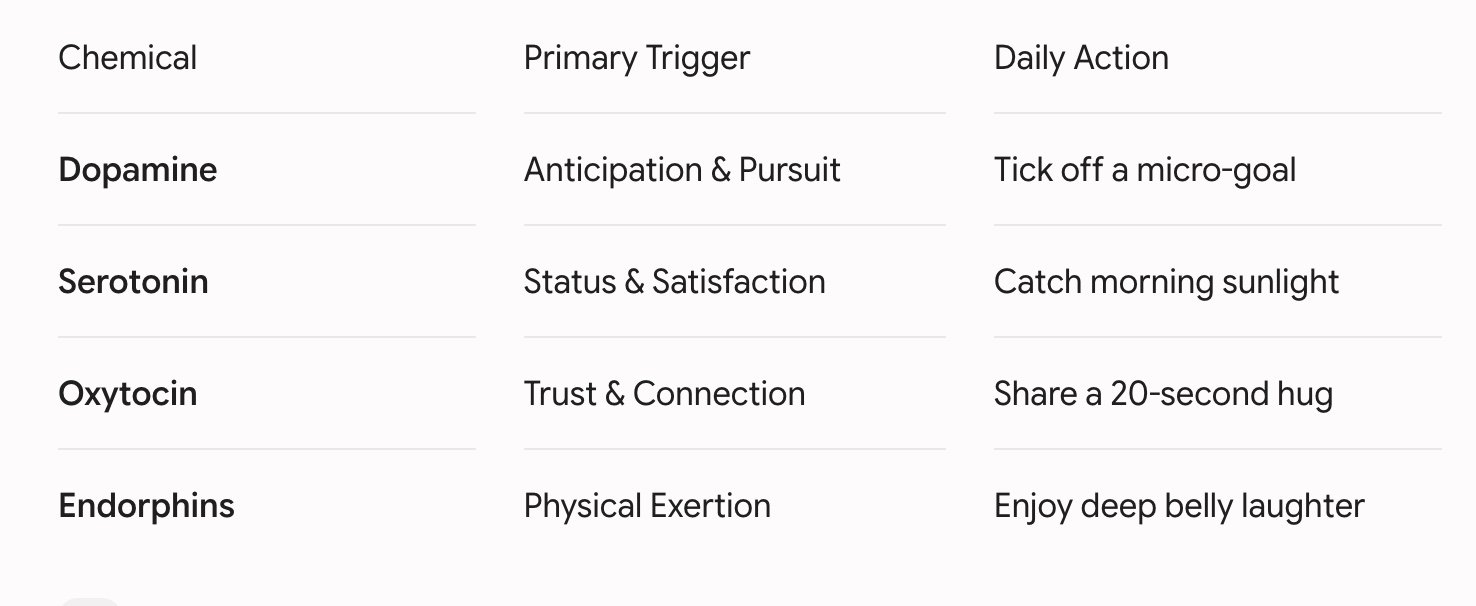
Conclusion: Putting Down the Test Tube for a Walk
So, what chemical genuinely makes you feel happy?
No single molecule can claim the crown. Your brain isn't a static test tube that just requires a splash of extra serotonin to fix a bad day.
True mental agility lies in recognising that you can consciously influence this internal pharmacy through your daily, somatic choices.
You don't need a PhD in biochemistry to master your internal cocktail.
You just need to realise that when your brain feels flat, it might just be asking you to put down the phone, step away from the glowing screen, stretch your legs, and step out into the daylight.
Stop waiting for the perfect chemical lightning bolt to strike from above. Focus on giving your magnificent nervous system the raw materials it needs to thrive—and if all else fails, just remember that a brisk walk, a proper laugh with an old friend, and a decent night of sleep will do more for your internal chemistry than any motivational checklist ever could.
If after reading this you are wondering why you are not feeling happy despite everything going well in your life, read this next.
Read This Next





Disclaimer: This article is for general informational purposes only and does not address individual circumstances, substitute for professional advice, or serve as a basis for decision-making. You should always seek the guidance of a physician or qualified healthcare provider regarding a medical condition, and never disregard or delay seeking professional medical advice due to this content. Any action taken based on this information is entirely at your own risk and responsibility; Energetics, its staff, and its medical advisors disclaim all liability for any inaccuracies, errors, or any personal or professional loss incurred as a direct or indirect consequence of using this content.