How Does Poor Sleep Amplify Depression?
Reading Time 4 mins

We have all been treated to the standard, well-meaning medical lecture on sleep.
We are told that if we do not get our neat little eight hours a night, we will be grumpy, our concentration will suffer, and we will probably overindulge in biscuits by 3:00 PM the next day.
But when you are navigating the heavy, suffocating grey fog of clinical depression, a night of fragmented, elusive sleep is not just an inconvenience.
It feels like someone has systematically gone into your brain overnight and turned down the volume on your remaining resilience while doubling the weight of your emotional baseline.
For decades, medicine viewed insomnia as a mere side effect of depression—a secondary symptom that would simply tidy itself up once your mood improved.
We now know that this view is completely backward.
Sleep disruption is not just sitting passively in the passenger seat of mood disorders; it is actively leaning over and violently jerking the steering wheel.
Trying to heal from depression while experiencing severe sleep deprivation is like trying to rebuild a house in the middle of a literal hurricane—every single brick of emotional progress you manage to lay down during the day gets swiftly blown away overnight.
This is not a personal failure or a lack of mental toughness; it is a direct, measurable consequence of neural mechanics. When your sleep biochemistry shatters, your brain's capacity to regulate human emotion goes down with the ship.
The Neurological Crossroads of Sleep and Mood
To understand why a bad night makes the world look so utterly bleak, we have to look at the communication lines between three critical brain regions: the prefrontal cortex (your logical, clear-headed manager), the amygdala (your hyper-reactive emotional alarm bell), and the hippocampus (your master memory filing cabinet).
In a healthy, well-rested brain, the prefrontal cortex acts like a calm, sensible adult, keeping a firm, soothing hand on the amygdala. When something minor goes wrong, your manager steps in and says, "It is just a small setback, let's not panic."
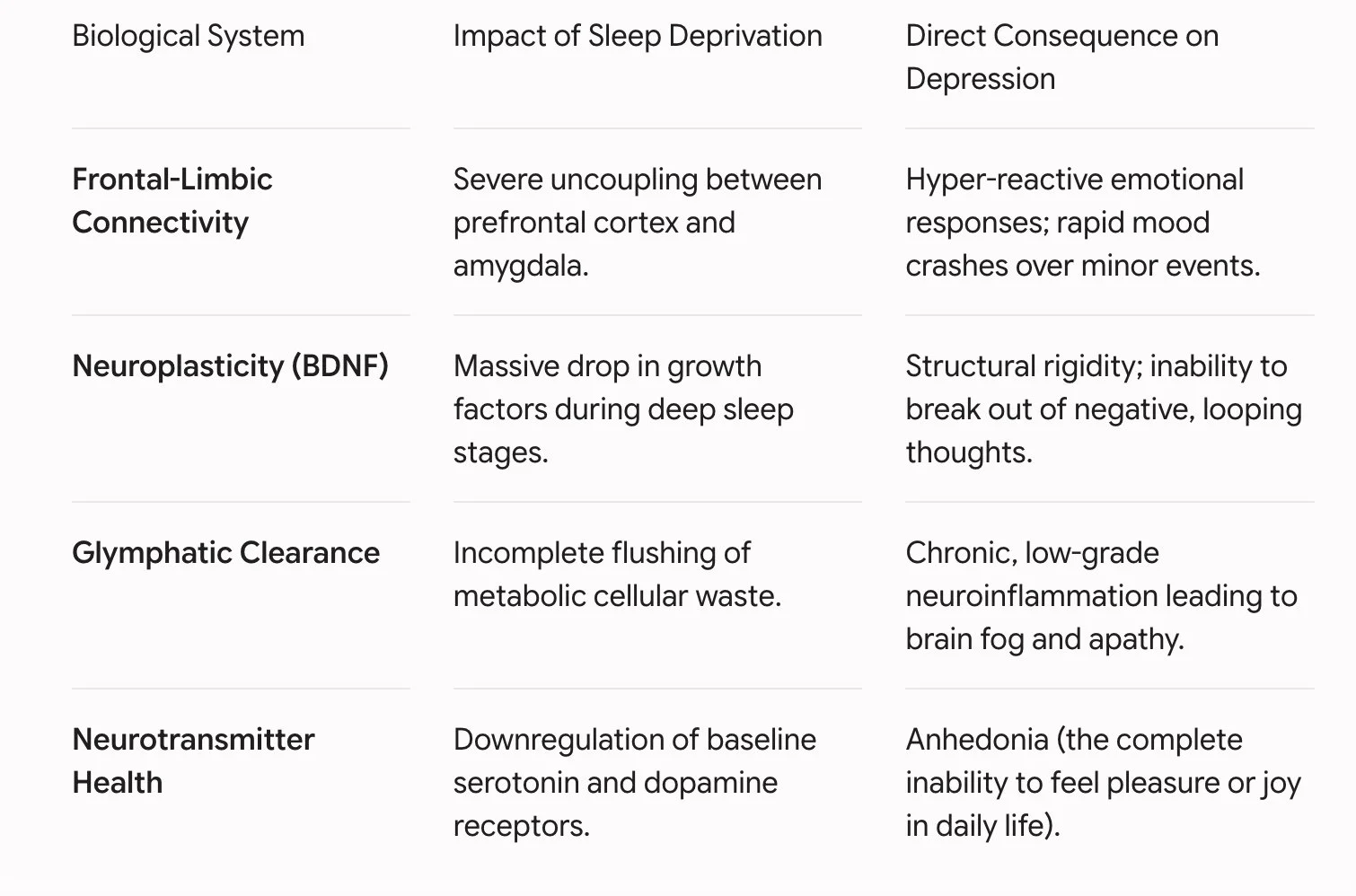
But when you deprive the brain of deep, slow-wave sleep and rapid eye movement (REM) cycles, that vital connection physically uncouples.
Without sleep, the prefrontal cortex essentially goes on strike, leaving the amygdala completely unsupervised.
Studies show that a sleep-deprived amygdala is up to 60% more reactive to negative stimuli.
Suddenly, a minor household chore or a slightly brief text message is no longer a small annoyance—it is perceived by your brain as an existential catastrophe, plunging you straight back into an emotional spiral.
[Sleep Deprivation] ➔ [Prefrontal Cortex Disconnection] ➔ [60% Amygdala Hyper-Reactivity] ➔ [Emotional Crash]
4 Biomechanical Pathways: How Poor Sleep Fuels the Depressive Loop
When your sleep infrastructure breaks down, it triggers a cascade of biological changes that directly reinforce the state of depression:
1. The Death of Neuroplasticity (BDNF Depletion)
Depression is fundamentally characterised by a lack of neuroplasticity—the brain’s ability to grow new connections, adapt, and heal.
The primary fuel for this growth is a protein called Brain-Derived Neurotrophic Factor (BDNF).
Your brain manufactures and distributes the vast majority of its BDNF during deep, slow-wave sleep.
When your sleep is short-changed, your BDNF levels plummet.
Without this vital fuel, your brain becomes structurally rigid, locking you firmly into the repetitive, negative, and looping thought patterns that characterise depression.
2. Neuroinflammation and the Glymphatic Blockage
Think of your brain as a busy office building.
During the day, it accumulates a massive amount of metabolic waste and cellular debris.
When you drop into deep sleep, an internal cleaning mechanism called the glymphatic system turns on, flushing cerebrospinal fluid through your brain tissue to wash away those toxic byproducts.
If you wake up repeatedly or cannot sustain deep sleep, this nightly cleaning crew never shows up.
The resulting buildup of cellular waste triggers low-grade, chronic neuroinflammation, which directly disrupts dopamine and serotonin production, leaving you feeling physically heavy, flat, and completely unmotivated.
3. REM Sleep Anomalies and Emotional Reset Failure
REM sleep is your mind's built-in overnight therapy session.
It is the only time your brain completely shuts off the stress chemical noradrenaline while actively processing the emotional events of your day.
It strips away the raw, painful edge from your memories so you can wake up with a clean slate.
In depressed individuals, the architecture of REM sleep is highly distorted—you often enter REM too quickly and stay there too long, burning through your brain's limited energy reserves in highly vivid, stressful, and looping dreams, only to wake up feeling emotionally exhausted before your feet even touch the floor.
4. Circadian Desynchronisation and Cortisol Blunting
Your body operates on a strict, internal 24-hour biological clock governed by light and dark cycles.
Poor sleep habits and chronic insomnia completely throw this clock out of alignment. Instead of a healthy, sharp spike of cortisol in the morning to give you energy, your cortisol curve flattens.
You wake up with no physical drive, dragging yourself through the day, only for your stress hormones to bizarrely spike late at night when you are desperately trying to rest.
Quick Reference: The Interlocking Cycle of Sleep Loss and Depression
Evidence-Based Somatic and Circadian Support Strategies
While navigating a clinical sleep deficit often requires professional medical oversight from a GP or registered specialist, neurobiological literature points to several non-medicinal, physiological levers that can support the body's natural circadian architecture and encourage autonomic balance.
1. Environmental Light Anchoring
The master biological clock is heavily regulated by photon exposure to the retina. To support natural sleep architecture, research emphasizes anchoring the circadian rhythm at both ends of the day:
The Morning Anchor: Stepping outside into natural daylight for 10 to 15 minutes within half an hour of waking down-regulates melatonin production and starts an internal biochemical countdown timer.
This morning exposure helps prompt natural evening sleepiness roughly 16 hours later.
The Evening Anchor: Dimming harsh overhead residential lighting after 8:00 PM and utilizing low-level, warm lamps helps shield the brain's evening melatonin surge, which is highly sensitive to blue light frequencies and vital for entering slow-wave sleep.
2. Non-Sleep Deep Rest (NSDR)
When nighttime sleep is highly fragmented, the sympathetic nervous system frequently remains locked in a hyper-vigilant state.
Clinical literature demonstrates that non-sleep deep rest protocols, such as structured Yoga Nidra, can introduce profound physiological calm during waking hours.
Spending 20 minutes lying flat under a comfortable weight while engaging in passive sensory tracking encourages brainwave frequencies to shift from active beta states down into alpha and theta patterns, offering a restorative buffer that can help lower systemic daytime cortisol.
To learn more about yoga nidra and NSDR, read this.
3. Nutritional and Biochemical Cofactors in Literature
From a nutritional science perspective, specific dietary compounds have been extensively evaluated for their ability to support the central nervous system's sleep preparation mechanisms.
Rather than a blanket recommendation, individuals often evaluate these components in consultation with a healthcare provider:
Targeted Magnesium Forms: Magnesium Threonate and Magnesium Bisglycinate are frequently highlighted in research due to their high bioavailability and ability to cross the blood-brain barrier.
Biochemically, magnesium serves as an agonist for calming GABA receptors, helping to quiet central nervous system activity.
Amino Acid Support (Glycine): In clinical sleep trials, the administration of 3 grams of the amino acid glycine before rest has been observed to facilitate a gentle drop in core body temperature.
This physiological cooling serves as a primary endogenous trigger required for the brain to transition smoothly into deep sleep cycles.
4. Vagal Down-Regulation (The 4-7-8 Pattern)
When waking abruptly during the night with a racing mind, the autonomic system is experiencing an acute sympathetic spike.
A controlled, down-regulating breath pattern can be utilized to manually engage the parasympathetic brake:
Inhale through the nose for 4 seconds.
Hold the breath gently for 7 seconds.
Exhale smoothly and completely through pursed lips for 8 seconds.
Repeating this sequence for four complete cycles leverages mechanical pressure changes in the thoracic cavity to stimulate the vagus nerve, sending a distinct physical signal to the brainstem that the immediate environment is secure.
Conclusion: Reclaiming Your Nightly Sanctuary
When all is said and done, fixing your sleep architecture is not a superficial lifestyle luxury—it is the absolute foundation of your mental health recovery.
Depression wants to convince you that you are fundamentally broken, that the world is a permanent shade of grey, and that things will never improve.
But very often, it is simply your exhausted, unwashed, and un-rested brain talking.
You do not have to fix your entire life, solve all your problems, or cure your mood overnight to start feeling better; you just need to give your nervous system the structural support it needs to have a decent night's sleep.
By dropping your shoulders, stepping into the morning sun, and utilising somatic tools like NSDR and rhythmic breathwork, you can slowly clear the neuroinflammatory fog and let your brain's internal cleaning crew do its job.
After all, protecting your sleep means you get to face the morning as a resilient, clear-headed human being—rather than someone who looks at an unmade bed like it is a complex, high-stakes puzzle and considers checking into a local hotel just to avoid dealing with the duvet!
Turn down the bright lights, protect your evening sanctuary, and let your body begin to heal itself from the inside out tonight.
To learn the difference between light sleep and deep sleep in biology, read this.
References
Read This Next





Disclaimer: This article is for general informational purposes only and does not address individual circumstances, substitute for professional advice, or serve as a basis for decision-making. You should always seek the guidance of a physician or qualified healthcare provider regarding a medical condition, and never disregard or delay seeking professional medical advice due to this content. Any action taken based on this information is entirely at your own risk and responsibility; Energetics, its staff, and its medical advisors disclaim all liability for any inaccuracies, errors, or any personal or professional loss incurred as a direct or indirect consequence of using this content.