
To the untrained eye, sleep looks like a beautifully peaceful state of absolute, lazy doing-nothing—a simple mechanical shutdown where you get to pull the duvet up, block out the world, and send your conscious mind on a mini-vacation.
If only it were that simple!
In reality, the moment your head hits the pillow, your brain isn't clocking off at all; it's just clocking into a night shift.
Beneath the surface, at a microscopic and neuroelectrical level, sleep is an incredibly busy, dynamic biological operation.
The brain isn't powering down; it's shifting gears, systematically moving through vastly different physiological states to clean up your mental files and literally rebuild your body.
For anyone trying to survive the modern world with their energy, memory, and sense of humour intact, understanding the distinct biological borders between light sleep and deep sleep is a total game-changer.
While light sleep serves as a vital transition state and a protective sensory filter, deep sleep is the body's ultimate physical repair shop.
Looking at the cellular mechanics, brainwave patterns, and metabolic shifts of these two phases reveals why cutting either one short leaves us feeling less like functioning human beings and more like uncalibrated robots.
The Master Architecture: The 90-Minute Sleep Cycle
To understand the difference between light and deep sleep, we must first look at how the brain organises its nightly workflow. Human sleep is governed by a recurring ultradian rhythm—a biological cycle that repeats throughout the night roughly every 90 to 110 minutes.
During each individual cycle, the brain progresses through distinct stages of Non-Rapid Eye Movement (NREM) sleep, moving from very light transitions down into heavy slow-wave rest, before shifting into Rapid Eye Movement (REM) sleep.
[Stage 1: Light Transition] ➔ [Stage 2: True Light Sleep] ➔ [Stage 3: Deep NREM Slow-Wave] ➔ [REM Sleep]
A healthy night of sleep consists of four to six of these complete cycles. However, the composition of these cycles changes across the night.
The first half of the night is heavily weighted toward Stage 3 deep sleep, as the body prioritises physical restoration.
The second half of the night is dominated by light sleep and extended REM phases, focusing on cognitive sorting and emotional integration.
Light Sleep: The Brain’s Protective Boundary
Light sleep consists of Stage 1 and Stage 2 NREM sleep.
Together, these stages account for roughly 50% to 60% of your total nightly sleep time.
Rather than being a waste of time or empty sleep, light sleep serves as a critical biological buffer and architectural foundation.
Stage 1: The Gateway State
Stage 1 is the fragile bridge between waking consciousness and sleep, lasting only a few minutes. Biologically, your muscles begin to relax, your heart rate slows, and your eyes show slow, rolling movements.
On an Electroencephalogram (EEG), which measures brainwave activity, the fast, alert alpha waves (8–12 Hz) of wakefulness are replaced by slower theta waves (4–7 Hz).
Because this stage is so light, you can be woken by the slightest ambient sound, and you might feel as though you haven't actually slept at all.
It is during this transition that people often experience hypnic jerks—sudden, involuntary muscle contractions often accompanied by a sensation of falling.
Stage 2: True Light Sleep and the K-Complex
Stage 2 marks the onset of true, stable sleep. While it is still classified as light sleep, the brain begins to actively insulate itself from the outside world.
The EEG reveals two defining biological signatures unique to this stage: Sleep Spindles and K-Complexes.
Sleep Spindles: These are brief, rapid bursts of high-frequency brain activity (11–16 Hz) lasting less than two seconds.
Sleep spindles are the brain’s sensory gatekeepers; they actively block external sounds from reaching the auditory cortex, protecting the brain from being woken up by minor background noises.
They also play a crucial role in transferring short-term memories from the temporary storage of the hippocampus to the permanent filing cabinet of the cerebral cortex.
K-Complexes: These are single, massive voltage peaks on the EEG.
They serve a dual purpose: they suppress cortical arousal to keep you asleep, while simultaneously evaluating whether an external sound is a threat that requires you to wake up.
Deep Sleep: The Cellular Restoration Phase
Deep sleep, specifically known as Stage 3 NREM or Slow-Wave Sleep (SWS), represents the most profound state of unconsciousness.
During this phase, the body completely deactivates its awareness of the external environment, shifting all available metabolic energy inward toward physical repair, structural growth, and physiological detoxification.
The Biology of Delta Waves
When the brain enters deep sleep, the frantic, chaotic electrical activity of the daytime mind organises into massive, highly synchronised, slow-moving electrical waves called delta waves (0.5–4 Hz).
These waves are generated by the thalamus and cortex pulsing together in perfect harmony.
During deep sleep, your blood pressure drops significantly, your breathing becomes slow and highly regular, and your muscles become deeply relaxed.
It is incredibly difficult to wake someone up from this state; if you are forced awake during deep sleep, you will experience severe sleep inertia—that disoriented, clumsy feeling where your brain takes minutes to realise where it is.
The Glymphatic System: Flushing the Brain
One of the most profound biological discoveries of recent years is the role of deep sleep in cerebral detoxification.
During slow-wave deep sleep, the brain’s glymphatic system—essentially its internal waste clearance mechanism—opens up.
The space between brain cells increases by roughly 60%, allowing cerebrospinal fluid to rapidly flush through the brain tissue.
This fluid washes away toxic metabolic waste products, including amyloid-beta and tau proteins, which accumulate during your waking hours and are linked to neurodegenerative conditions.
Without sustained, uninterrupted deep sleep, this cellular waste builds up, causing the classic sensation of heavy daytime brain fog.
[Deep Sleep Begins] ➔ [Cellular Space Increases 60%] ➔ [Cerebrospinal Fluid Flushes Brain] ➔ [Toxins Cleared]
To learn more about the glymphatic power wash, read this.
Hormonal Output and Physical Repair
Deep sleep is also the primary window for endocrine system restoration.
The massive delta-wave synchrony triggers the anterior pituitary gland to release a massive surge of Human Growth Hormone (HGH).
In adults, HGH is vital for tissue repair, muscle growth, cellular regeneration, and wound healing. Furthermore, deep sleep is when the immune system synthesises and releases cytokines—proteins that are essential for targeting inflammation and fighting off infections.
Biological Comparison: Light vs. Deep Sleep
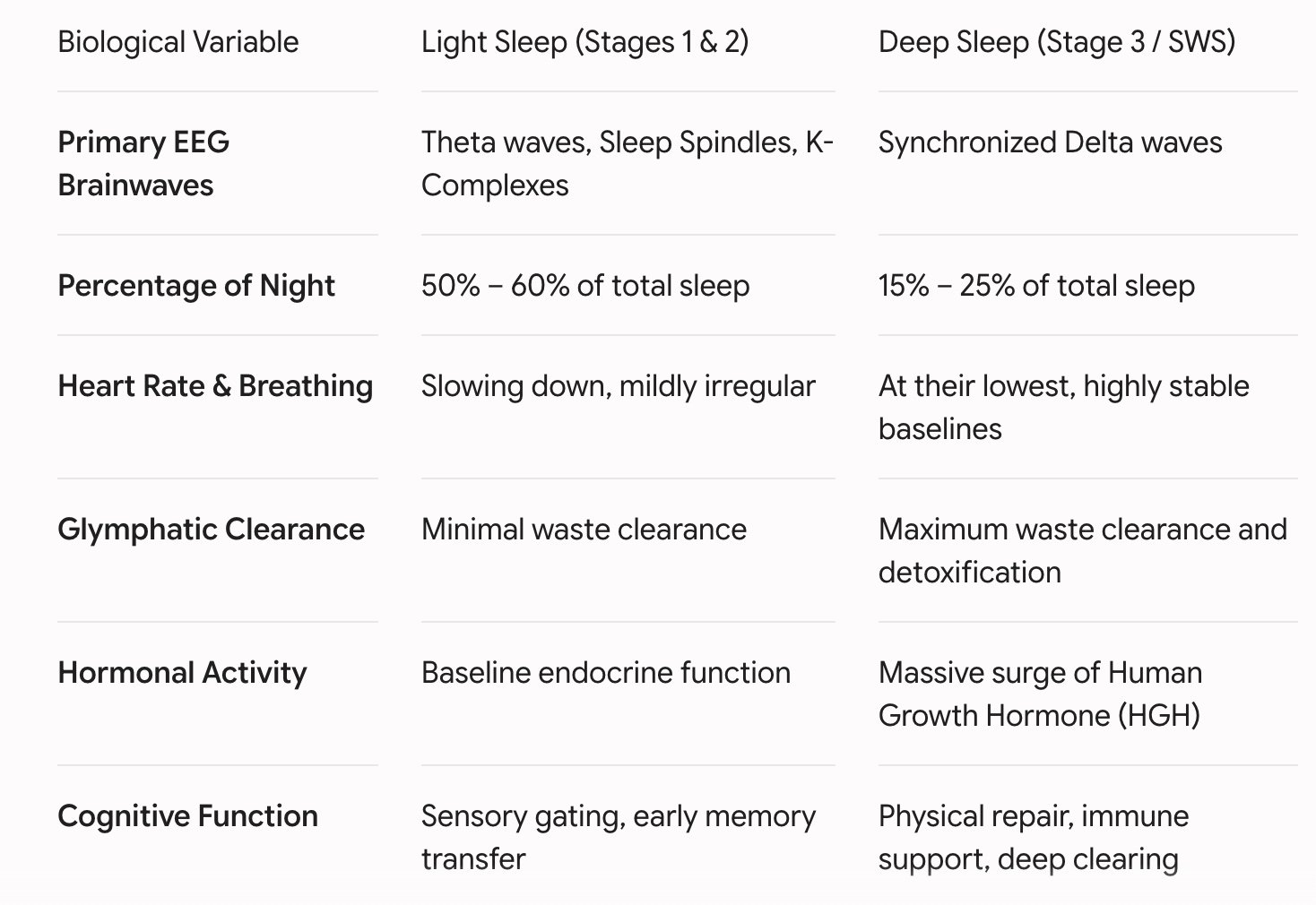
Conclusion: Balancing the Biological Ledger
When the dust settles, biology doesn't treat light sleep and deep sleep as rivals fighting for real estate on your mattress; they are cooperative partners executing a beautifully choreographed nightly dance.
Light sleep acts as the crucial guardian, politely telling the outside world to be quiet while filing away your daily interactions, while deep sleep steps in like a premium, heavy-duty cleaning crew to power-wash your brain, reset your immune system, and fix your physical tissues.
Trying to bypass either phase is a losing game that even the strongest morning espresso can't fix.
By setting up a proper bedtime ritual, keeping your room beautifully cool, and respecting these natural 90-minute biological cycles, you aren't just sleeping—you are actively giving your mind and body the precise tune-up they deserve.
So, turn off the late-night screens, let your brain shift through its gears, and permit yourself to truly rest.
Your cells, your sanity, and everyone who has to interact with you tomorrow morning will certainly thank you.
To learn a bit more about your biofield and how to Release Anxiety for Restorative Sleep, read this next.
Bibliography & Citations
Sanei, S. and Chambers, J.A., 2013. EEG signal processing. John Wiley & Sons.
Read This Next





Disclaimer: This article is for general informational purposes only and does not address individual circumstances, substitute for professional advice, or serve as a basis for decision-making. You should always seek the guidance of a physician or qualified healthcare provider regarding a medical condition, and never disregard or delay seeking professional medical advice due to this content. Any action taken based on this information is entirely at your own risk and responsibility; Energetics, its staff, and its medical advisors disclaim all liability for any inaccuracies, errors, or any personal or professional loss incurred as a direct or indirect consequence of using this content.