What Are the Signs of Quiet Burnout?
Reading Time 4 mins

We all know what classic, explosive burnout looks like.
It is the dramatic, cinematic moment where a colleague throws their hands up in a meeting, slams a laptop shut, and takes an immediate month-long stress leave.
Or it is the breaking point where you find yourself sobbing in your car in the office car park before a Monday morning shift because your nervous system simply cannot handle another single email.
But there is another, much quieter thief of joy and energy operating in our offices and homes today.
It doesn't scream, it doesn't make a scene, and it rarely shows up as a dramatic meltdown.
It is called quiet burnout.
It is the slow, stealthy evaporation of your professional passion, your emotional resilience, and your vital energy. To the outside world—and even to your family—you still look entirely functional.
You are hitting your deadlines, making the school runs, packing the lunches, and replying to messages with the standard polite emojis.
But on the inside, the pilot light has completely gone out.
You are essentially operating like a vintage car that is running entirely on fumes, a prayer, and duct tape—you look perfectly fine sparkling in the driveway, but the moment you try to go up a slight hill, the engine makes a sound like a tin can full of angry wasps and threatens to leave you stranded by the side of the road!
You are operating entirely on autopilot, running on the residual momentum of sheer discipline while feeling increasingly hollow, detached, and exhausted.
Because quiet burnout wears a convincing mask of "just being a bit tired," it is incredibly easy to ignore until your mental and physical health are deeply compromised.
Spotting the subtle biological and psychological red flags early is the only way to step off the treadmill before your body forces a complete stop.
The Biological Spectrum of Exhaustion
Quiet burnout is not a personal failure, a lack of willpower, or just a bad mood—it is a progressive state of nervous system dysregulation.
When you experience chronic, unremitting lifestyle stress without adequate recovery windows, your body’s hypothalamic-pituitary-adrenal (HPA) axis—the master command centre for your stress response—becomes fundamentally exhausted.
[Chronic Lifestyle Stress] ➔ [HPA Axis Overdrive] ➔ [Cortisol Blunting] ➔ [Quiet Burnout / Apathy]
Initially, chronic stress keeps your cortisol and adrenaline spiked, causing high anxiety and frantic overworking. But in the quiet burnout phase, the body flips a biological safety switch.
To protect itself from systemic damage, it blunts its response to stress hormones.
You don't feel panicked or hyper-vigilant anymore; instead, you feel completely numb, flat, and physically weighed down.
The autonomic nervous system becomes trapped in a low-energy "dorsal vagal" survival state, commonly known as the freeze response, where your brain chooses isolation and emotional conservation over active engagement.
5 Subtle Signs You Are "Quietly Burning Out"
If you are trying to determine whether you are just having a demanding month or are actively sinking into a state of quiet burnout, look closely for these five stealthy signs:
1. High-Functioning Cynicism & Detachment
The hallmark of quiet burnout is a shift from engagement to cold detachment. You don't stop doing your job or caring for your family; you just stop investing any emotional currency into them.
You might find yourself mentally rolling your eyes during team meetings, feeling completely uninspired by projects that used to excite you, or treating personal interactions as checkboxes to clear rather than moments to enjoy.
You have become a spectator in your own life.
2. The Fragmented "Tired But Wired" Sleep Cycle
When your cortisol rhythm is completely inverted by prolonged survival mode, your sleep shatters.
You might experience a profound daytime sleepiness that leaves you craving a nap at 3:00 PM, only to find that when you finally turn off the lights at 10:00 PM, your brain refuses to switch off.
Even when you do sleep for a full eight hours, you wake up feeling completely unrefreshed—as if your cells never actually dropped into the deep, restorative slow-wave states required for structural repair.
3. Progressive Cognitive Efficiency Drops
Because chronic stress actively causes structural inflammation in the hippocampus (the brain’s memory and learning hub), your mental processing speed takes a quiet hit.
You might find yourself reading the same paragraph three times just to understand it, losing your train of thought in the middle of a sentence, or taking two hours to draft a simple response that used to take you ten minutes.
4. An Increasingly Degraded Emotional Filter
When you are quietly burning out, your capacity to regulate your emotional responses wears dangerously thin.
You might not explode in public, but you notice a simmering, uncharacteristic irritability just below the surface.
A minor household mess, a slow internet connection, or a small change in family plans can feel like an absolute catastrophe, triggering sudden internal resentment or a desire to completely withdraw into isolation.
5. Physical "Whispers" of Systemic Stress
When the mind refuses to acknowledge exhaustion, the body starts dropping physical hints. Because chronic nervous system activation suppresses baseline immune and digestive function, quiet burnout frequently manifests as:
Tension headaches or a persistently tight jaw from subconscious clenching.
Chronic low-grade digestive issues, bloating, or food sensitivities.
A baseline vulnerability to every single cold or virus circulating in your social circle.
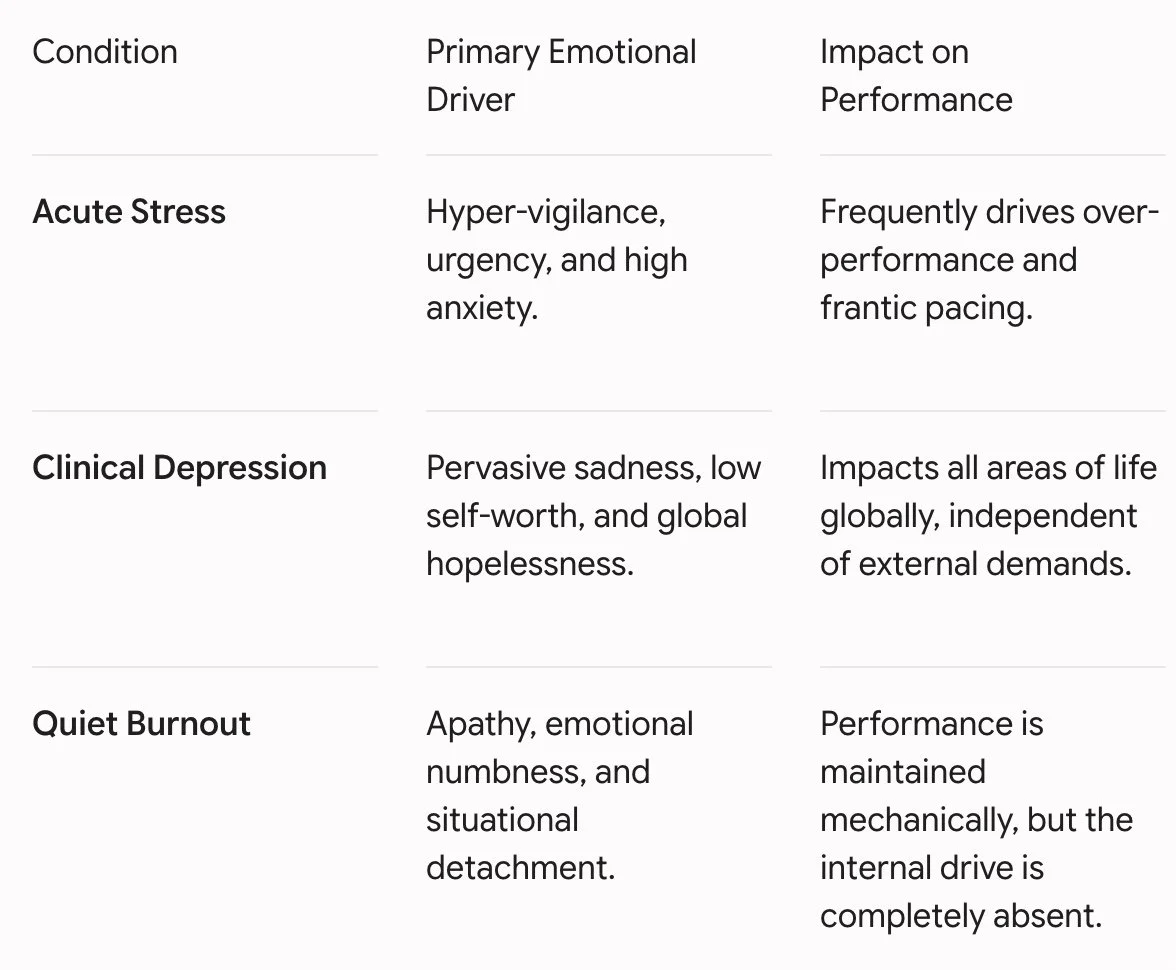
The Core Distinctions: Stress, Depression, and Quiet Burnout
It is highly common to mistake quiet burnout for general life stress or clinical depression.
However, they possess very distinct biological and situational signatures:
Somatic and Biofield Regulation Strategies
You cannot fix an exhausted nervous system by using the same aggressive, analytical drive that broke it.
Forcing yourself to "think positively" or reading complex productivity books will only add to the cognitive overload. Instead, the path back to vitality requires speaking directly to your nervous system through somatic (body-based) and biofield practices that signal absolute safety to the brain.
1. Yoga Nidra (Non-Sleep Deep Rest)
When you are quietly burning out, traditional sitting meditation can sometimes feel incredibly frustrating because an exhausted brain either races or falls straight to sleep.
Yoga Nidra, often referred to as "psychic sleep," is the perfect alternative.
Done lying down under a warm blanket, this systematic, guided relaxation practice guides your brainwaves down from alert beta frequencies into the deeply restorative theta and delta zones.
Just twenty minutes of Yoga Nidra has been shown to deeply rest the nervous system, mimic the cellular restoration of deep sleep phases, and replenish depleted dopamine stores in the brain without requiring any mental effort.
To learn more about the many uses and science of yoga nidra, read this.
2. Targeted Vagus Nerve Exercises
The vagus nerve is the main highway of your parasympathetic nervous system—the internal brake that calms your heart rate, lowers blood pressure, and switches off the stress response.
When you are stuck in autopilot, you can manually stimulate the vagus nerve to pull your body out of the "freeze" state:
The Auricular Massage: The outer ear is packed with nerve endings connected directly to the main branch of the vagus nerve.
Gently massaging the central hollow of your ear (the concha) and earlobes in slow, circular motions for two minutes can trigger an immediate grounding effect.
Low-Frequency Humming or Chanting: Because the vagal nerve passes directly by your vocal cords and larynx, vocal vibrations physically stimulate it.
Taking a deep breath and letting out a sustained, low-pitched "voooo" or "ox" sound on the exhale can quickly reset a tight chest and racing heart.
3. Coherent and Down-Regulating Breathwork
Your breath is the only component of your autonomic nervous system that you can consciously control.
By shifting your breathing patterns, you rewrite the data your brain receives about its environment:
Coherent Breathing: Inhale through your nose for exactly 5 seconds, and exhale smoothly through your nose for 5 seconds.
This creates a rhythm of 6 breaths per minute, optimizing your heart rate variability (HRV) and balancing autonomic tone.
The Physiological Sigh: Take two quick inhales through the nose (one deep inhale, followed immediately by a sharp "top-up" inhale), then let out a long, slow sigh through the mouth.
Doing this just three times instantly pops the alveoli in your lungs, releases accumulated carbon dioxide, and signals the brain to lower its stress output.
4. Mindful Body-Scan Meditation
Instead of trying to empty your mind, use an open-monitoring body-scan meditation to rebuild the connection between your conscious awareness and your physical form.
Spending ten minutes slowly moving your attention from your toes up to the crown of your head, observing sensations without judgment, helps re-engage the insular cortex of the brain.
This calms the overactive amygdala (the brain's alarm bell) and helps dissolve the emotional numbness and high-functioning cynicism that characterize quiet burnout.
Conclusion: Listening to the Whispers
At the end of the day, quiet burnout is your body’s incredibly intelligent, albeit deeply frustrating, way of stage-managing your survival.
It is not a sign that you are weak, incapable, or failing at your life; it is simply your biological operating system gently waving a white flag, letting you know that the current pace is entirely unsustainable.
You do not have to wait for a catastrophic health scare or a public emotional breakdown to earn the right to change your life.
Start listening to the whispers of your exhaustion before they are forced to become screams.
By putting down the heavy burden of trying to be absolutely everything to everyone, setting firm boundaries, and giving your nervous system the genuine, unhurried rest it is begging for through breathwork, vagus exercises, and deep somatic rest, you can slowly clear the gray fog and relight that inner spark.
After all, taking time to regenerate means you get to return to the world as a vibrant, fully awake human being—rather than someone who looks at a simple pile of laundry like it’s Mt. Everest and contemplates calling in mountain rescue just to clear the sofa!
Turn down the external noise, trust what your body is telling you, and take that first gentle step toward recovery today.
To learn about some simple exercises to improve HRV and Vagal Tone, read this next.
Bibliography
Read This Next





Disclaimer: This article is for general informational purposes only and does not address individual circumstances, substitute for professional advice, or serve as a basis for decision-making. You should always seek the guidance of a physician or qualified healthcare provider regarding a medical condition, and never disregard or delay seeking professional medical advice due to this content. Any action taken based on this information is entirely at your own risk and responsibility; Energetics, its staff, and its medical advisors disclaim all liability for any inaccuracies, errors, or any personal or professional loss incurred as a direct or indirect consequence of using this content.