Instant Grounding Techniques for Severe Panic
Reading Time 4 mins

Let’s bypass the textbook pleasantries and speak plainly: a severe, full-scale panic attack does not politely knock on your door and ask if you have five minutes to spare.
It crashes through your psychological boundaries like an uninvited, chaotic house guest at the worst possible moment.
One minute you are sitting in a perfectly normal budget meeting or picking up milk at the local supermarket, and the next, your heart is hammering against your ribs like an escaped convict, your throat feels like it is closing up, and a terrifying wave of adrenaline convinces your brain that you are actively dying.
When you are trapped in that intense biological storm, being told to "just think happy thoughts" or "calm down" is about as helpful as handing someone a teacup to bail out a sinking cruise ship.
Your brain’s executive control centre has completely gone offline, and your evolutionary threat-detection system has taken full control of the wheel.
It is an intensely lonely, frightening experience—but it is also an entirely mechanical one. You are not losing your mind, you are not having a heart attack, and your body isn't actually broken.
You are simply experiencing a massive, temporary autonomic nervous system hijack.
To break that circuit instantly, you don't need a deep philosophical breakthrough; you just need to drop a massive biological anchor right into the physical room you are standing in.
The Neurobiology of Acute Panic
To stop a panic attack in its tracks, we have to look directly at the neurological gears grinding beneath the surface.
Panic begins when the amygdala—the brain’s emotional alarm bell—senses a perceived threat and instantly triggers the sympathetic nervous system's "fight-or-flight" response.
Within milliseconds, a massive flood of adrenaline and cortisol drops into your bloodstream.
[Perceived Threat] ➔ [Amygdala Alarm] ➔ [Sympathetic Flood] ➔ [Hyperventilation & Racing Heart]
This chemical surge causes your blood vessels to constrict, forces your breathing to become shallow and rapid (hyperventilation), and shifts your vision into a narrow tunnel.
Because you are shallow-breathing, your blood's carbon dioxide levels drop, which paradoxically triggers the brain to think it is suffocating, causing you to gasp for even more air.
Grounding techniques work by intentionally introducing competing sensory data and altering your physical mechanics, forcing the brain’s parasympathetic nervous system—the internal braking mechanism—to override the adrenaline loop.
The "Right Now" Anchor: The 5-4-3-2-1 Sensory Reset
When severe panic threatens to completely detach you from reality, your sensory organs are your fastest ticket home.
The 5-4-3-2-1 technique is a highly structured cognitive defusion tool that forces your prefrontal cortex to re-engage by systematically auditing your immediate physical environment.
Do not rush through this. Force yourself to look at the room around you and call these items out loud, or say them clearly inside your mind:
5 Things You Can See: Look past the internal fog and lock your eyes onto specific, concrete objects.
The grain of wood on a desk, a stray clip on a piece of paper, a scratch on the wall, a passing car, or a plant leaf.
4 Things You Can Physically Feel: Shift your awareness entirely down into your tactile receptors.
Notice the firm pressure of your feet pressing flat against the hard floor, the exact texture of your trousers against your fingertips, the cold surface of a desk, or the breeze on your face.
3 Things You Can Hear: Listen past the roaring sound of your own heartbeat.
Identify external, objective noises: the distant hum of a refrigerator, traffic passing outside, a bird chirping, or the clicking of a keyboard in the next room.
2 Things You Can Smell: Engage your olfactory system to shift your brain's focus.
Sniff your wrist to smell your perfume, the scent of a cup of coffee, or the crisp smell of the outside air.
1 Thing You Can Taste: Focus intensely on the current environment inside your mouth.
Notice the lingering taste of mint, toothpaste, or even just the clean taste of a sip of cold water.
Somatic and Vagal Interventions for Rapid De-escalation
If the panic is so intense that you cannot focus on counting your surroundings, you need to use direct, physical interventions that force your physiology to shift from the outside in.
1. Temperature Shocks (Mammalian Dive Reflex)
One of the fastest ways to shut down a runaway panic response is to leverage an ancient evolutionary survival mechanism called the mammalian dive reflex.
When your face detects a sudden drop in temperature, it sends an immediate, high-priority signal via the trigeminal nerve directly to your brainstem.
[Ice Water on Face] ➔ [Trigeminal Nerve Signal] ➔ [Vagus Nerve Activation] ➔ [Immediate Drop in Heart Rate]
Go straight to the nearest bathroom, turn the tap to its coldest setting, and splash freezing water directly onto your face, ensuring you cover your eyes and nose.
Alternatively, press an ice pack or a frozen bag of peas firmly against your eyes and upper cheeks for fifteen seconds while holding your breath.
Your brain will instantly prioritise conserving oxygen, forcing your heart rate to drop by up to 25% within seconds and breaking the physical momentum of the panic attack.
2. The Box-Breathing Emergency Brake
When you are panicked, your instinct is to take large, gasping inhales, which only fuels the hyperventilation cycle.
To fix this, you must control the exhale.
Box breathing is a technique utilised by high-stress professionals and first responders to maintain autonomic balance under direct pressure:
Inhale deeply through your nose for a count of 4.
Hold that air in your lungs for a count of 4.
Exhale smoothly and completely through pursed lips for a count of 4.
Hold your lungs completely empty for a count of 4.
Repeat this cycle exactly four times.
The deliberate pauses stop the hyperventilation loop, balance your blood's oxygen-to-carbon-dioxide ratio, and let your amygdala know that you are not, in fact, running away from a sabre-toothed tiger.
To learn more about how your breath can biohack your wellbeing, read this.
3. Proprioceptive Anchoring and Posture Resets
Panic often makes you want to curl inward or pace frantically. Counteract this by establishing firm, physical boundaries with your environment.
Drop your shoulders away from your ears, unclench your jaw, and press both palms flat against a solid wall or place both feet completely flat on the floor.
Stomp your feet hard against the ground a few times.
This intense proprioceptive feedback (your brain's awareness of where your body is in space) reassures your nervous system that you are structurally supported, grounded, and safe.
Quick Reference: Panic vs. Grounded Mechanics
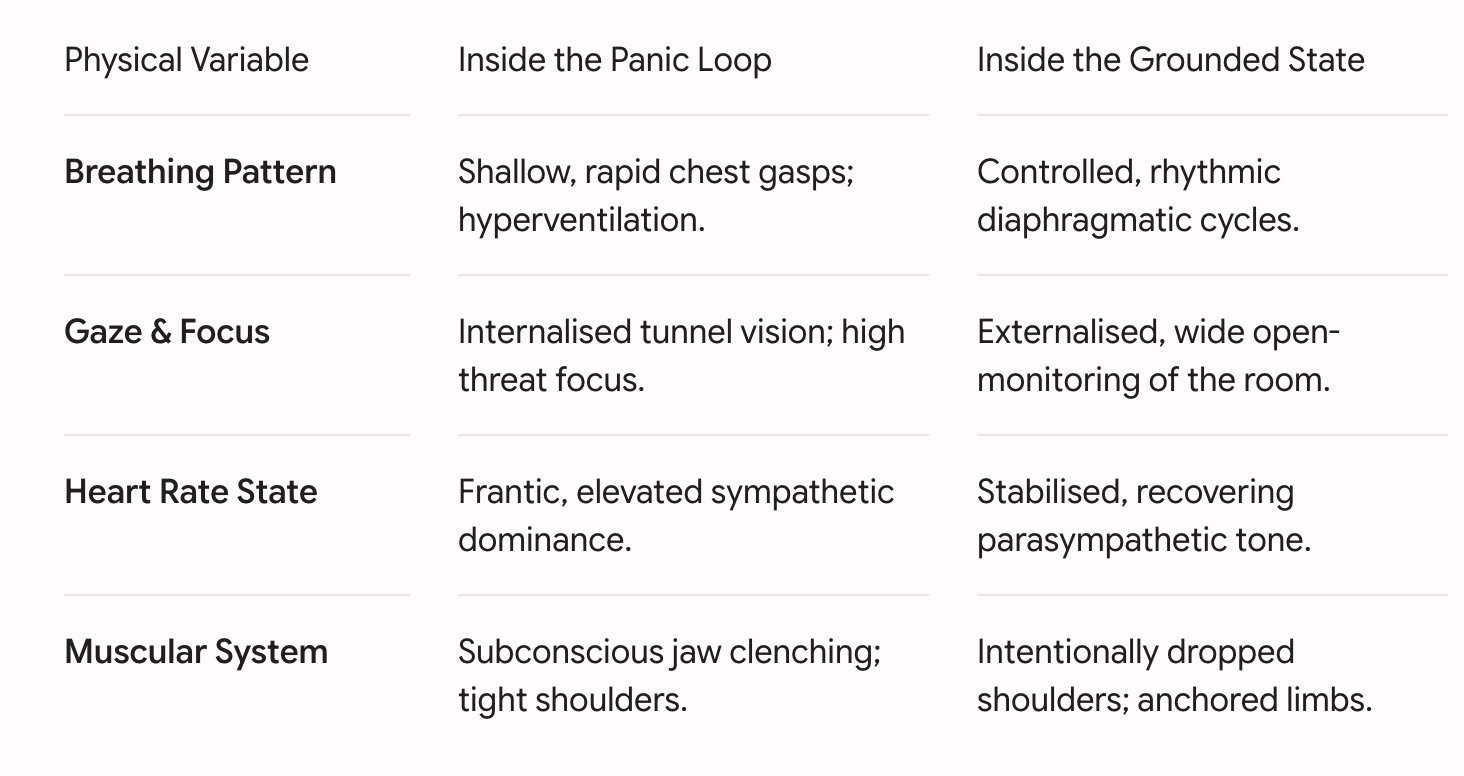
Conclusion: Riding the Wave Back to Shore
At the end of the day, a panic attack is not an emotional defect or a sign that you are fragile; it is simply your body's incredibly enthusiastic, hyper-vigilant defence system throwing an accidental false alarm.
It feels like an absolute lifetime when you are in the thick of it.
Still, biochemically, an adrenaline surge has a strict shelf life—your body literally cannot sustain that level of peak panic for more than about 10 to 20 minutes before the wave naturally breaks.
By stepping away from the internal narrative of fear, anchoring your senses with the 5-4-3-2-1 method, and manually tapping your vagus nerve with a splash of freezing water or a deliberate box-breathing pattern, you are taking back the steering wheel.
You do not have to fight the panic; you have to out-anchor it.
So, drop your shoulders, stomp your feet, and let the storm pass right over you.
After all, reclaiming your physiology means you get to step back into your day as a completely calm, capable human being—and as a bonus, you won't have to explain to your colleagues why you were staring at a water cooler for ten minutes like it was an advanced piece of alien technology!
Take a deep breath, trust your body's design, and anchor yourself right here.
To learn about how to widen your window of tolerance, read this next.
Read This Next





Disclaimer: This article is for general informational purposes only and does not address individual circumstances, substitute for professional advice, or serve as a basis for decision-making. You should always seek the guidance of a physician or qualified healthcare provider regarding a medical condition, and never disregard or delay seeking professional medical advice due to this content. Any action taken based on this information is entirely at your own risk and responsibility; Energetics, its staff, and its medical advisors disclaim all liability for any inaccuracies, errors, or any personal or professional loss incurred as a direct or indirect consequence of using this content.