Signs you are outside your window of tolerance
Reading Time 4 mins

We have all had those moments where we look at our own behaviour in the rear-view mirror and think, Who on earth was that?
Perhaps it was the time you found yourself furiously drafting a four-paragraph response to a mildly critical comment on LinkedIn, your heart hammering against your ribs as if you were preparing for hand-to-hand combat.
Or maybe it was the afternoon you sat in your car outside the supermarket, staring blankly at the steering wheel for forty minutes, completely unable to muster the physical energy to open the car door to buy groceries.
When we look back at these episodes, our cultural default is to blame our character.
We tell ourselves we are too sensitive, too lazy, emotionally dramatic, or completely lacking in professional discipline.
But if you look at these moments through the lens of modern neuroscience, a much kinder, objective reality emerges: you weren’t experiencing a sudden personality flaw; your nervous system had simply breached its structural perimeter.
You were operating entirely outside your Window of Tolerance.
Coined by pioneering psychiatrist Dr Dan Siegel, the Window of Tolerance represents the optimal zone of physiological arousal where your brain and body can process life efficiently.
Inside this window, you can navigate an incredibly high-stakes meeting, receive a piece of stinging feedback, feel a surge of genuine frustration, and still respond with conscious composure.
You remain anchored.
But when stress pushes you past the upper or lower sill of this window, your capacity to rationalise, innovate, and connect vanishes entirely.
Recognising the precise moment you have crossed these biological borders is the single most critical skill in somatic health.
Because you cannot fix a dysregulated system until you identify exactly where it has travelled, here is the expanded clinical manual on the distinct physical, cognitive, and emotional warning signs that you have left your window of tolerance—and how to spot them before a total system crash occurs.
Red Alerts: Signs You Have Broken Through the Ceiling (Hyperarousal)
When life pushes you out of the top of your window, your sympathetic nervous system completely hijacks your biology. This is the Fire Zone. Your brain stem concludes that you are under immediate, existential attack and releases the autonomic brake, flooding your bloodstream with adrenaline and cortisol.
In a modern professional setting, this rarely manifests as physically fighting a predator; instead, it looks like a system trapped on a frantic, high-alert loop, desperately trying to outrun its own shadow.
Here are the clear signs that your nervous system is bouncing off the ceiling:
1. The Physical Shift
Your body acts as an early warning radar long before your conscious mind catches up. In hyperarousal, your heart rate climbs, your breathing becomes fast and shallow, and your muscles unconsciously brace for impact.
You might notice your jaw is tightly clenched, your shoulders are pinned to your ears, or your stomach feels knotted and acidic.
Chronic restlessness, a constant urge to bounce your leg, or a sudden ambient heat in your chest and face are all physical manifestations of trapped, mobilising survival energy.
2. Cognitive Chaos and Racing Thoughts
Inside your window, your thoughts flow like a controlled, strategic river. In hyperarousal, that river bursts its banks. Your mind races at an unmanageable velocity, leaping from one worst-case scenario to the next.
You lose the capacity for deep focus, finding yourself completely unable to read a single page of a report or finish an operational task without getting distracted by a new, imaginary emergency.
3. Emotional Hyper-Reactivity
When you are hovering above your window, your emotional threshold drops to zero. You become hyper-vigilant, scanning your environment for threats that do not exist.
A partner’s neutral expression looks like absolute disapproval; a colleague's short email format feels like an act of deliberate workplace aggression.
You are highly irritable, quick to snap, and easily swept away by waves of overwhelming anxiety, panic, or sudden, explosive anger.
Blue Alerts: Signs You Have Collapsed Through the Floor (Hypoarousal)
When stress is too intense, too prolonged, or simply too overwhelming for your sympathetic system to fight off, your nervous system resorts to its ultimate, primitive insurance policy: the dorsal vagal shutdown. You drop straight through the floorboards of your window into hypoarousal.
This is the Ice Zone. Your system preserves life by pulling the plug on your energy reserves.
It is the biological equivalent of a safety switch tripping in a fuse box to prevent the whole house from burning down. Here are the classic signs that you have slipped into the basement:
1. The Physical Drop
Physically, hypoarousal feels like trying to move your limbs through thick, wet cement.
Your posture slumps, your voice loses its melodic, warm inflection and becomes entirely flat or monotone, and your heart rate and blood pressure drop. You experience a profound, heavy exhaustion that cannot be cured by a good night’s sleep or an extra coffee.
Your digestion often stalls entirely, leaving you feeling bloated, heavy, and physically hollow.
2. Cognitive Numbness and Brain Fog
If hyperarousal is a storm of chaotic noise, hypoarousal is a thick, damp fog. Your capacity to process complex operational data vanishes.
You may find yourself staring at an open laptop screen for an hour, reading the same sentence repeatedly without a single word registering in your consciousness.
Making basic decisions—such as choosing what to wear or deciding what to eat—feels like an impossible intellectual mountain to climb. You are physically present, but cognitively offline.
3. Emotional Disconnection and Flatness
In the ice zone, you do not feel anxious or angry; you feel profoundly detached. A sense of cold numbness settles over your emotional landscape.
You feel completely disconnected from the people around you, watching your life play out like a distant, low-resolution movie.
This state is defined by a feeling of utter helplessness, passivity, and an intense desire to completely isolate yourself from the world, sliding into the background where nothing can touch you.
The Autonomic Landscape
The transition out of your window of tolerance rarely happens in a single, cataclysmic leap. It is typically a gradual slide down the rungs or a steady climb toward the ceiling.
The secret to maintaining inner stability is developing a sharp internal awareness—what neuroscientist Dr Stephen Porges calls tracking your neuroception.
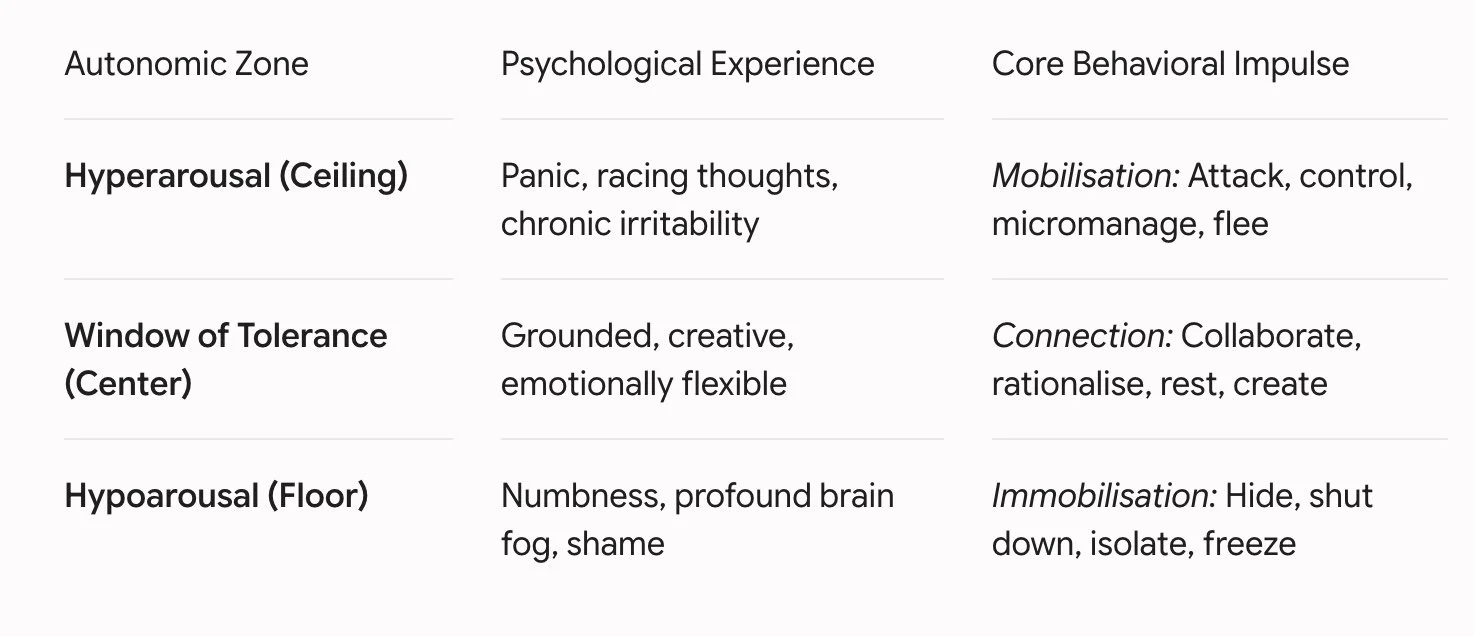
The "Biochemical Hangover"
One of the least discussed aspects of crossing these borders is the inevitable physical aftermath. When you enter hyperarousal or hypoarousal, your body undergoes massive biochemical changes.
Once your nervous system finally claws its way back into the window, you don't instantly feel normal—you experience a profound biochemical hangover.
After a hyperarousal spike, the sudden drop in cortisol and adrenaline leaves your muscles aching, your head throbbing, and your energy completely depleted.
Conversely, crawling out of a hypoarousal freeze can trigger a wave of intense shaking, nausea, or raw emotional vulnerability as your system re-mobilises.
Recognising this hangover as a normal sign of your body recalibrating stops you from misinterpreting this post-stress fatigue as a brand-new problem.
Conclusion: Turning Judgment Into Biological Curiosity
Learning the signs of being outside your window of tolerance completely reconfigures how you view your daily struggles. It allows you to drop the heavy, unhelpful burden of self-blame and replace it with a sense of compassionate, scientific curiosity.
The next time you find yourself overreacting to a minor workplace glitch or freezing in the middle of a routine domestic task, remind yourself that your character isn't broken. Your brilliant, ancient biology has simply left its optimal zone in a well-meaning attempt to protect you from perceived danger.
By treating these signs not as moral failures, but as clear physical invitations to stop, breathe, and apply tactical somatic care, you can gently guide your biology back into its sweet spot.
Trust your body's warnings, honour its boundaries, and you will find your way back to a life lived with genuine space, clarity, and unshakeable inner resilience.
References
van der Kolk BA. Clinical implications of neuroscience research in PTSD. Ann N Y Acad Sci. 2006 Jul;1071:277-93. doi: 10.1196/annals.1364.022. PMID: 16891578. https://pubmed.ncbi.nlm.nih.gov/16891578/
Read This Next





Disclaimer: This article is for general informational purposes only and does not address individual circumstances, substitute for professional advice, or serve as a basis for decision-making. You should always seek the guidance of a physician or qualified healthcare provider regarding a medical condition, and never disregard or delay seeking professional medical advice due to this content. Any action taken based on this information is entirely at your own risk and responsibility; Energetics, its staff, and its medical advisors disclaim all liability for any inaccuracies, errors, or any personal or professional loss incurred as a direct or indirect consequence of using this content.