Rewiring Your Stress Response: A Guide to Nervous System Regulation and Burnout Recovery
Reading Time 4 mins

Let’s be entirely honest with ourselves: we are currently living through an unacknowledged epidemic of chronic survival panic. We treat chronic stress like an unavoidable badge of modern honor—something we actively complain about over a flat white, yet secretly wear like a corporate medal.
We check our work notifications before our eyes have fully focused in the morning, rush through our days with our shoulders glued to our ears, and then wonder why we feel an undercurrent of low-grade irritability when our partner asks what we want for dinner.
We have been profoundly conditioned to believe that stress is merely a psychological inconvenience—an abstract cloud of "worry" that we should simply be mentally tough enough to override.
So, we try to think our way out of exhaustion, or we spend our weekends aggressively trying to force ourselves to "just relax," only to find that our minds keep racing like a high-speed train with no brakes.
But stress does not live exclusively in your thoughts. It is a concrete, full-body event. Your cells do not care about your deadlines; they care about your survival.
When you perceive a threat—whether it is a looming work deadline or a genuine physical emergency—your body initiates the exact same primitive cascade. If you leave that loop open indefinitely, you aren't just feeling "a bit frazzled"—you are actively keeping your cardiovascular, metabolic, and neuroendocrine systems frozen in a high-alert defensive posture.
True calm is not the absence of life's demands; it is the active presence of physiological safety. Whether you are battling deep corporate burnout, struggling with chronic hypervigilance, or simply looking to reclaim your emotional baseline, this guide establishes the definitive clinical framework for true, somatic resilience.
1. The Landscape of Autonomic Architecture
To effectively navigate and downregulate the stress response, we must understand the dual-branch architecture of the Autonomic Nervous System (ANS).
Think of it as a beautifully balanced, self-regulating biological seesaw.
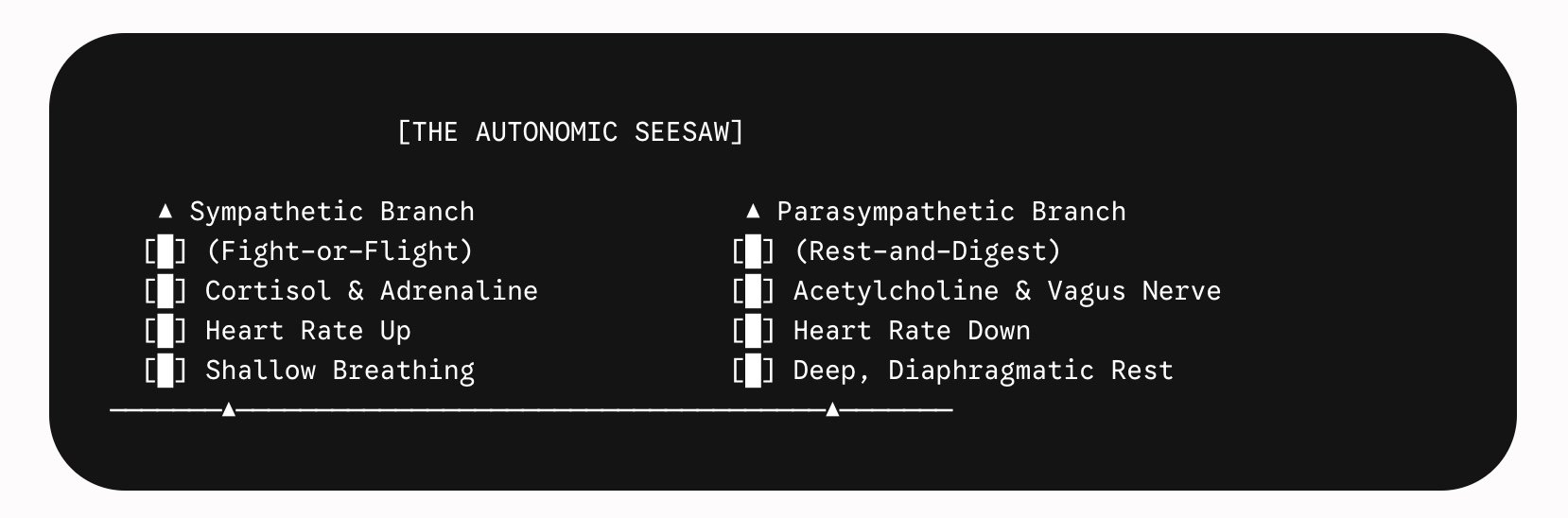
The Sympathetic Branch (The Accelerator)
This is your evolutionary survival mechanism. When your brain perceives a stressor, the sympathetic branch fires instantly, priming your body for immediate physical action.
Adrenaline floods your bloodstream, your heart rate rises, your blood vessels constrict to redirect blood to your major muscle groups, and your respiration becomes rapid and shallow.
Crucially, non-essential survival systems—like digestion, cellular repair, and reproductive hormone manufacture—are immediately offline or severely downregulated.
The Parasympathetic Branch (The Brake)
Driven primarily by the vagus nerve, this branch is responsible for returning your body to homeostasis. When the parasympathetic nervous system dominates, your heart rate variability (HRV) increases, systemic inflammation is actively suppressed, and your body enters a state of deep cellular restoration.
The problem arises when the sympathetic accelerator is permanently pressed down, leaving the parasympathetic braking system entirely unable to engage.
2. Chronic Cortisol Dynamics and HPA Axis Dysregulation
When a stressor persists for weeks or months, the immediate adrenaline response shifts into a long-term hormonal strategy managed by the Hypothalamic-Pituitary-Adrenal (HPA) axis.
Under continuous threat, the hypothalamus releases hormones that ultimately instruct the adrenal glands to pump out a steady stream of cortisol.
Cortisol is a highly effective short-term survival tool—it mobilizes glucose into the bloodstream to keep you moving and dampens immediate immune responses to conserve energy.
However, chronic, unremitting cortisol exposure behaves like an internal corrosive agent.
It fundamentally alters your metabolic baseline, downregulates your sleep architecture by suppressing natural evening melatonin production, and leaves the brain’s emotional center—the amygdala—in a permanent state of hyper-reactivity.
Over time, this continuous demand can lead to HPA axis dysregulation, commonly felt as profound, unshakeable systemic burnout, where your morning cortisol curve is entirely flattened, leaving you feeling completely exhausted yet deeply wired at night.
3. Somatic Intelligence: Moving Beyond "Mind Over Matter."
The reason conventional stress-management advice so often fails is due to a profound misunderstanding of human biology.
Roughly 80% of the fibers in the vagus nerve are afferent—meaning they send information up from the body to the brain, rather than down from the brain to the body.
When your body is tight, your breathing is shallow, and your visceral organs are locked in a defensive posture, it sends a continuous stream of data to your brain saying, "We are in danger."
No amount of logical, positive thinking can override that direct physical signaling.
To achieve authentic, lasting peace, you cannot simply tell your mind to calm down.
You must actively speak the language of the nervous system by utilizing body-based, somatic interventions to signal physical safety directly to the brain.
4. Biofield Dynamics and Subtle Energy Regulation
Beyond the chemical and neurological pathways, stress introduces profound fragmentation into the human biofield—the complex, interconnected matrix of subtle energy that coordinates cellular vitality.
Under chronic stress, our energetic field naturally becomes restricted, hyper-reactive, and defensive.
This structural compression limits the smooth circulation of vital life-force energy, manifesting as localized physical tension, creative blocks, and a general sense of emotional exhaustion.
By deliberately incorporating non-invasive, drug-free biofield therapies into your routine, you can actively gently unravel these blocked, stagnant patterns.
These practices work collaboratively with your nervous system, clearing the energetic signatures of historical stress and allowing your body's self-healing mechanisms to fully activate.
5. The Core Resource Directory (Deep Dives)
Reclaiming your physiological baseline requires moving past generic lifestyle platitudes and turning toward precise, clinically validated, non-drug interventions. Use the directory below to explore some helpful science-backed protocols and insights.
The Biology of Stress: Practical Tools for Your Body & Mind
Master your biological seesaw with our clinical breakdown of advanced somatic and autonomic regulation. Discover how neural pathways dictate your stress response by exploring Polyvagal theory explained clearly, and learn practical, evidence-based Exercises to improve Vagal Tone and HRVto actively downregulate hypervigilance.
To effectively manage emotional and physiological reactivity, it is essential to understand your nervous system's capacity. Start by asking, What is the window of tolerance in psychology?, and learn to identify the distinct Signs you are outside your window of tolerance—whether you lean toward hyperarousal or functional shutdown.
If you experience the latter, it is critical to understand the Difference between depression and hypoarousal so you can apply the correct clinical protocols for HPA axis restoration and burnout recovery. Finally, equip yourself with actionable strategies on: How to widen your window of tolerance -to permanently build psychological resilience and reverse cortisol fatigue.
6. The Path to Sustained Somatic Resilience
Ultimately, learning to stress less is not about transforming into a perfectly detached, unemotional being who is entirely unfazed by the world.
It is about building an extraordinarily responsive, resilient nervous system that can step up to meet a challenge with absolute clarity, and then drop effortlessly back into a state of deep, restorative rest the exact moment the challenge has passed.
Consider this hub page your permanent sanctuary.
As our platform expands, this guide will serve as the anchor for a comprehensive, highly interconnected ecosystem of science-backed spoke articles. We will focus entirely on exceptional, holistic, non-drug protocols—rooted deeply in clinical science and proven to be highly effective—to help you systematically unravel stress, restore your adrenal vitality, and live from a place of grounded somatic peace.
For now, drop your shoulders away from your ears, release your jaw, take a long, slow exhalation, and let us begin guiding your nervous system home.
Read This Next





Disclaimer: This article is for general informational purposes only and does not address individual circumstances, substitute for professional advice, or serve as a basis for decision-making. You should always seek the guidance of a physician or qualified healthcare provider regarding a medical condition, and never disregard or delay seeking professional medical advice due to this content. Any action taken based on this information is entirely at your own risk and responsibility; Energetics, its staff, and its medical advisors disclaim all liability for any inaccuracies, errors, or any personal or professional loss incurred as a direct or indirect consequence of using this content.