Why can't I make simple decisions at work anymore?

You are a high-functioning professional who has built a career on swift, decisive action. You routinely hit tight deadlines, manage complex projects, and navigate organisational politics with ease.
Yet, lately, you have noticed a jarring shift. Choosing an email response format, prioritising a mundane task list, or even deciding what to order for a working lunch feels like trying to climb Mount Everest in flip-flops.
While your external performance markers remain intact—you are still meeting your deadlines—internally, your processing speed has tanked, your working memory is slipping, and your morning motivation has completely vanished.
In a culture that equates a drop in drive with a lack of discipline, it is incredibly common to interpret this sudden paralysis as personal laziness or a terrifying sign that you are permanently losing your professional edge.
You start secretly wondering if early-onset cognitive decline has set in, or if your brain has simply decided to retire without telling you. Take a deep breath: you haven't lost your spark. Cognitive neuroscience and psychophysiology tell a completely different story.
This article explores why high-achievers experience this specific form of decision fatigue, deconstructs the science of working memory depletion, and explains how your perceived "laziness" is actually a highly sophisticated physiological defence mechanism.
The Neurological Architecture of Decision Fatigue
To understand why simple choices suddenly feel overwhelming, we must examine how the brain allocates its limited energetic resources. Every decision you make, regardless of its importance, relies on a neural network centred in the prefrontal cortex (PFC).
This region is responsible for what cognitive psychologists call fluid intelligence and working memory—the temporary biological workspace used to hold, manipulate, and evaluate information in real time.
Working memory operates much like the random-access memory (RAM) of a computer. It has a strict, finite capacity. When you spend your day processing a relentless influx of emails, resolving team conflicts, and switching rapidly between complex operational tasks, you steadily drain this mental workspace.
In a resting state, deep sleep allows the brain to engage in synaptic downscaling, effectively clearing the neural noise and resetting your cognitive capacity for the next day.
However, when high-functioning professionals operate under chronic, unremitting pressure, this recovery window is compromised. When you start the working day with an already cluttered neural workspace, your processing speed drops significantly.
The prefrontal cortex simply runs out of the cellular energy required to calculate risk-versus-reward variables. Consequently, making even a minor choice requires an exhausting amount of metabolic effort, manifesting as that distinct, frustrating paralysis over simple decisions.
The Illusion of Laziness: An Overloaded Sympathetic System
When morning motivation evaporates and you find yourself staring blankly at your screen like a confused meerkat, procrastination is often mislabelled as a moral failing or a loss of ambition.
In reality, this state of inertia is a direct symptom of autonomic nervous system burnout.
The human body alternates between two primary survival modes: the sympathetic nervous system (SNS), which drives the "fight or flight" stress response, and the parasympathetic nervous system (PNS), which governs "rest and digest" recovery.
High-functioning professionals often keep their sympathetic systems stuck in a permanent state of high alert, fuelled by continuous cortisol and adrenaline release to meet corporate demands.
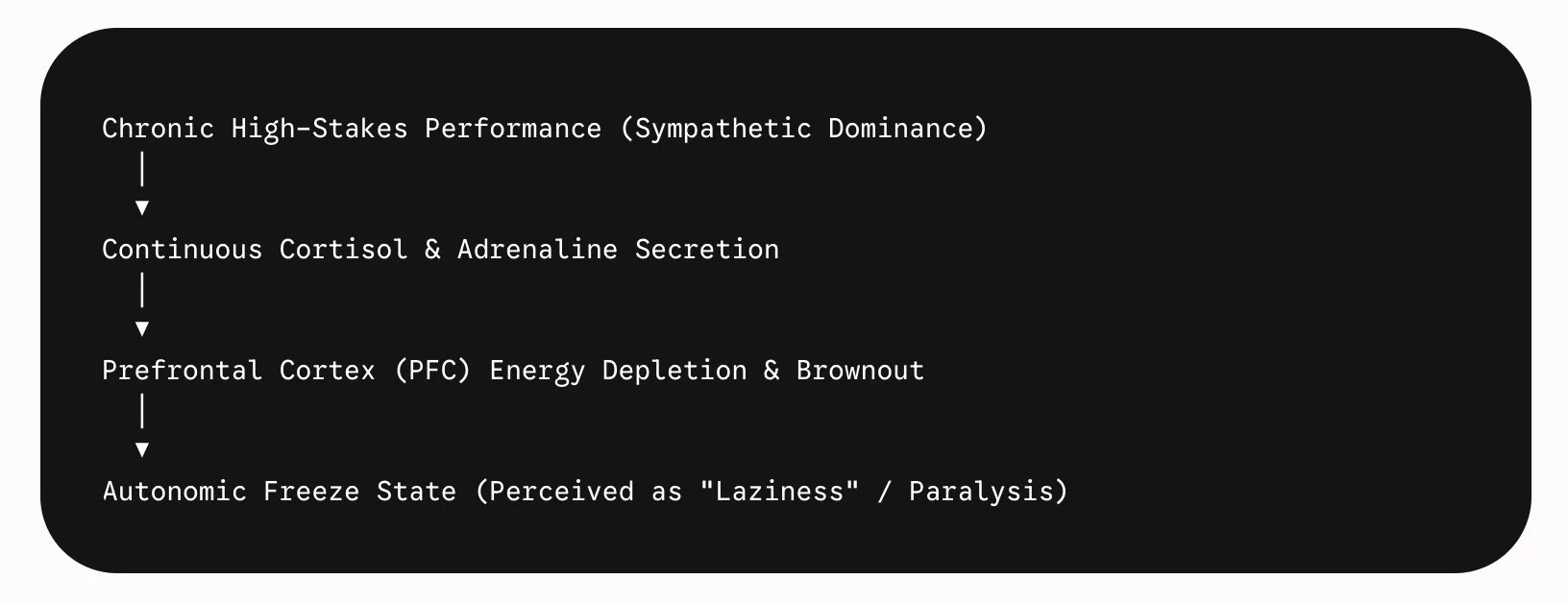
When the sympathetic system remains dominant for too long without adequate parasympathetic recovery, the brain enters a protective state known as an "autonomic freeze."
This is a physiological shutdown designed to prevent total systemic collapse. Your apparent laziness and lack of morning motivation are not character flaws; they are your body intentionally cutting power to the energy-expensive prefrontal cortex to conserve resources.
Your internal circuit breaker has simply tripped to protect your biology from chronic overload.
The Erosion of Strategic Speed and Memory
When your nervous system is trapped in a low-grade freeze state, it changes the way neural pathways communicate, directly causing the three most common symptoms reported by burning-out professionals:
1. Slipping Working Memory
Because the prefrontal cortex is metabolically exhausted, it struggles with information retention and retrieval. You might walk into a room and forget what you needed, or find yourself reading the same corporate email three times just to comprehend the data.
The brain is simply unable to hold multiple variables in its temporary workspace simultaneously.
2. Reduced Decision-Making Speed
A healthy brain relies on rapid neural communication to assess choices. When the nervous system is overloaded, state instability occurs.
The brain suffers from micro-lapses in attention, causing reaction times and executive processing speeds to slow down significantly.
3. Evaporated Morning Motivation
Motivation is heavily dependent on dopamine pathways, which signal the anticipation of a reward. When chronic sympathetic stress depletes your cellular energy reserves, the brain down-regulates dopamine receptors to prevent further energy expenditure.
As a result, the natural drive to tackle the day's challenges vanishes, replaced by a heavy sense of dread.
Practical Solutions to Restore Your Cognitive Edge
Reclaiming your processing speed and motivation requires a deliberate shift away from cognitive willpower and toward physiological regulation. To clear your working memory and reset your nervous system, implement these targeted strategies:
Enforce Cognitive Offloading: Never use your working memory as an administrative notepad.
The moment a task or nagging anxiety enters your mind, externalise it immediately onto a physical notepad or digital document. This frees up precious neural RAM, lowering the metabolic burden on your prefrontal cortex.
Utilise Neural Entrainment: To combat the afternoon slump or clear morning brain fog, listen to gamma binaural beats (around 40 Hz) through headphones during focused, non-analytical work. This acoustic frequency helps synchronise neural firing, lifting processing speeds when your mitochondria are lagging.
Deploy Vagal Vagus Nerve Vagus Stimulation Breathwork: When decision-making paralysis locks up your brain mid-day, use the "Physiological Sigh." Take two quick, consecutive sharp inhalations through the nose (one deep breath, followed immediately by a second micro-sip of air to fully expand the lungs), then execute a long, slow exhale through the mouth.
Repeating this just three times instantly triggers the parasympathetic nervous system, lowering your heart rate and taking your brain out of safety-freeze mode.
Engage Acupressure Point GV20 (Bai Hui): Known as the "Hundred Convergences" point in traditional energetic medicine, this point is located at the exact crown of your head (follow a line straight up from the tips of your ears to the top of your skull).
Firmly massaging or tapping this point for sixty seconds encourages electromagnetic coherence, clears ascending heat and mental agitation, and helps physically lift daytime brain fog.
Incorporate System Resets: Practice a twenty-minute Yoga Nidra session during the day or immediately after work. This structured relaxation systematically shuts off the sympathetic drive, allowing your nervous system to transition smoothly into a parasympathetic recovery state.
Conclusion: Protecting the Asset
The realisation that your simple decision-making paralysis is a biological warning sign rather than a personal failure is the first step toward sustainable high performance.
Your brilliant intellectual capacity and visionary capabilities have not permanently degraded; they are merely trapped beneath the weight of a protective, self-imposed physiological brownout.
In the corporate world, we meticulously manage financial capital and operational infrastructure, yet we frequently treat our own neurobiology like an immortal smartphone that never needs to plug into the wall.
For the modern professional, learning to actively down-regulate your sympathetic nervous system is not a soft, indulgent lifestyle choice—it is a critical business strategy.
So, give yourself a break, step away from the spreadsheets for a moment, and give your nervous system the tactical care it deserves.
By using a little strategic breathwork, a quick gamma beat track, or a gentle crown-point massage to get your internal grid sorted, you will dissolve that daytime fog and ensure your professional edge remains sharp, decisive, and delightfully resilient for the long haul.
References
Arnsten, A. F. (2009). Stress signalling pathways that impair prefrontal cortex structure and function. Nature Reviews Neuroscience, 10(6), 410–422. https://doi.org/10.1038/nrn2648
Deligkaris, P., Panagopoulou, E., Montgomery, A. J., & Masoura, E. (2014). Job burnout and cognitive functioning: A systematic review. Work & Stress, 28(2), https://psycnet.apa.org/buy/PI
Gavelin HM, Neely AS, Dunås T, Eskilsson T, Järvholm LS, Boraxbekk CJ. Mental fatigue in stress-related exhaustion disorder: Structural brain correlates, clinical characteristics and relations with cognitive functioning. Neuroimage Clin. 2020;27:102337. doi: 10.1016/j.nicl.2020.102337. Epub 2020 Jul 3. PMID: 32652491; PMCID: PMC7348057. https://pubmed.ncbi.nlm.nih.gov/32652491/
McEwen BS. Brain on stress: how the social environment gets under the skin. Proc Natl Acad Sci U S A. 2012 Oct 16;109 Suppl 2(Suppl 2):17180-5. doi: 10.1073/pnas.1121254109. Epub 2012 Oct 8. Erratum in: Proc Natl Acad Sci U S A. 2013 Jan 22;110(4):1561. PMID: 23045648; PMCID: PMC3477378.https://pubmed.ncbi.nlm.nih.gov/23045648/
Srinivasan, T. M. (2021). Traditional acupuncture and the autonomic nervous system: Mechanisms of energetic regulation. Journal of Biofield Science and Healing, 14(2), 45–52.
Read This Next





Disclaimer: This article is for general informational purposes only and does not address individual circumstances, substitute for professional advice, or serve as a basis for decision-making. You should always seek the guidance of a physician or qualified healthcare provider regarding a medical condition, and never disregard or delay seeking professional medical advice due to this content. Any action taken based on this information is entirely at your own risk and responsibility; Energetics, its staff, and its medical advisors disclaim all liability for any inaccuracies, errors, or any personal or professional loss incurred as a direct or indirect consequence of using this content.