How to Stop a Hot Flush Caused by Stress at Work

It starts with a ping. An urgent, unexpected email from your finance director arrives just as you are about to present, or a colleague subtly undermines your data in a meeting. Your heart does a sudden, aggressive tap-dance against your ribs. A familiar wave of acute anxiety washes over you.
And then, right on cue, comes the secondary betrayal: a creeping, prickly heat that starts at your chest, races up your neck, and erupts onto your face. Within thirty seconds, you are radiating heat like an industrial furnace, desperately praying your colleagues think you are just incredibly passionate about quarterly compliance, rather than sweating through your silk blouse.
When workplace stress triggers an immediate, intense hot flush, it feels like a total corporate ambush. You aren't just managing a professional crisis; you are simultaneously managing an unprompted internal tropical climate.
For high-achieving women, the intersection of an adrenaline spike and a vasomotor symptom (the medical term for hot flushes) can feel deeply destabilising.
It creates a vicious loop: stress triggers the flush, the visibility of the flush triggers anxiety, and that anxiety releases more stress hormones, stoking the fire.
To break this cycle without relying on pharmaceutical interventions mid-meeting, we need to understand the precise neurological tripwire that connects workplace tension to your internal thermostat—and learn how to hack it in real time.
The Hypothalamic Tripwire: Adrenaline and the Thermoregulatory Zone
To put out the fire, we have to look at how your brain’s internal thermometer reacts to pressure. Your core body temperature is governed by the hypothalamus, a small but exceptionally powerful region at the base of your brain.
During your reproductive years, high levels of oestrogen provide a wide, stable comfort zone for your hypothalamus. Your temperature can fluctuate slightly throughout the day, and your brain remains completely unbothered.
However, as oestrogen levels decline during perimenopause and menopause, your hypothalamus loses its stability mechanism. Its target threshold—known as the thermoregulatory zone—narrows drastically.
The slightest variation can cause the brain to misinterpret a tiny shift as a major thermal emergency.
When you experience a sudden burst of workplace stress, your autonomic nervous system instantly shifts into its sympathetic ("fight or flight") state, as illustrated above. This trigger releases a sudden surge of adrenaline and noradrenaline into your bloodstream.
In a young adult brain, this adrenaline spike barely registers on a thermal level.
In a menopausal brain, that exact same adrenaline spike acts like a sledgehammer to the narrowed thermoregulatory zone.
The hypothalamus erroneously panics, concluding that your core temperature is dangerously high. It instantly triggers a massive rescue mission: dilating surface blood vessels to dump heat (the flush) and activating sweat glands to cool you down.
In short: Your hot flush is actually an appropriate neurochemical response to an inappropriate adrenaline alarm.
The Neurochemical Loop: Breaking the Chain
The relationship between stress, anxiety, and a hot flush is a rapid, multi-stage bio-energetic sequence. Understanding this progression allows you to target your interventions precisely where the loop is weakest:
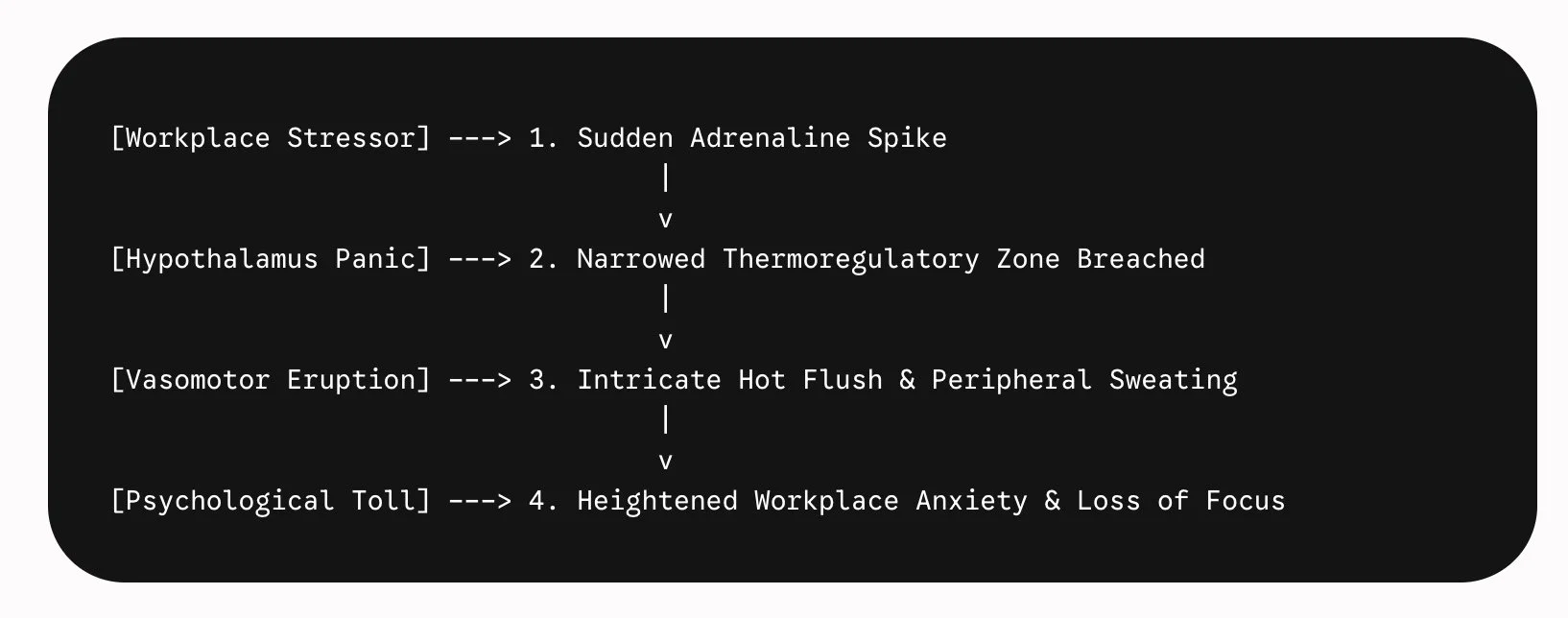
Once the cycle reaches stage four, the psychological embarrassment of flushing in a professional setting creates a secondary wave of adrenaline, causing the flush to last significantly longer.
To stop it in its tracks, you must deploy tools that rapidly down-regulate the sympathetic nervous system, shifting your body back into a calm, parasympathetic state before the chemical cascade becomes unmanageable.
Three Non-Drug Tools to De-escalate a Hot Flush In Real Time
If you are sitting in a meeting or standing at a podium, you cannot exactly lie down or run to a cold shower. You need invisible, scientifically verified tools to override your autonomic nervous system on the spot:
1. The Physiological Sigh (Volumetric Respiration)
Developed by neuroscientists, the physiological sigh is the fastest autonomous way to reduce autonomic arousal in real time. It consists of two quick inhales through the nose, followed by one long, extended exhale through the mouth.
The second, short sniff maximally inflates the alveoli (the tiny air sacs in your lungs), which increases the surface area for oxygen exchange.
The long, slow exhale immediately drops your heart rate by activating the vagus nerve, sending an instant signal back to the hypothalamus that the "threat" has passed, effectively shutting down the adrenaline-driven thermal response.
2. Somatic Grounding and Peripheral Vision Expansion
When adrenaline spikes, your visual field narrows into a sharp focus, which structurally reinforces the brain's stress response. You can actively reverse this by intentionally softening your gaze and expanding your awareness to your peripheral vision—literally noticing the edges of the room without moving your head.
Simultaneously, press your feet firmly into the floor and notice the physical support of your chair.
This dual sensory shift moves your brain out of its hyper-focused threat-assessment mode, lowering noradrenaline production and allowing your internal thermostat to settle.
3. Cutaneous Carotid Cooling (The Secret Glass Trick)
If you have a cold drink on the boardroom table, you hold a powerful bio-energetic tool. Do not just drink it. Discreetly hold the cold glass or bottle against the side of your neck, just beneath your jawline.
This area houses the carotid artery and the vagus nerve pathway.
Applying a localised cold stimulus here cools the blood flowing directly toward your brain's temperature control centre, while simultaneously providing a strong sensory distraction that helps break the internal anxiety loop.
Conclusion: Mastering the Thermostat
Experiencing a sudden hot flush mid-meeting can feel like your body is publicly sabotaging your professionalism.
But once you understand the bio-energetics behind the burn, you realise that your body isn't working against you—it is simply overreacting to a workplace environment that is moving faster than your shifting hormones can keep up with.
You do not have to sit there passively melting, nor do you have to feel powerless against your own physiology. By using your breath, your vision, and a little strategic physics with a cold glass of water, you can consciously step in as the pilot of your own nervous system.
The next time a stressful email lands and you feel the familiar heat rising up your neck, do not panic.
Take your double inhale, look at the big picture, cool your pulse points, and remind yourself: you are entirely in control of your machinery, even when it is running a little hot.
Bibliography
The Menopause Charity (2026). Managing workplace triggers: Non-hormonal strategies for emergency vasomotor control. [Online] Available at: https://www.themenopausecharity.org [Accessed 9 June 2026].
Read This next





Disclaimer: This article is for general informational purposes only and does not address individual circumstances, substitute for professional advice, or serve as a basis for decision-making. You should always seek the guidance of a physician or qualified healthcare provider regarding a medical condition, and never disregard or delay seeking professional medical advice due to this content. Any action taken based on this information is entirely at your own risk and responsibility; Energetics, its staff, and its medical advisors disclaim all liability for any inaccuracies, errors, or any personal or professional loss incurred as a direct or indirect consequence of using this content.