Crushing Afternoon Fatigue During Menopause

You know the exact moment. It is 2:14 PM on a Tuesday. You are sitting in a boardroom, your eyes locked onto a slide deck titled “Strategic Synergy for Q3.” Your managing director is passionately discussing deliverables, but your brain has completely detached from reality. A heavy, leaden weight has settled over your limbs. Your eyelids feel like they are being pulled down by industrial magnets. You are no longer thinking about strategy; you are calculating whether it is socially acceptable to slip under the table for a twenty-minute power nap, or if you can micro-sleep for three seconds every time you blink.
This isn't your standard "ate too many carbs at lunch" sluggishness. This is a sudden, crushing, bone-deep physical exhaustion that makes sitting upright feel like a dynamic core workout.
For high-achieving women navigating perimenopause and menopause, this early afternoon collapse can feel deeply alarming. You are used to outworking everyone in the room, yet here you are, being thoroughly defeated by a 2:00 PM calendar invite.
Before you blame your work ethic or assume your body is completely breaking down, let's look at the underlying cellular biology. This mid-afternoon wall is not a personal failure—it is a direct consequence of a massive hormonal and metabolic renegotiation happening at a cellular level.
The Master Regulators: Oestrogen, Progesterone, and ATP
To understand why your energy levels drop off a cliff just after lunch, we have to examine the master fuel production system of your cells. Every ounce of your physical stamina depends on adenosine triphosphate (ATP), the energy currency produced by your mitochondria (the powerhouses of your cells).
For decades, your mitochondria have relied on a steady supply of two major hormonal co-factors to keep ATP production seamless: oestrogen and progesterone.

When menopause approaches, this dual-regulatory system encounters severe turbulence:
1. The Oestrogen Crash and Glucose Starvation
Oestrogen is a primary metabolic driver. In both your muscles and your brain, oestrogen directly stimulates glucose transport and uptake. It ensures that the sugar in your bloodstream can actually enter your cells to be converted into physical energy. During menopause, as oestrogen levels fluctuate wildly and ultimately plummet, your cells experience a form of localized fuel starvation. The glucose is in your blood, but the hormonal key required to unlock the cellular doors is missing. When your body tries to draw on energy for an afternoon stretch of cognitive and physical output, the engine simply stalls.
2. The Progesterone Paradox and Sleep Architecture
Progesterone is your body’s natural valium. It binds to GABA receptors in the brain, promoting deep, restorative slow-wave sleep. As progesterone production drops during menopause, your sleep architecture becomes severely compromised. Even if you manage to stay in bed for seven hours, a lack of progesterone means you are spending far less time in the deep, physically restorative phases of sleep. You wake up already operating on an energy deficit, leaving you highly vulnerable to an early afternoon crash.
The Cortisol Tug-of-War: The HPA Axis Malfunction
The mid-afternoon wall is further exacerbated by an intimate dance between your ovaries and your adrenal glands, known as the Hypothalamic-Pituitary-Adrenal (HPA) axis.
In a healthy system, your body follows a strict diurnal cortisol rhythm. Cortisol (your primary alertness hormone) should peak sharply in the morning to get you out of bed, gradually glide downward throughout the day, and hit a stable low point in the evening.
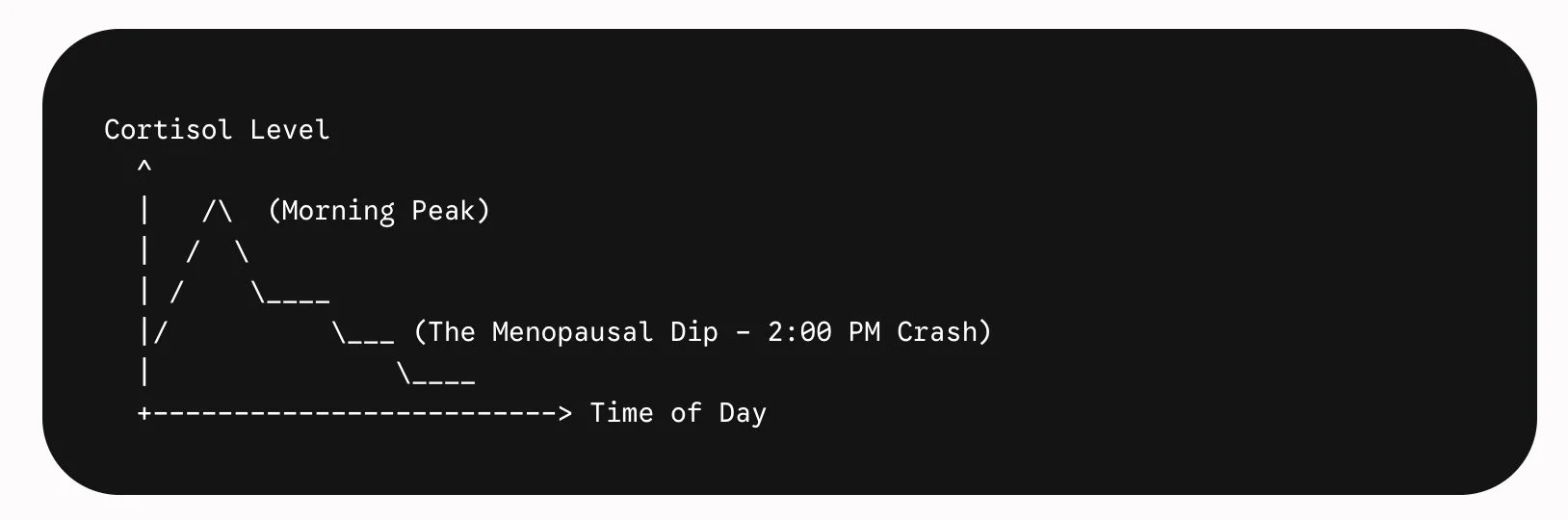
When oestrogen and progesterone drop, the nervous system loses its primary buffering mechanisms, making you highly sensitive to stress. High-achieving women often compensate for morning sluggishness by driving up their cortisol artificially through back-to-back meetings, intense focus, and extra caffeine.
By 2:00 PM, this artificial adrenaline surge completely burns out. Because the body's baseline hormonal support is gone, your cortisol levels do not just glide downward—they plummet off a cliff. This creates a severe mismatch between your schedule's demands and your body's biochemical reality.
Decoupling the Deficit: Menopausal Fatigue vs. Chronic Illness
Because the exhaustion hits so suddenly, it is easy to worry that you are developing an autoimmune condition or a systemic illness. To understand what is happening inside your cells, we can contrast the distinct physiological patterns of menopausal fatigue against chronic fatigue profiles:
The Underlying Mechanism
Menopausal Fatigue: Driven by predictable circadian and metabolic drops tied directly to fluctuating ovarian hormones that regulate cellular fuel intake.
Chronic Fatigue: Rooted in persistent immune dysregulation, viral reactivation, or systemic nervous system inflammation.
The Timing and Rhythm
Menopausal Fatigue: Characterised by a diurnal and cyclical pattern. It concentrates heavily in the early afternoon (1:00 PM – 4:00 PM), and your energy often rebounds slightly in the evening once the circadian dip passes.
Chronic Fatigue: Feels persistent and unremitting. The exhaustion is profound the moment you open your eyes and rarely fluctuates regardless of the hour.
Response to Physical or Mental Effort
Menopausal Fatigue: You can generally still use a spike of adrenaline or willpower to push through a temporary workplace crisis, even though you will likely pay a steep metabolic price for it the next day.
Chronic Fatigue: Triggers Post-Exertional Malaise (PEM), where even minor physical or cognitive effort can result in a severe, multi-day systemic crash that leaves you bedridden.
Accompanying Biomarkers
Menopausal Fatigue: Frequently overlaps with distinct thermoregulatory shifts (like hot flushes or night sweats) and variable menstrual cycles.
Chronic Fatigue: Commonly travels with systemic symptoms like low-grade fevers, swollen lymph nodes, or widespread joint and muscle pain.
Actionable Bio-Energetic Strategies to Reclaim Your Afternoon
To bridge this mid-afternoon energetic gap, you must actively assist your mitochondria and support your shifting endocrine pathways:
Implement Circadian Light Triage: Step outside or look directly into a high-lux daylight lamp for 10 minutes at precisely 1:30 PM. This exposure suppresses melatonin production and provides a natural, non-chemical signal to your HPA axis to stabilise cortisol output.
Utilise Micro-Dosing Movement: Before the fatigue hits, engage in 3 to 5 minutes of resistance-based movement (such as bodyweight squats or wall pushes). Muscle contractions stimulate glucose transporters (GLUT4 receptors) independently of oestrogen, forcing fuel into your cells without needing a hormonal key.
Re-engineer Your Lunch Macro-Profile: Avoid the classic trap of a carbohydrate-heavy lunch or a complete lack of food. Opt for high-quality protein and fats (like wild salmon, eggs, or avocado) combined with leafy green vegetables to prevent insulin spikes that accelerate the 2:00 PM crash.
Conclusion: Re-calibrating the Machine
Sitting through a two-hour strategic meeting when your body is experiencing a literal cellular power outage is an exercise in pure willpower. But remembering that this is a predictable, biochemical event can completely change how you handle it.
You are not becoming lazy, you are not losing your drive, and you certainly haven't lost the capacity to lead. Your body is simply undergoing a massive industrial upgrade, shifting from a system fueled by high oestrogen to one that requires more deliberate, conscious metabolic management.
So the next time you find yourself staring blankly at a spreadsheet at 2:30 PM, fighting the urge to rest your forehead on the keyboard, give yourself a moment of grace.
Slip out of the room, get some natural light, move your muscles, and remind yourself that the machine isn't broken—it's just re-routing its power grid.
Bibliography
British Menopause Society (2026). Fatigue, sleep architecture, and the role of progesterone in perimenopausal women. [Online] Available at: https://www.thebms.org.uk [Accessed 9 June 2026].
Read This next






Disclaimer: This article is for general informational purposes only and does not address individual circumstances, substitute for professional advice, or serve as a basis for decision-making. You should always seek the guidance of a physician or qualified healthcare provider regarding a medical condition, and never disregard or delay seeking professional medical advice due to this content. Any action taken based on this information is entirely at your own risk and responsibility; Energetics, its staff, and its medical advisors disclaim all liability for any inaccuracies, errors, or any personal or professional loss incurred as a direct or indirect consequence of using this content.