Does helping others actually make you happier?
Reading Time 4 mins

Picture this: it is a brisk, drizzly Saturday morning, and every logical fibre of your being is screaming at you to stay wrapped up under your duvet with a steaming mug of tea.
Instead, through some inexplicable lapse in judgement, you have volunteered to spend four hours shivering in a drafty church hall, helping your local community group heave heavy folding tables, untangle fifty metres of stubborn fairy lights, and sort through mounds of donated knitwear.
Your feet are cold, your hands are dusty, and yet, as you hand a piping-hot cuppa to a fellow tired volunteer and watch the room transform, something deeply peculiar happens inside your chest.
You don't feel aggrieved, exhausted, or bitter. In fact, you feel ridiculously light, absurdly warm, and quietly euphoric—as if you've just swallowed a cup of pure, liquid sunshine.
This unexpected emotional lift is one of the most delightfully upside-down paradoxes of human nature.
To see how this fits into our guide to happiness, you can read our master directory.
We live in an era that aggressively preaches relentless self-care, where we are told that the ultimate fast track to happiness involves setting fierce boundaries, treating ourselves to expensive bath oils, and fiercely guarding our personal time.
Yet, when we step completely outside our own self-absorbed orbit to lend a hand to someone else, our mood takes an immediate, massive leap upward.
Is this warm, fuzzy feeling just a pleasant placebo effect cooked up by our societal conditioning, or is there a genuine, hardwired biological benefit to putting others first?
I wanted to explore more this idea of "helping others equals happiness”, so I did some deep dive research, and this is what I discovered:
The Neurobiology of the "Helper’s High"
When you perform an act of kindness—whether that means carrying a heavy pram up a steep flight of station stairs, dropping off groceries for an unwell neighbour, or donating your spare time to a local charity—your brain does not treat it as a selfless sacrifice.
It treats it as an absolute feast.
Neuroscientists studying brain activity during prosocial behaviour have discovered that helping others activates the same neural circuitry that responds to food, sex, and winning a prize: the mesolimbic reward system.
This phenomenon, famously dubbed the Helper’s High by bioethics researcher Allan Luks, is triggered by a potent, custom cocktail of internal neurochemistry:
The Oxytocin Cascade: Kindness stimulates the immediate release of oxytocin, nature's ultimate bonding molecule. Oxytocin systematically calms the amygdala (your brain's emotional alarm system), reduces systemic inflammation, and dilates blood vessels, which actively lowers your blood pressure.
The Dopamine Spark: The simple act of giving triggers a noticeable pulse of dopamine—the neurotransmitter of reward and motivation—creating a clean, natural feeling of accomplishment.
Endorphin Surge: Engaging in supportive, compassionate actions stimulates your body's natural pain-relieving endorphins, producing a subtle physical sensation of warmth and vitality.
Far from being a passive moral virtue, generosity is a dynamic biological engine that actively repairs and refreshes your own physical body.
The Compassion Paradox: Escaping the Ego Trap
To understand why helping others provides such a profound emotional boost, we have to look at what usually makes us miserable in the first place: hyper-fixation on the self.
When we spend our days trapped inside our own heads, we tend to run an endless, exhausting internal commentary.
We worry about our career trajectory, ruminate on our minor physical ailments, re-read awkward text messages, and obsess over whether we are earning enough money or looking sufficiently impressive to the outside world.
This relentless self-scrutiny keeps the default mode network (DMN) of our brain working overtime, feeding a steady stream of mild anxiety and self-conscious stress.
Stepping forward to assist another human being acts as a brilliant, immediate emergency brake on that mental hamster wheel.
By redirecting your cognitive energy toward someone else's immediate needs, you instantly quiet the ego.
Your own personal mountain of worries suddenly shrinks into a manageable molehill, replaced by a refreshing surge of perspective, purpose, and genuine human connection.
Quick Reference: The Generosity Return Matrix
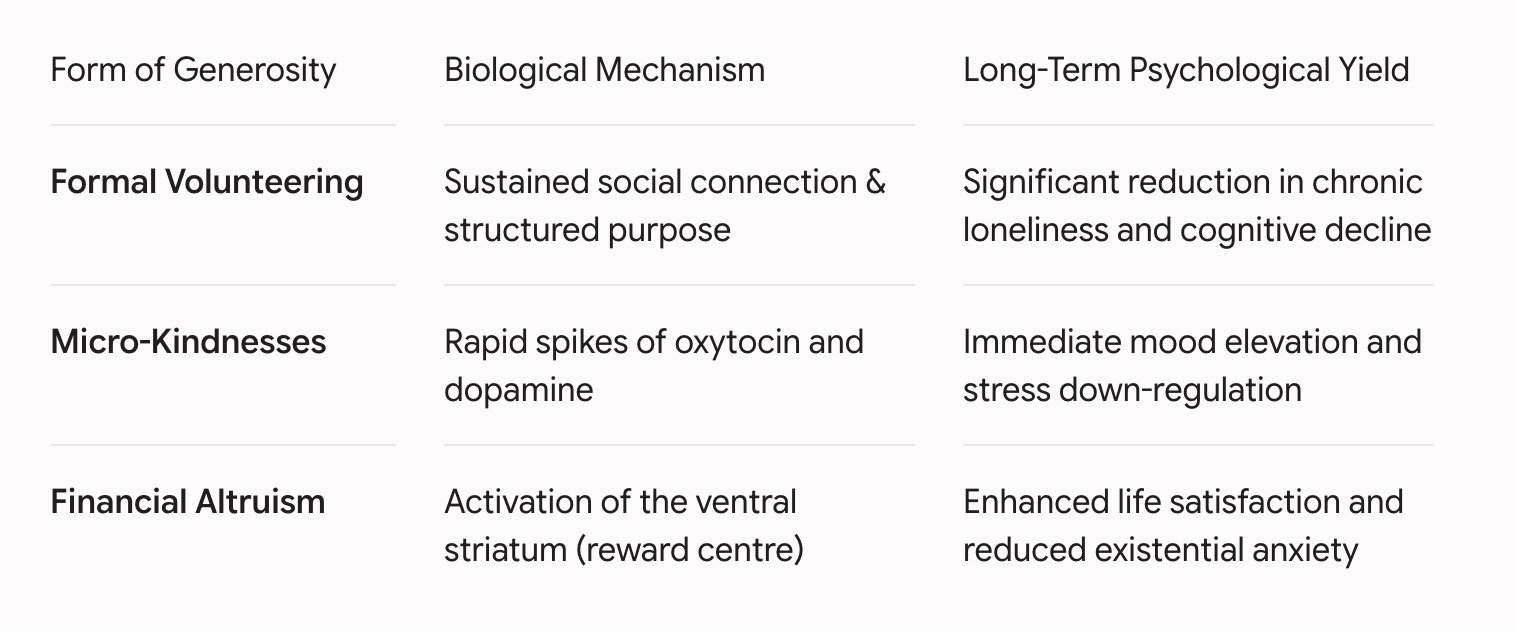
The Science of Strategic Altruism
While the urge to help is deeply rewarding, behavioural scientists offer one critical caveat: how you give matters immensely.
Not all acts of helping yield the same psychological dividend.
To experience the genuine, mood-boosting benefits of altruism without burning yourself out, three specific conditions need to be met:
1. Autonomy Over Obligation
If you are helping someone because you feel guilt-tripped, cornered, or pressured by societal expectations, the benefit vanishes.
Forced generosity feels like a chore, triggering a surge of stress-inducing cortisol.
True emotional rewards occur when you choose to give freely out of genuine empathy and personal agency.
2. Seeing the Impact
The human brain craves feedback.
You experience a far greater neurochemical lift when you can directly observe or understand the tangible difference your actions make.
Seeing a smile on someone's face or knowing a specific, local project succeeded because of your efforts creates a powerful, complete emotional feedback loop.
3. Sustainable Boundaries
Altruism is not about setting yourself on fire to keep someone else warm.
When generosity crosses the line into chronic self-neglect or boundary-less people-pleasing, it leads straight to compassion fatigue.
True, sustainable helping flows from a place of healthy self-care; you must keep your own tank filled if you wish to pour into the cups of others.
Conclusion: Trading the Mirror for a Window
So, does helping others actually make you happier?
Without a shadow of a doubt.
The human brain was never designed to find ultimate satisfaction in isolation, self-absorption, or the relentless accumulation of personal possessions.
We are fundamentally social, cooperative creatures, hardwired across millions of years of evolution to find our deepest peace, safety, and joy in looking after one another.
True happiness isn't an elusive treasure you find by gazing obsessively into a mirror, picking apart your flaws and polishing your personal brand.
It is a warm, radiant light that streams in the moment you open a window to look out at the world around you.
So, the next time life feels a bit heavy, grey, or hopelessly complicated, don't waste your energy over-analysing your own navel.
Put down the self-help books, step out the front door, pop the kettle on for an exhausted colleague, hold the door for a stranger, or lend a hand to a friend in need.
You'll quickly discover that in the quiet, simple business of making someone else's day a little brighter, you inadvertently illuminate your own.
If you are interested in finding out what the secret to long-term happiness is, read this next.
References
Aknin, L. B., Barrington-Leigh, C. P., Dunn, E. W., Helliwell, J. F., Burns, J., Biswas-Diener, R., Kemeza, I., Nyende, P., Ashton-James, C. E., & Norton, M. I. (2013). Prosocial spending and well-being: Cross-cultural evidence for a psychological universal. Journal of Personality and Social Psychology, 104(4), 635–652. https://doi.org/10.1037/a0031578
Elizabeth W. Dunn et al., Spending Money on Others Promotes Happiness.Science319,1687-1688(2008).DOI:10.1126/science.1150952
Luks, A. (2001). The Healing Power of Doing Good: The Health and Spiritual Benefits of Helping Others. United States: iUniverse.
Post, S.G. Altruism, happiness, and health: it’s good to be good. Int. J. Behav. Med. 12, 66–77 (2005). https://doi.org/10.1207/s15327558ijbm1202_4
Read This Next




Disclaimer: This article is for general informational purposes only and does not address individual circumstances, substitute for professional advice, or serve as a basis for decision-making. You should always seek the guidance of a physician or qualified healthcare provider regarding a medical condition, and never disregard or delay seeking professional medical advice due to this content. Any action taken based on this information is entirely at your own risk and responsibility; Energetics, its staff, and its medical advisors disclaim all liability for any inaccuracies, errors, or any personal or professional loss incurred as a direct or indirect consequence of using this content.