Is happiness a state of mind or an emotion?
Reading Time 4 mins
Reading Time: 5 minutesPicture this: you are sitting by a window on a soggy, squally Tuesday evening, listening to the rain hammer relentlessly against the glass.
You are wrapped in a slightly bobbly blanket, clutching a steaming mug of tea, feeling utterly at peace, settled, and quietly pleased with your place in the universe.
Suddenly, your phone buzzes on the armrest with a spectacularly silly video sent by your cousin, and you burst into a brief, snorting fit of laughter, nearly launching your tea across the carpet.
A few seconds later, the snickering dies down, the room returns to its peaceful quiet, and you sink back into that same calm, cosy baseline.
That sudden, bubbly surge of giggles was undeniably an emotional spark—a fast, fleeting reaction to a bit of unexpected nonsense.
But what about that underlying, steady warmth that kept you grounded before, during, and after the joke? Was that also an emotion, or were you experiencing a completely different layer of human psychology altogether?
To see how this fits into our guide to happiness, you can read our master directory.
We throw the word "happiness" around with wild, reckless abandon, using it to describe everything from the ecstatic thrill of finding a forgotten £20 note in a winter coat to the quiet satisfaction of a life well-lived.
This linguistic blurring leaves us deeply confused about what we are actually striving for.
If happiness is merely a fleeting emotion, then chasing it is like trying to bottle lightning: exciting, exhausting, and guaranteed to leave you empty-handed.
But if happiness is a state of mind, it becomes something far sturdier—an internal operating system that can survive even the most chaotic weather.
I looked into this in detail, and I found that by looking through the lenses of cognitive psychology and neurobiology, we can untangle this age-old puzzle and discover why knowing the difference changes everything.
The Emotional Spark: Transient, Intense, and Ephemeral
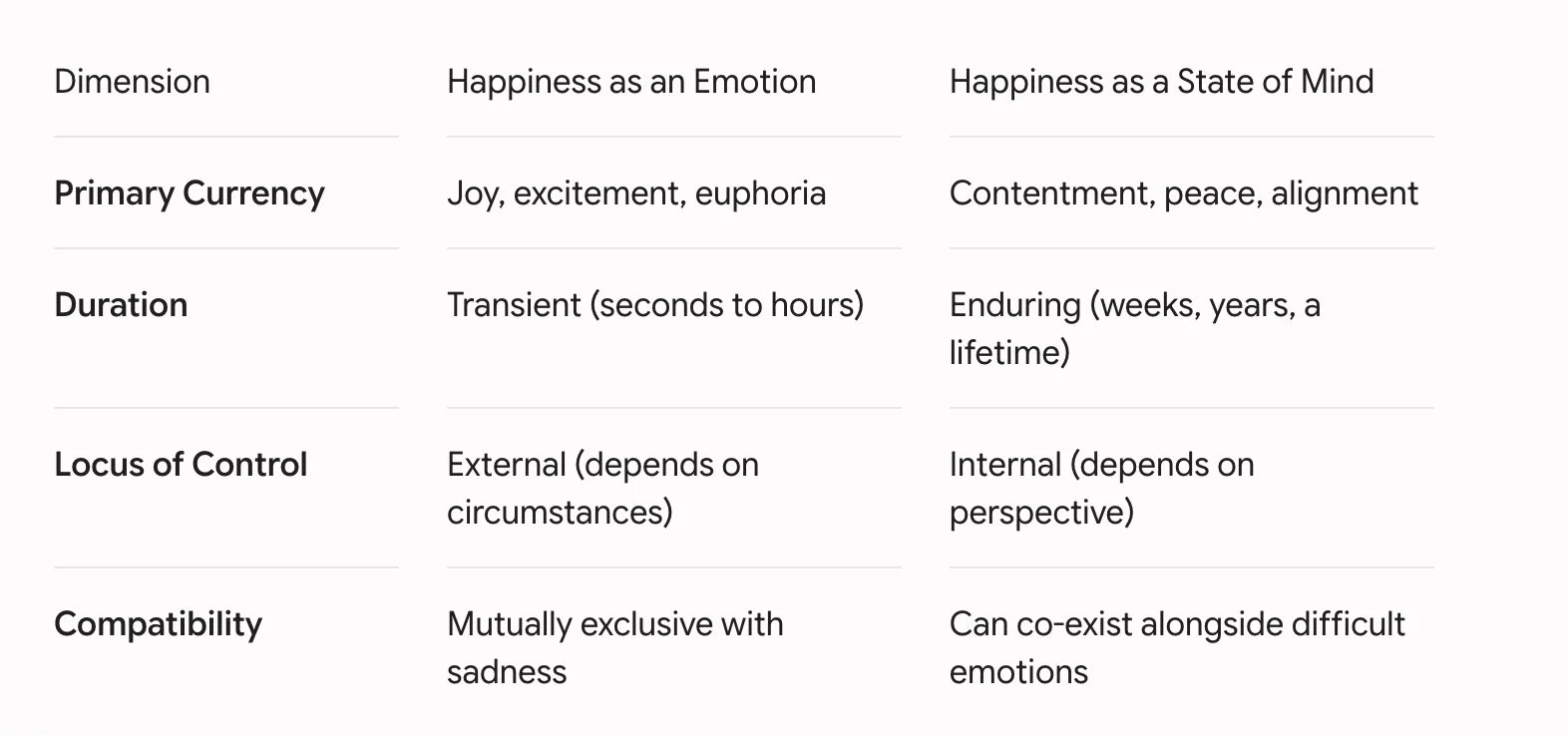
From an evolutionary and neurobiological standpoint, emotions are short-term physiological responses designed to help us navigate immediate environmental events.
When you experience happy emotions—joy, excitement, amusement, or delight—your brain releases a sudden surge of neurochemicals, primarily dopamine and adrenaline. These emotional spikes share very distinct characteristics:
Short Lifespan: An emotional experience operates like a wave.
It rises quickly, peaks, and naturally dissipates within seconds or minutes as your body metabolises the neurochemical rush.
External Triggers: Emotional joy is almost always reactive.
It relies on something happening: receiving good news, eating a sublime slice of cake, or hearing a favourite track on the radio.
High Intensity: Because emotions are designed to grab our immediate attention, they carry a high level of physical arousal—an elevated heart rate, an involuntary grin, or a sudden gasp of delight.
Treating happiness purely as an emotion creates a dangerous psychological trap.
Because emotions are biologically built to fade, expecting to stay in a constant state of emotional joy is like expecting a firework to stay suspended in the night sky forever while you stand below expecting it to keep you warm.
The State of Mind: The Enduring Baseline
If emotions are the weather—sudden rainstorms, bright flashes of sun, or unexpected gusts of wind—then a state of mind is the climate.
In psychological terms, a state of mind (often referred to as life satisfaction or subjective well-being) represents an overarching cognitive framework.
It is not something you feel in a sudden, dramatic burst; it is a fundamental way of interpreting reality.
Supported by stable baseline levels of serotonin and oxytocin, your deeply held values shape this psychological orientation, your sense of purpose, and how you process difficulty.
Crucially, an enduring state of mind provides the solid floor beneath your feet.
A person with a grounded, resilient state of mind can experience grief, frustration, or a thoroughly bad day at work without their foundational sense of well-being collapsing into rubble.
If you are interested in finding out which chemicals make you happy, read this fascinating article.
Quick Reference: Emotion vs. State of Mind Matrix
The Co-Existence Principle: Why You Need Both
The modern tragedy of self-help culture is the misguided belief that to be truly happy, one must aggressively purge all negative feelings. This is a complete misunderstanding of how human beings are built.
When happiness is cultivated as a robust state of mind, it creates a spacious inner harbour capable of hosting the full spectrum of human feeling.
You do not need to banish sadness, worry, or righteous indignation to maintain a happy state of mind.
In fact, attempting to suppress natural emotional reactions destroys your baseline peace far faster than the emotions themselves ever could.
Cultivating the Mindset
Shifting your focus from chasing emotional highs to building a sustainable state of mind involves three practical psychological habits:
Cognitive Reframing: Learning to view setbacks not as fatal catastrophes, but as temporary, manageable hiccups that offer useful data.
Acceptance of Contrast: Recognising that difficult emotions are not system errors or personal failures, but natural, healthy responses to a complex world.
Values-Based Action: Anchoring your sense of self in what you stand for (connection, curiosity, integrity) rather than what you happen to own or achieve on any given Tuesday.
Conclusion: Tending the Garden Instead of Chasing Butterflies
So, is happiness a state of mind or an emotion?
It is ultimately both, but confusing the two is precisely why so many of us end up feeling perpetually cheated by life.
Emotional happiness is like a butterfly—gorgeous, erratic, and utterly unbothered by your personal schedule.
If you spend your entire life sprinting around the garden with a net trying to catch it, you will end up sweaty, exhausted, and feeling slightly ridiculous.
A state of mind, on the other hand, is the soil, the sturdy fencing, and the oak trees of the garden itself.
When you take the time to cultivate a rich, resilient internal landscape—grounded in self-compassion, curiosity, and a healthy sense of humour—the butterflies have a lovely habit of floating in and landing on your shoulder when you least expect it.
Stop measuring the success of your existence by whether every afternoon feels like a carnival ride; put the kettle back on, and give yourself credit for building a mind that keeps you warm no matter what the British weather throws at you.
If you are interested in finding out if helping others makes you happier, read this next.
References
Diener, E., 1984. Subjective well-being. https://labs.psychology.illinois.edu/~ediener/Documents/Diener_1984.pdf
Fredrickson, B. L. (2001). The role of positive emotions in positive psychology: The broaden-and-build theory of positive emotions. American Psychologist, 56(3), 218–226. https://doi.org/10.1037/0003-066X.56.3.218
The Science of Well-being. (2005). United Kingdom: Oxford University Press. https://www.google.co.uk/books/edition/The_Science_of_Well_being/DDFqqeko9boC?hl=en&gbpv=0
Ryff, C. D. (1989). Happiness is everything, or is it? Explorations on the meaning of psychological well-being. Journal of Personality and Social Psychology, 57(6), 1069–1081. https://doi.org/10.1037/0022-3514.57.6.1069
Read This Next





Disclaimer: This article is for general informational purposes only and does not address individual circumstances, substitute for professional advice, or serve as a basis for decision-making. You should always seek the guidance of a physician or qualified healthcare provider regarding a medical condition, and never disregard or delay seeking professional medical advice due to this content. Any action taken based on this information is entirely at your own risk and responsibility; Energetics, its staff, and its medical advisors disclaim all liability for any inaccuracies, errors, or any personal or professional loss incurred as a direct or indirect consequence of using this content.