Exercises to improve Vagal Tone and HRV
Reading Time 4 mins

There is a distinct moment during a truly horrific corporate meeting when you can actually feel your primal survival mechanisms kicking in.
Your chest tightens, your breathing migrates exclusively to your collarbones, and your internal temperature spikes as if you have suddenly been transported to the Sahara. In that precise second, your heart rate is redlining, and your nervous system is screaming at you to throw your lukewarm coffee at the projector screen and flee the building.
If you manage to sit perfectly still, nod politely, and survive the ordeal without a single HR violation, you have your vagus nerve to thank.
For years, high-functioning professionals looking to optimise performance have focused almost entirely on the brain. We drank specialised coffee blends, downloaded productivity apps, and tried to bully our minds into submission.
However, modern clinical science has revealed that the real secret to staying cool under corporate pressure lies deep within your torso. It is governed by a complex neural superhighway called the vagus nerve, and its efficiency is measured by a gold-standard biometric known as Heart Rate Variability (HRV).
If you want to stop feeling like an anxious, twitchy wreck by Tuesday lunchtime, you don't need a new time-management matrix; you need to systematically train your vagal tone.
Here is the clinical breakdown of how this system operates and the practical, evidence-based exercises you can use to upgrade your biological resilience.
The Autonomic Braking System: Understanding Vagal Tone and HRV
To understand why your body reacts so dramatically to a passive-aggressive email, we have to look at the two opposing branches of your Autonomic Nervous System (ANS):
The Sympathetic Nervous System (SNS): The physiological accelerator. It increases your heart rate, dilates your pupils, floods your blood with glucose, and prepares you to fight a sabre-toothed tiger (or a quarterly audit).
The Parasympathetic Nervous System (PNS): The physiological braking system. Often called the "rest and digest" branch, it dampens down inflammation, lowers your heart rate, repairs cellular tissue, and returns you to a state of calm, social connection.
The undisputed commander-in-chief of this parasympathetic braking system is the vagus nerve (the tenth cranial nerve).
Wandering all the way from the brainstem down through the neck, heart, lungs, and digestive tract, it acts as a bidirectional communication cable, constantly reporting the structural state of your organs back to your brain.
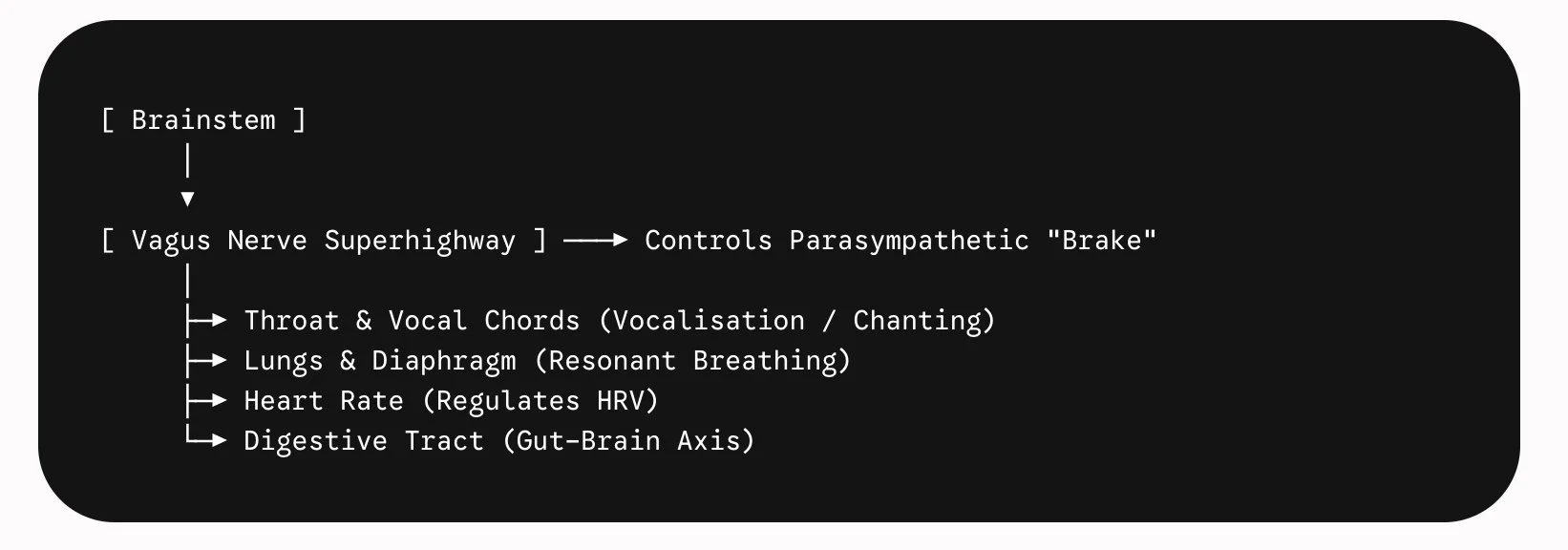
"Vagal tone" refers to the baseline activity and efficiency of your vagus nerve. When your vagal tone is high, your internal braking system is exceptionally responsive.
You can experience a massive spike in sympathetic adrenaline during a high-stakes pitch, but the moment the pressure drops, your vagus nerve steps in like a seasoned pit crew, pumping the biological brakes and bringing your physiology back to a calm baseline within minutes.
We measure the strength of this vagal brake through Heart Rate Variability (HRV). Contrary to what many believe, a healthy heart does not beat with the rigid regularity of a metronome.
If your pulse is a steady sixty beats per minute, a healthy heart does not beat exactly once every single second. Instead, there are microscopic fluctuations in the intervals between consecutive heartbeats—perhaps 0.85 seconds between the first two, 1.15 seconds between the next, and 0.95 seconds after that.
This variation is HRV.
A high HRV means your nervous system is beautifully adaptive, dynamic, and capable of shifting gears instantly in response to changing environmental demands.
A low HRV means your system is stuck in a rigid, brittle, sympathetic-dominant state—you are running on empty, your biological brakes are worn down to the metal pads, and you are dangerously close to burnout.
Clinical Exercises to Up-Regulate Your Vagal Brake
The brilliant news from contemporary neuroscience is that vagal tone and HRV are not genetically fixed attributes. They behave exactly like skeletal muscles; if you apply the correct, targeted physiological stress and stimulus, you can actively train them to become stronger, thicker, and more resilient.
Here are four clinically validated somatic exercises designed to systematically tone your vagus nerve and boost your daily HRV margins.
1. Resonant Coherent Breathing (0.1 Hz Training)
Your respiratory system is the only component of your autonomic nervous system that you can consciously control.
By deliberately altering your breathing architecture, you can directly hijack your cardiovascular mechanics to force a massive spike in parasympathetic activity.
Clinical studies demonstrate that the optimal blueprint for vagal stimulation is a breathing cadence that falls exactly at a frequency of 0.1 Hz—which translates precisely to six full breaths per minute.
At this specific rhythm, your respiration synchronises perfectly with your heart's natural blood pressure rhythms (known as Baroreflex sensitivity), creating a biological phenomenon called cardiovascular resonance.
The Practice: Sit comfortably with your spine upright and feet flat on the floor. Inhale smoothly through your nose for a count of five seconds, allowing your abdomen to expand laterally.
Without pausing or holding at the top, transition immediately into a smooth, relaxed exhale through your nose for a count of five seconds.
The Cadence: Repeat this continuous, circular cycle for a minimum of five to ten minutes.
The Physiology: This structured deceleration of your breath tricks your brainstem into believing you are completely safe, forcing an immediate reduction in sympathetic outflow and a measurable, near-instantaneous increase in root-mean-square successive differences (RMSSD)—the key clinical metric for HRV.
2. Vocal Cord Resonance (Chanting, Humming, and Trilling)
The vagus nerve passes directly through your neck and chest, wrapping meticulously around your larynx and pharynx. Because of this specific anatomical pathway, the muscles of your vocal cords are directly innervated by vagal nerve fibres.
When you vocalise with structural intention, the mechanical vibrations physically stimulate the auricular and pharyngeal branches of the vagus nerve, sending an immediate retro-grade signal of safety directly back into your central nervous system.
The Practice: Take a deep, low diaphragmatic inhalation. As you exhale slowly, create a sustained, low-pitched humming sound (like a deep "Veee" or "Ooommm"), focussing the physical vibration right at the back of your throat and down into your breastbone.
The Variation: Alternatively, you can utilise lip trilling (blowing air through loose lips to make a "brrr" motorboat sound).
The Timeline: Continue this vocal resonance for two to three minutes.
It might make you look and sound like a slightly eccentric opera singer to anyone outside your office door, but the mechanical vibration stimulates the vagus nerve to rapidly dump acetylcholine—the primary neurotransmitter responsible for down-regulating heart rate and calming cardiac tissue.
3. The Lateral Divergent Gaze (The Basic Exercise)
Developed by noted craniosacral therapist Stanley Rosenberg, this deceptively simple neurological exercise leverages the close anatomical relationship between the vagus nerve and the ocular nerves governing your eye movements.
By shifting the position of your eyeballs without moving your cranium, you alter the blood flow and structural tension around the atlas and axis vertebrae, directly unlocking the vagus nerve right as it exits the jugular foramen at the base of the skull.
The Practice: Interlace your fingers and place your hands directly behind the back of your head, letting the weight of your skull rest comfortably in your palms. Keep your face pointing dead ahead.
The Shift: Without turning your head even a millimetre, shift your eyes as far to the right as you comfortably can. Hold your gaze there.
The Trigger: Maintain this extreme lateral gaze for thirty to sixty seconds. Keep watching until you experience an involuntary autonomic reset signal—this will manifest clearly as a sudden, deep sigh, an unexpected yawn, or a spontaneous swallow.
Once you feel that shift, bring your eyes back to the centre and repeat the exact same process looking all the way to the left until the next sigh or yawn occurs.
4. Cold Thermogenesis (Targeted Mammalian Dive Reflex)
Plunging your body into freezing temperatures might sound like a modern wellness trend championed by internet fitness gurus, but the physiological mechanism behind it is deeply rooted in evolutionary biology.
When your face or body encounters a sudden, sharp drop in temperature, it triggers the ancient Mammalian Dive Reflex.
This survival reflex instantly overrides your sympathetic nervous system, shifting blood flow from your limbs to your core organs and forcing a profound, immediate drop in heart rate governed entirely by a massive surge of vagal parasympathetic output.
The Practice: You do not need to buy an expensive commercial ice bath to access this benefit. Simply fill a clean basin or sink with freezing cold water and add a few ice cubes.
Take a deep breath, hold it, and submerge your entire face into the icy water for ten to fifteen seconds, ensuring the areas around your eyes and forehead are fully coated.
The Alternative: If you are at work and don't want to ruin your professional makeup or suit, simply wrap an ice pack in a thin towel and hold it firmly against the sides of your neck (over the carotid sinus) or over your eyes for two minutes while breathing slowly.
This localised cooling serves as an immediate, tactical circuit-breaker for acute corporate panic attacks.
Conclusion: Upgrading Your Biological Hardware
Mastering your professional life ultimately requires a fundamental realisation: your nervous system is not an abstract psychological concept; it is a piece of living, breathing biological hardware.
Trying to think your way out of a severe stress spiral using sheer positive thinking is like trying to rewrite a computer's operating system by yelling at the monitor.
If your baseline vagal tone is weak and your HRV is chronically depressed, your body will keep misinterpreting routine professional challenges as existential threats to your life.
By treating these clinical exercises not as an indulgent luxury, but as essential maintenance for your internal machinery, you can actively alter your stress threshold.
Dedicate a few quiet minutes each day to practising your resonant breathing, humming your way through a difficult morning commute, or strategically cooling down your nervous system after a bruising presentation.
You will quickly find yourself transforming from a frazzled, reactive passenger in your corporate life into a beautifully regulated, exceptionally resilient captain of your own physiology.
Take care of your vagus nerve, give your heart its natural rhythm back, and let your body remember exactly how it feels to operate from a position of absolute, unshakeable calm.
References
Gerritsen RJS, Band GPH. Breath of Life: The Respiratory Vagal Stimulation Model of Contemplative Activity. Front Hum Neurosci. 2018 Oct 9;12:397. doi: 10.3389/fnhum.2018.00397. PMID: 30356789; PMCID: PMC6189422. https://pubmed.ncbi.nlm.nih.gov/30356789/
Kromenacker BW, Sanova AA, Marcus FI, Allen JJB, Lane RD. Vagal Mediation of Low-Frequency Heart Rate Variability During Slow Yogic Breathing. Psychosom Med. 2018 Jul/Aug;80(6):581-587. doi: 10.1097/PSY.0000000000000603. PMID: 29771730. https://pubmed.ncbi.nlm.nih.gov/29771730/
Laborde S, Mosley E, Thayer JF. Heart Rate Variability and Cardiac Vagal Tone in Psychophysiological Research - Recommendations for Experiment Planning, Data Analysis, and Data Reporting. Front Psychol. 2017 Feb 20;8:213. doi: 10.3389/fpsyg.2017.00213. PMID: 28265249; PMCID: PMC5316555.Rosenberg, S. (2017). https://pubmed.ncbi.nlm.nih.gov/28265249/
Accessing the healing power of the vagus nerve: Self-help exercises for anxiety, depression, trauma, and autism. North Atlantic Books.
Thayer JF, Ahs F, Fredrikson M, Sollers JJ 3rd, Wager TD. A meta-analysis of heart rate variability and neuroimaging studies: implications for heart rate variability as a marker of stress and health. Neurosci Biobehav Rev. 2012 Feb;36(2):747-56. doi: 10.1016/j.neubiorev.2011.11.009. Epub 2011 Dec 8. PMID: 22178086. https://pubmed.ncbi.nlm.nih.gov/22178086/
Read This Next





Disclaimer: This article is for general informational purposes only and does not address individual circumstances, substitute for professional advice, or serve as a basis for decision-making. You should always seek the guidance of a physician or qualified healthcare provider regarding a medical condition, and never disregard or delay seeking professional medical advice due to this content. Any action taken based on this information is entirely at your own risk and responsibility; Energetics, its staff, and its medical advisors disclaim all liability for any inaccuracies, errors, or any personal or professional loss incurred as a direct or indirect consequence of using this content.