What is the window of tolerance in psychology?
Reading Time 4 mins

We have all had those days where a minor domestic mishap threatens to completely derail our entire existence.
You are running slightly late, you drop a piece of buttered toast onto the kitchen floor (always buttered-side down, naturally), and suddenly you are either weeping into the tea towel as if experiencing a classical Greek tragedy, or you are slamming the cupboard doors with enough raw fury to startle the neighbours.
Alternatively, you might just blank out entirely, staring at the ruined toast with the glazed, hollow expression of a computer that has permanently frozen mid-update.
When our responses to life's minor irritations become this dramatic, it is easy to assume we are simply losing our grip. However, in behavioural science, this boundary line is known as your "window of tolerance".
Coined by prominent psychiatrist Dr Dan Siegel, this concept is the ultimate framework for understanding how your nervous system processes stress, why you occasionally overreact to microscopic problems, and how high-stress professionals can stop swinging between explosive emotional outbursts and total mental paralysis.
The Anatomy of the Window: Finding Your Optimal Zone
At any given moment, your nervous system is sitting in one of three distinct biological zones.
The middle zone—the sweet spot—is your window of tolerance. When you are inside this window, your brain and body are operating in a state of autonomic equilibrium.
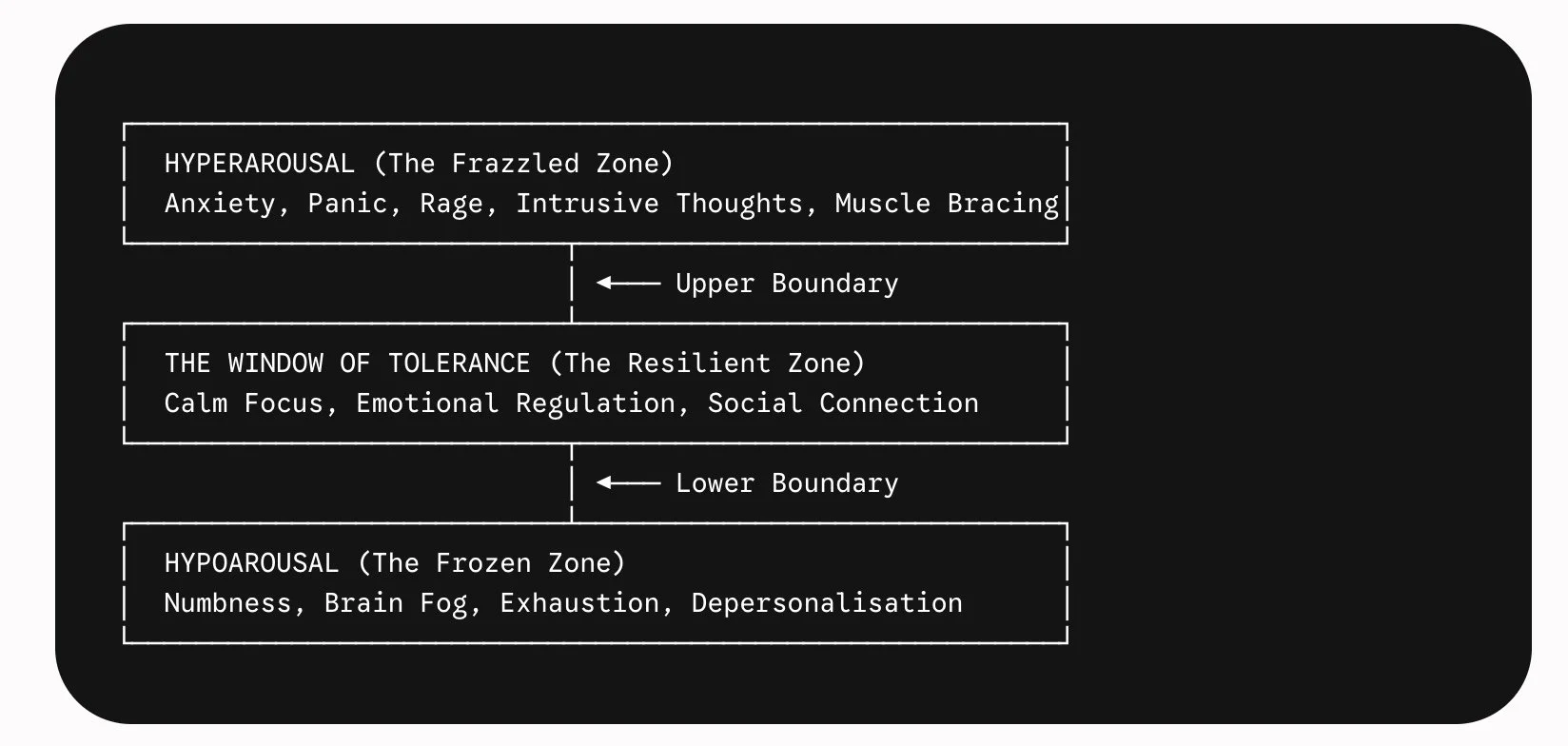
Inside this optimal band, life is still messy, and work is still demanding, but you possess the neurological bandwidth to process the data effectively.
If a client pulls a contract at the eleventh hour, you don't start hyperventilating or completely shut down; instead, you calmly evaluate your options, reallocate your resources, and pivot your strategy.
You can feel anger, sadness, or excitement without these emotions hijacking your prefrontal cortex and driving your entire behavioural bus.
Hitting the Ceiling: The Chaos of Hyperarousal
When stress accumulates past your upper boundary line, your nervous system interprets the overload as an immediate threat to survival, forcefully ejecting you into hyperarousal.
This is your sympathetic "fight or flight" system getting stuck with the accelerator pedal pinned to the floor.
When you are hyperaroused, your system is flooded with adrenaline and cortisol. Physically, your heart rate spikes, your breathing shallowing into your upper chest, and your digestion grinds to a halt.
Mentally, this manifests as racing thoughts, chronic irritability, hypervigilance, and acute anxiety.
In the office environment, the hyperaroused professional is the one firing off defensive, passive-aggressive emails at midnight, micromanaging their team into oblivion, or reacting to a simple constructive critique as if it were a direct, personal assassination attempt.
Your brain has completely lost its ability to distinguish between a genuine emergency and a routine administrative hiccup.
Crashing Through the Floor: The Numbness of Hypoarousal
Conversely, if the stress continues unabated without any opportunity for recovery, the brain decides that fighting or fleeing is entirely futile.
To protect your core biology from systemic collapse, it hits the emergency brake, plunging you down past your lower boundary line into hypoarousal.
This is the parasympathetic "freeze or submit" response. If hyperarousal is an engine redlining, hypoarousal is your battery being completely disconnected.
When you slip into this frozen state, you experience profound emotional numbness, daytime brain fog, depersonalisation, and an overwhelming sense of lethargy.
You might find yourself sitting at your desk, staring blankly at a blinking cursor for forty-five minutes, completely unable to summon the cognitive energy required to construct a basic sentence. This is often the point where high-achievers panic, mislabelling their protective biological shutdown as a sudden onset of laziness or a total loss of ambition.
Why Your Window Shrinks (and How to Expand It)
The most frustrating aspect of the window of tolerance is that it isn't a fixed size. When you are well-rested, properly nourished, and socially supported, your window is wide and resilient.
You can handle a screaming toddler, an unexpected tax bill, and a difficult corporate presentation all before noon without breaking a sweat.
However, when you are running on chronic stress, poor sleep, and a diet consisting primarily of caffeine and adrenaline, your window of tolerance shrinks down to the width of a razor blade.
When your window is that narrow, the tiniest bump—like someone taking your favourite mug from the office kitchen—is enough to instantly catapult you out of your zone of tolerance and directly into a full-blown emotional crisis.
Widening your window requires shifting away from sheer psychological willpower and focusing instead on targeted somatic regulation:
To Cool Down Hyperarousal: Use grounding, down-regulating practices to signal safety to your overactive sympathetic system.
Lengthen your exhalations so they are twice as long as your inhalations, apply a cold compress or splash ice water onto your face to stimulate the vagus nerve, or push firmly against a wall with your hands to physically discharge trapped motor energy.
To Warm Up Hypoarousal: Use gentle, up-regulating stimulation to safely wake up a frozen nervous system. Listen to rhythmic, energising music, introduce sensory changes like a bright citrus scent or a brisk walk in the fresh air, or practice gentle somatic shaking to invite blood flow and movement back into your tissues.
Conclusion: Mastering Your Internal Thermostat
Learning to identify your position on this nervous system map is the absolute foundation of sustainable mental health and professional performance.
You are not a temperamental machine or an emotionally unstable wreck; you are simply a biological organism trying to manage its energetic margins under a heavy allostatic load.
The next time you find yourself wanting to throw your laptop out of a window or crawl underneath your desk for an extended nap, pause and check your coordinates. Ask yourself: Have I breached my ceiling into chaos, or crashed through my floor into the freeze zone?
By treating your nervous system like a delicate internal thermostat rather than a personal character flaw, you can actively widen your window of tolerance.
Step away from the corporate madness, use a little strategic physiology to bring yourself back into the room, and keep your professional edge brilliantly sharp, beautifully regulated, and wonderfully human for the long haul.
References
Corrigan FM, Fisher JJ, Nutt DJ. Autonomic dysregulation and the Window of Tolerance model of the effects of complex emotional trauma. J Psychopharmacol. 2011 Jan;25(1):17-25. doi: 10.1177/0269881109354930. Epub 2010 Jan 21. PMID: 20093318. https://pubmed.ncbi.nlm.nih.gov/20093318/
Ogden, P., Minton, K., & Pain, C. (2006). Trauma and the body: A sensorimotor approach to psychotherapy. W. W. Norton & Company. https://wwnorton.com/books/9780393704570
Cherland E. The Polyvagal Theory: Neurophysiological Foundations of Emotions, Attachment, Communication, Self-Regulation. J Can Acad Child Adolesc Psychiatry. 2012 Nov;21(4):313–4. PMCID: PMC3490536.https://pmc.ncbi.nlm.nih.gov/articles/PMC3490536/
Siegel, D. J. (1999). The Developing Mind: How relationships and the brain interact to shape who we are. Guilford Press. https://www.guilford.com/excerpts/siegel_ch1.pdf?t=1
Van der Kolk, B. A. (2014). The body keeps the score: Brain, mind, and body in the healing of trauma. Penguin Books.
Read This Next






Disclaimer: This article is for general informational purposes only and does not address individual circumstances, substitute for professional advice, or serve as a basis for decision-making. You should always seek the guidance of a physician or qualified healthcare provider regarding a medical condition, and never disregard or delay seeking professional medical advice due to this content. Any action taken based on this information is entirely at your own risk and responsibility; Energetics, its staff, and its medical advisors disclaim all liability for any inaccuracies, errors, or any personal or professional loss incurred as a direct or indirect consequence of using this content.