Am I Too Young for Perimenopause Symptoms?

If you are a woman trying to balance a demanding career with the beautiful chaos of family life, your mornings probably feel like a military operation.
You wake up early, immediately start mental multitasking—thinking about school runs, family packed lunches, your massive to-do list at work—and rely on a strong cup of tea or a double-espresso just to get your brain functioning. It works for an hour or two.
But lately, by the afternoon, you find yourself staring blankly at your computer screen, fighting off a thick, heavy daytime brain fog, and wondering why your usually sharp, capable mind has suddenly gone completely offline.
Then there are the nights.
You start waking up at 3:00 AM drenched in a cold sweat, your heart racing for no apparent reason.
You find yourself uncharacteristically losing your temper over minor household chores or feeling deeply anxious before a normal presentation at work.
Your very first thought is probably: "I am completely burning out. I’m just trying to do too much." Your second thought? "Wait... could this be menopause? No, absolutely not. I’m only in my early forties. I am far too young for that."
It is a massive cultural myth that menopause is an abrupt event that happens exclusively in your fifties.
In reality, the transitional phase leading up to it—known as perimenopause—frequently begins far earlier than most women realise.
If you are experiencing shifting emotions, fractured sleep, and a sudden drop in your mental processing speed in your late thirties or early forties, you are not losing your mind, nor are you failing your family or your job.
You are simply experiencing the first unpredictable hormonal shifts of the perimenopausal transition.
Shifting the Baseline: What is Perimenopause?
To understand exactly what is happening to your body and your mind during a busy week, we have to look at our hormones.
Menopause itself is actually defined as a single point in time: the twelve-month anniversary of your very last menstrual period.
The average age for this in the UK is 51.
However, perimenopause is the extended transitional chapter leading up to that moment. It can last anywhere from four to ten years.
During this window, your ovaries do not simply stop working overnight; instead, they begin to sputter.
Your production of key hormones—specifically oestrogen and progesterone—stops following its smooth, predictable monthly rhythm and begins to fluctuate wildly from day to day, or even hour to hour.
[Normal Cycle: Smooth Monthly Waves] ➔ [Perimenopause: Wild, Unpredictable Hormonal Spikes & Drops]
Because hormone receptors are located in almost every major organ system—including your blood vessels, your gut, and critically, your brain—these erratic spikes and drops trigger a massive array of physical and emotional symptoms long before your periods actually stop or change.
The Core Symptoms Affecting Your Daily Life
For a woman running a busy household and working a demanding job, the most frustrating aspect of perimenopause isn't just the physical changes; it is the silent assault on your daily mental clarity and emotional balance:
1. The Breakdown of the Brain's Thermostat (Hot Flushes & Insomnia)
The classic perimenopausal hot flush or night sweat isn't just an inconvenience; it is a neurological event. Oestrogen acts as a master regulator of the hypothalamus—the brain's internal thermostat.
When oestrogen drops unpredictably, the brain mistakenly senses that the body is overheating, triggering an immediate emergency response to shed heat: a rapid pulse, dilated blood vessels, and profuse sweating.
When this happens in the middle of the night, it shatters your deep sleep, preventing you from getting the restorative rest you need to handle your family and work commitments the next day.
2. The Mental Saboteur: Daytime Brain Fog
If you find yourself walking into a room and forgetting why you went in there, struggling to recall a common word during a conversation, or feeling like your brain is wading through treacle, hormone withdrawal is the likely culprit.
Oestrogen is highly protective of the brain and plays a vital role in how your brain utilises its energy fuel.
As oestrogen levels fluctuate and decline, the brain’s ability to process energy efficiently drops, manifesting as a sudden, deeply frustrating mental fog and a distinct decline in short-term memory.
To have more of a deep dive into daytime fog and why you are forgetting simple words, read this.
3. Detonating the Emotional Filter
Progesterone is often referred to as the brain's natural valium because it breaks down into a compound that calms the nervous system.
As progesterone levels plummet during early perimenopause, this natural soothing mechanism vanishes.
Combined with erratic oestrogen drops, this can leave you feeling incredibly vulnerable to baseline anxiety, sudden panic, uncharacteristic irritability, or a severely degraded emotional filter when dealing with family arguments or stressful work situations.
Am I Too Young? The Statistical Reality
So, let’s answer the primary question directly: how young is too young?
Medical consensus establishes that entering perimenopause in your early forties is entirely normal and statistically common. Roughly 10% of women experience natural perimenopausal transitions before the age of 45.
Furthermore, around 1% of women experience Premature Ovarian Insufficiency (POI), where perimenopause and menopause begin before the age of 40.
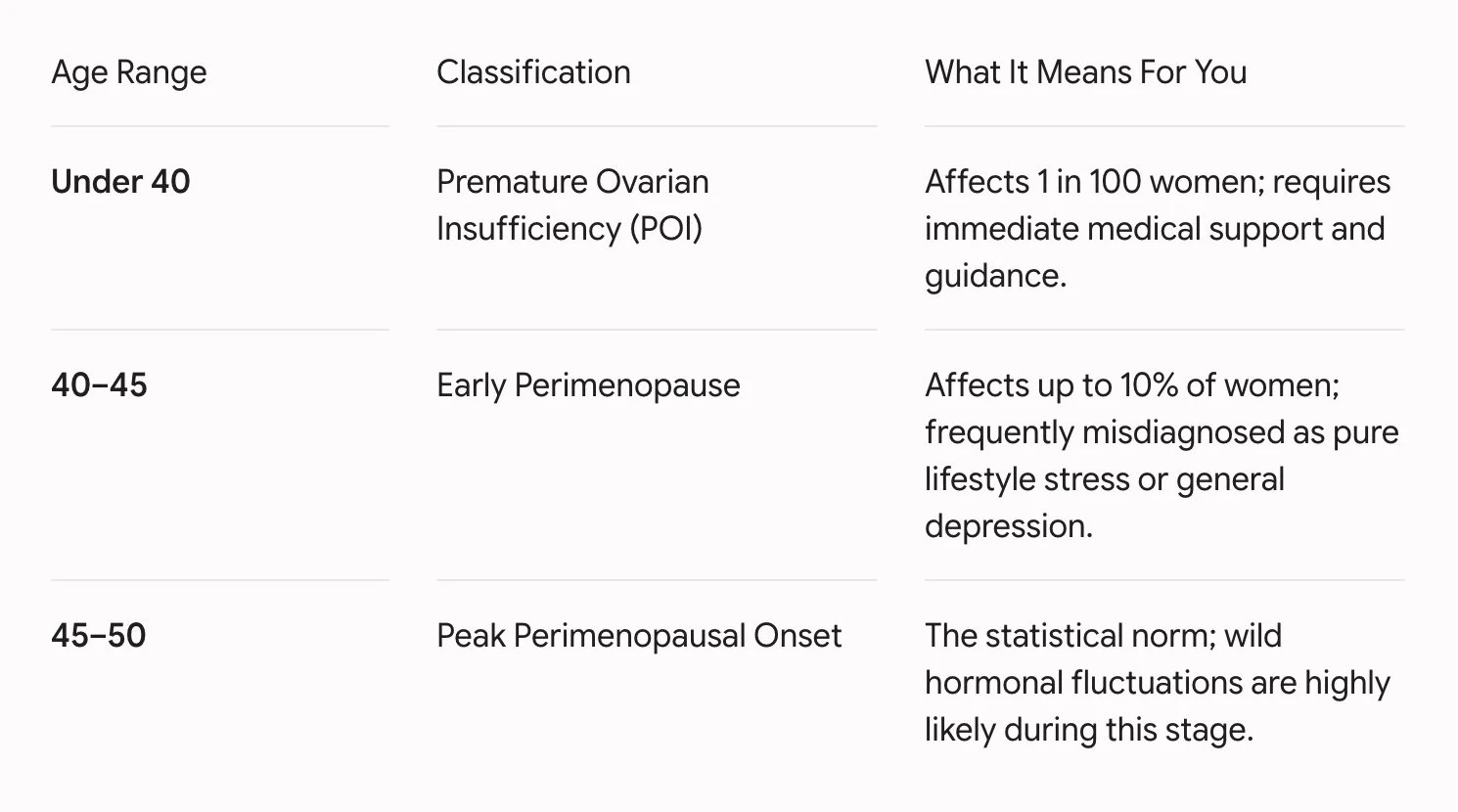
Because women are often managing the peak of their careers and raising growing families precisely in their late thirties and forties, these early symptoms are routinely and dangerously misattributed to general lifestyle stress or burnout.
This leads many brilliant, successful women to feel like they can no longer cope, causing them to step back from their passions just when they should be thriving.
Reclaiming Your Clarity: A Proactive Strategy
If you suspect your energy, sleep, and patience are being compromised by early hormonal shifts, you do not have to simply sit back and accept it as an inevitable tax on getting older.
You can take proactive control of your health with a few science-backed steps:
Track Your Symptoms, Not Your Periods: Because hormones fluctuate wildly during perimenopause, a single blood test showing "normal" levels doesn't mean you aren't in the transition.
Keep a daily log of your mood, sleep quality, and physical symptoms alongside your cycle to present a clear pattern to your GP.
Priorise a Cool Sleeping Environment: Because your internal thermostat is vulnerable, keeping your bedroom cool (between 16°C and 18°C) and avoiding a late-night glass of wine can dramatically reduce night sweats, protecting your deep, restorative sleep cycles.
Explore Evidence-Based Support: Modern Body-Identical Hormone Replacement Therapy (HRT)—which uses regulated hormones derived from natural plant sources that are molecularly identical to the ones your body produces—has been shown to effectively help clear daytime brain fog and restore emotional equilibrium.
Conclusion: A Turning Point, Not a Malfunction
Look, let’s completely rewrite the narrative around this phase of life.
Experiencing perimenopausal symptoms in your late thirties or early forties does not mean your body is broken, and it certainly doesn't mean you have to compromise on your career or your family life.
It simply means your biological software is going through a major transition.
By stripping away the outdated taboos, understanding the basic science of your body, and taking proactive control of your hormonal health, you can completely clear the daytime brain fog, get your patience back, and ensure you remain the vibrant, capable woman you have always been.
Step away from the endless caffeine cycle, talk to the right professionals, and give your mind and body the precise support they deserve. Your family—and your sanity—will thank you.
Next, you may want to read and learn about instant energy hacks.
References
Read This next





Disclaimer: This article is for general informational purposes only and does not address individual circumstances, substitute for professional advice, or serve as a basis for decision-making. You should always seek the guidance of a physician or qualified healthcare provider regarding a medical condition, and never disregard or delay seeking professional medical advice due to this content. Any action taken based on this information is entirely at your own risk and responsibility; Energetics, its staff, and its medical advisors disclaim all liability for any inaccuracies, errors, or any personal or professional loss incurred as a direct or indirect consequence of using this content.