Executive Burnout Prevention: A Science-Backed Guide to Leadership Stamina and Resilience

Let’s be entirely transparent about the modern corporate landscape: the contemporary office environment—whether a glass tower in the City or a hybrid home-office setup—is a beautifully engineered sensory trap.
It is an environment that actively demands peak intellectual output while simultaneously forcing the biological organism into a state of profound physical stagnation and near-constant digital overload.
We sit stationary for eight to ten hours a day, bathed in synthetic blue light, processing a non-stop barrage of emails, Slack alerts, and back-to-back video calls.
We treat our bodies like mere transport mechanisms for our heads—unfortunate physical packages whose only purpose is to carry our brains from one meeting room to the next.
When our necks lock up, our eyes burn, or our afternoon focus drops off a cliff, we don’t listen to the signal; instead, we override it with a double espresso or a sugary snack and push through.
The corporate world frequently frames "resilience" as a mental or psychological trait—a mix of grit, time management, and emotional intelligence. But high-stakes professional performance is fundamentally anchored in your physiology.
You cannot make optimal, strategic decisions, manage complex team dynamics, or maintain creative focus when your prefrontal cortex is experiencing a severe energy deficit and your body is stuck in a low-grade, sedentary stress loop.
True corporate stamina is not about working yourself into early burnout; it is about managing your biological energy with the precision of an elite athlete.
This comprehensive hub guide establishes a clear, clinically backed, non-drug framework to help you master workplace somatics, conquer digital fatigue, and maintain peak operational vitality without sacrificing your long-term health.
1. The Physiology of the Desk: Sedentary Biomechanics
To optimise performance in a corporate environment, we must first address the sheer physical reality of prolonged sitting. The human body was structurally designed for varied, dynamic movement; it was never built to maintain a static, 90-degree seated posture for a third of the day.
When you remain seated at a desk for hours on end, a predictable cascade of biomechanical adaptations takes place:
Prolonged Seated Posture ──► Shortened Hip Flexors & Glute Amnesia ──► Compensatory Lumbar & Cervical Strain.
The Kinetic Chain Collapse
Your hip flexors remain in a chronically shortened state, leading to reciprocal inhibition—a neurological phenomenon where the brain essentially "turns off" or numbs the gluteal muscles.
This "glute amnesia" forces the lower back and hamstrings to take on extra structural loads, resulting in chronic lumbar discomfort.
The Upper Cross Syndrome
As focus intensifies on a screen, the shoulders naturally round forward, and the head drifts forward into a "text neck" position.
For every inch your head moves forward from its natural alignment, it places an additional ten pounds of pressure on the cervical spine.
This chronic muscular strain directly restricts the suboccipital muscles at the base of the skull, compressing local blood vessels and nerves, which directly drives tension headaches and reduces cerebral blood flow.
2. Digital Fatigue and the Neurobiology of Screens
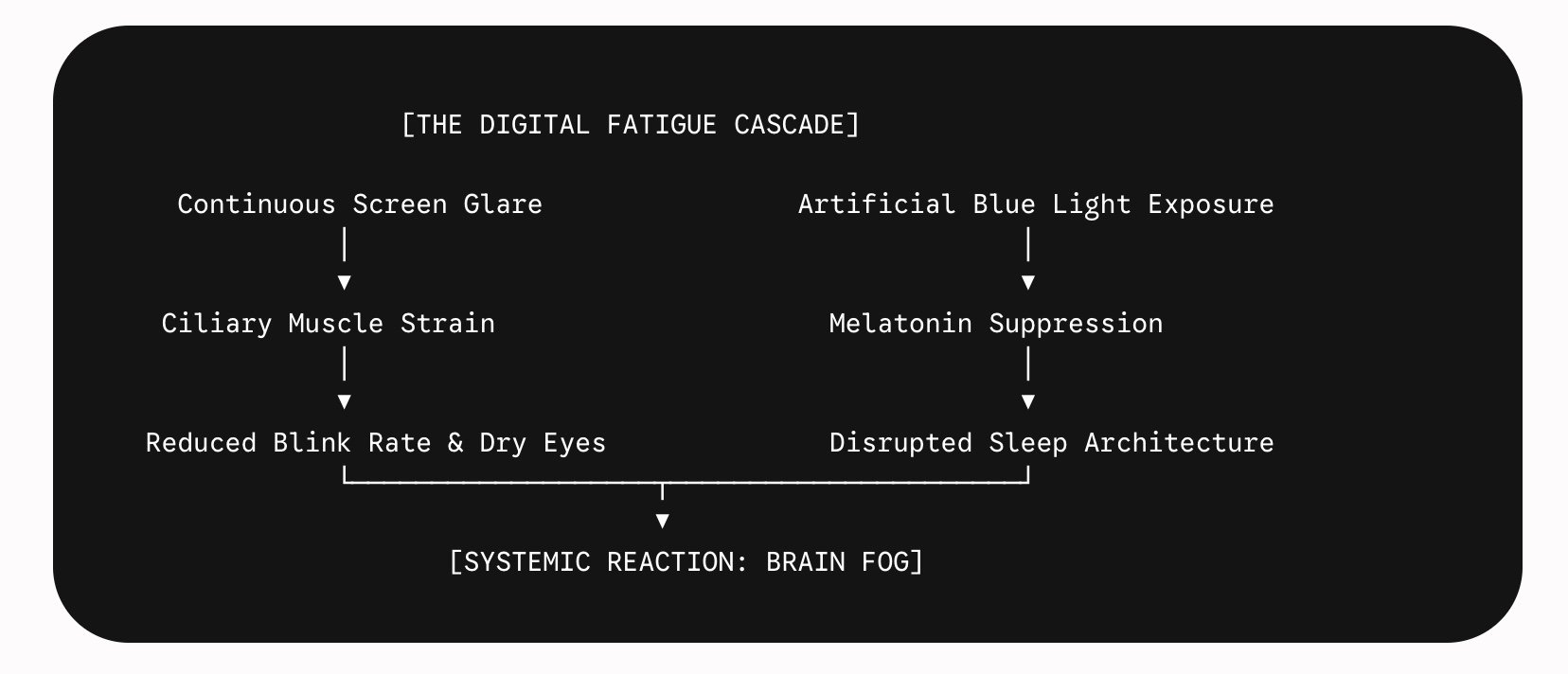
The exhaustion felt after a long day of virtual meetings is not just mental fatigue; it is a specific neurobiological state driven by sensory mismatch and screen overstimulation.
The Visual Strain Loop
When staring at a digital display, your blink rate automatically drops by up to 60%.
This causes rapid evaporation of the tear film, leading to dry, inflamed eyes.
Furthermore, focusing continuously at a fixed distance forces the ciliary muscles inside the eye into a prolonged, unnatural contraction.
This constant strain signals a state of effort and fatigue directly to the nervous system, triggering low-grade central nervous system exhaustion.
Blue Light and Circadian Disruption
The high-intensity blue light emitted by corporate screens mimics the peak wavelength of afternoon sunlight.
Exposure to this light—especially during late-evening catch-up work—strongly suppresses the brain’s secretion of melatonin, the hormone required to initialise deep, restorative sleep.
As a result, even if you manage to sleep for seven hours, the underlying sleep architecture is fractured, depriving the brain of essential deep-stage glymphatic cleansing (the brain's internal waste-clearance system).
3. Workplace Somatics: Micro-Interventions for Macro Performance
To maintain cognitive stamina throughout a demanding corporate day, you must move away from the outdated concept of waiting until the weekend to recover.
True resilience requires the strategic deployment of somatic micro-interventions during the workday itself.
By interrupting the sedentary, high-alert state every 60 to 90 minutes with brief, targeted physical resets, you can actively prevent the accumulation of systemic fatigue.
These practices are designed to be subtle, highly efficient, and easily executed within a standard office or home-workspace.
They focus on rapidly restoring pelvic alignment, opening the thoracic spine to enhance respiratory capacity, and using targeted visual shifts to release tension in the extraocular muscles.
These quick shifts break the survival-mode loop, shifting your biology out of defensive stagnation and instantly restoring oxygenation to the brain.
4. Biofield Balance in the Electronic Workspace
The modern corporate office is a dense matrix of environmental stressors.
Beyond the psychological pressure of deadlines, our bodies are constantly immersed in artificial electromagnetic environments, surrounded by high-density Wi-Fi networks, server bays, and multiple personal devices.
From an energetic perspective, this constant interaction with ungrounded, synthetic fields can induce a state of subtle fragmentation within the human biofield.
This subtle disruption frequently manifests as an unexplainable feeling of being "fried," an inability to settle into deep focus, and an increased susceptibility to emotional reactivity during high-stress interactions.
Integrating non-pharmacological biofield protocols—such as deliberate grounding techniques and subtle energy clearing—helps neutralise these environmental stressors, re-establishing a clear, stable energetic boundary and restoring internal somatic equilibrium amidst digital chaos.
5. The Core Resource Directory (Deep Dives)
Achieving sustained executive stamina demands moving past generic corporate wellness advice and adopting precise, clinically backed, non-drug protocols. Use the directories below to explore our comprehensive, specialised resources.
Phase 1: Cognitive Efficiency & Strategic Preservation
Protect your prefrontal cortex from the compounding toll of decision fatigue and neurological depletion.
Deconstruct the specific neurological shifts that compromise long-term risk assessment and risk-mitigation by exploring Why am I making poor strategic decisions when tired?
Identify the biological thresholds of acute micro-level cognitive depletion and discover how to overcome daily micro-stalls with our operational guide on Why can't I make simple decisions at work anymore?
Phase 2: Somatic Resilience & Sleep Architecture
Down-regulate your sympathetic nervous system to transition smoothly from high-stakes corporate environments into deep, restorative recovery states.
Discharge accumulated physical tension and lower baseline cortisol right at your desk by mastering tactical protocols to physically release stress from your body.
Interrupt the midnight cortisol spike, quiet secondary cognitive loops, and establish a clean boundary between the boardroom and the bedroom by applying our protocol on how to turn off an overactive brain before bed.
Phase 3: Hormonal Optimisation & Executive Menopause Management
Navigate complex biological shifts without compromising your professional momentum or leadership authority.
Stabilise metabolic energy, bypass the 3:00 PM corporate energy crash, and sustain cognitive stamina by implementing our targeted dietary and lifestyle shifts for Crushing Afternoon Fatigue During Menopause.
Override acute, stress-induced physical flare-ups during high-stakes presentations or board meetings using the immediate physiological anchors outlined in How to Stop a Hot Flush Caused by Stress at Work.
6. Mastering the Executive Landscape
Ultimately, thriving in the corporate world is not about trying to change the fast-paced nature of modern business. It is about changing how your physical body responds to that environment.
By treating your biology with the respect it deserves, integrating smart somatic micro-breaks, protecting your visual pathways, and regularly resetting your nervous system, you can perform at the highest professional levels while keeping your health, vitality, and internal peace completely intact.
Consider this hub page your strategic blueprint for executive stamina.
As our platform continues to expand, this guide will serve as the foundation for a deeply interconnected ecosystem of science-backed spoke articles.
We will focus exclusively on outstanding, holistic, non-drug protocols—deeply rooted in clinical science and highly effective—to help you systematically neutralise digital fatigue, master workplace somatics, and lead with clear, grounded executive presence.
For now, take your eyes off the screen for a moment, look out of a window at a distant point to relax your eyes, drop your shoulders, and let us begin optimising your professional biology.
Read This Next



Disclaimer: This article is for general informational purposes only and does not address individual circumstances, substitute for professional advice, or serve as a basis for decision-making. You should always seek the guidance of a physician or qualified healthcare provider regarding a medical condition, and never disregard or delay seeking professional medical advice due to this content. Any action taken based on this information is entirely at your own risk and responsibility; Energetics, its staff, and its medical advisors disclaim all liability for any inaccuracies, errors, or any personal or professional loss incurred as a direct or indirect consequence of using this content.