Reading Time 5 minutes.
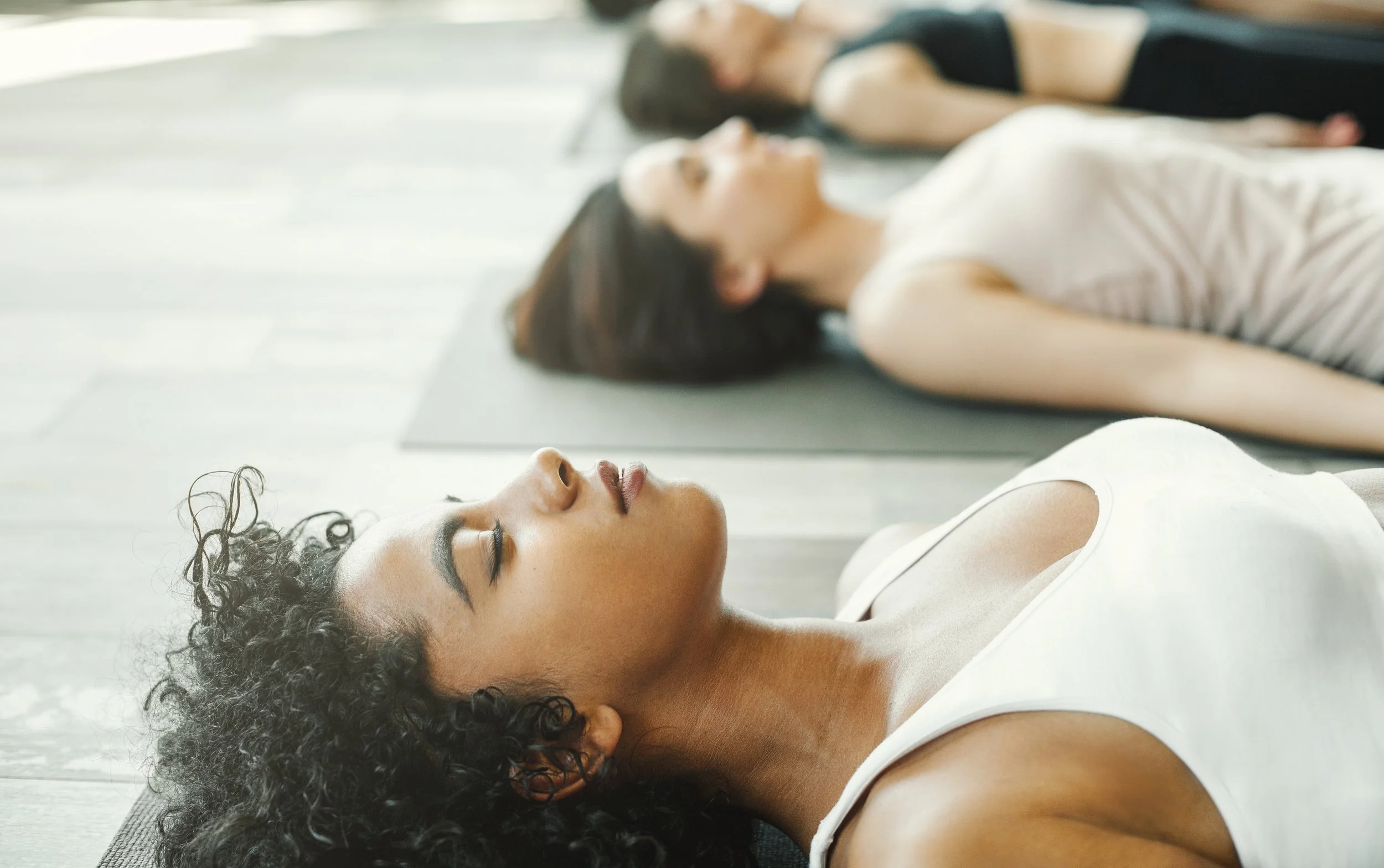
Reading Time: 5 minsI FEEL LIKE YOGA NIDRA IS THE BEST-KEPT SECRET FOR THE LAZIEST AND EASIEST ULTIMATE BRAIN AND BODY HACK.
That’s right, I believe in it so much I wrote it in bold font.
In our busy multitasking lives, we are experts at carrying an enormous amount of tension in our shoulders while claiming we’re "absolutely fine, thanks."
Yet we often fluctuate between frazzled, fatigued, and frankly fudging through life, fantasising about when we can pour the next coffee or chocolate bar into our mouth.
Well, I’m here to tell you the answer isn’t more caffeine (maybe sometimes it is more chocolate) - actually no, the answer will always be Yoga Nidra!
Often called "yogic sleep," this isn't just a nap; it is a clinical-grade tool for helping your body recharge and reboot while you lie perfectly still and do nothing. Hurrah!
Beyond Relaxation: The Science of "Conscious Sleep"
Yoga Nidra translates to "sleep with a trace of awareness." While your physical body enters a state of profound rest, your consciousness remains awake, hovering in the hypnagogic state—that magical borderland between wakefulness and sleep.
From a biophysical perspective, this is where the restructuring happens. Research shows that during Yoga Nidra, the brain transitions from high-frequency Beta waves (the "busy" state) into Alpha, Theta, and eventually Delta waves [1].
In Delta deep, dreamless sleep, we are totally unconscious. However, by staying "awake" in these states, we allow the body’s "repair instructions" to be delivered without the interference of the "monkey mind."
To learn more about brainwaves and how we can use binaural beats for optimal living, read this.
The "Koshas": Tidying the Layers of the Soul
In the tradition of Tantra, we don't just have one body; we have five "sheaths" or Koshas. Yoga Nidra is the only practice that systematically "checks in" with every single one of them. Think of it like a deep clean for your entire house, from the front porch to the attic.
Annamaya Kosha (Physical): We start with the physical.
By rotating consciousness through the body—thumb, index finger, palm—we release the "clench" in our muscles.
Pranamaya Kosha (Energy): Here, we focus on the breath.
This is where we smooth out the "jagged" rhythms in the biofield.
Manomaya Kosha (Mental/Emotional): We acknowledge thoughts and feelings as they arise, but we don't "invite them in for tea."
This clears the mental static.
Vijnanamaya Kosha (Wisdom): We tap into our intuition and move beyond the ego.
Anandamay Kosha (Bliss): The core of our being, where we experience total coherence and peace.
By the time you reach the deeper layers, you are effectively "combing out" the knots in your Etheric Body.
(This could all sound a bit woo-woo, but think of it as an efficient way to access your unconscious and tap into deep relaxation.)
Studies on the effect of Yoga Nidra on the autonomic nervous system show a significant shift from "fight or flight" to "rest and digest" (parasympathetic dominance), allowing for systemic healing that a regular night of tossing and turning simply cannot provide [3].
Rewriting the Blueprint with the "Sankalpa"
The most powerful part of Yoga Nidra is the Sankalpa—your "heart's resolve."
Because you plant this seed while your biofield is in its most receptive Delta state, it acts like code written directly into your operating system.
If you try to tell yourself "I am healthy" while you're stressed at your desk, your conscious mind (the "inner critic") will likely argue with you.
But in Yoga Nidra, the inner critic is asleep.
The Sankalpa bypasses the ego and goes straight to the blueprint.
Clinical research suggests that this practice can significantly reduce anxiety and depression, precisely because it addresses the "frequency" of the person rather than just the symptoms [2].
The Biology of "NSDR" (Non-Sleep Deep Rest)
In recent years, Stanford neuroscientists have rebranded Yoga Nidra as NSDR (Non-Sleep Deep Rest).
Why? Because the physiological data is undeniable.
Practicing for just 20 minutes can provide the same level of cognitive recovery as two hours of conventional sleep [4].
When you lie in Nidra, your brain’s neuromodulatory systems reset.
You flush out metabolic waste and replenish dopamine in the basal ganglia.
For the "tired but wired" professional in London, this is the ultimate hack. It’s not just "chilling out"; it’s a biological reset that improves focus, creativity, and physical immunity.
Your Step-by-Step Guide to Energetic Hygiene
You don't need to be a flexible yogi to benefit from this. You need a flat surface and no interruptions.
Set the Scene: Lie on your back (Savasana). Use a pillow behind your knees to protect your lower back.
Get Comfy: Cover yourself. As the biofield expands and the nervous system settles, your body temperature will drop.
Listen, Don't Think: Find a guided Yoga Nidra track. Your only job is to follow the voice. If you fall asleep, don't worry—your subconscious is still listening.
The Sankalpa: Choose a short, present-tense positive statement. "I sleep well," or "I am at peace." (I once helped an athlete who wanted to win the World Champs - for 5 years she was always nearly there, but never quite managed it. I got her to listen to Yoga Nidra daily. Her Sankapla was ‘I am a World Champion.’ Roll on 6 months, and she won the title. I’m not saying Yoga Nidra is a wish fairy, but it can be a powerful tool for self-belief and action.)
The Return: When the practice ends, move your fingers and toes slowly. Imagine you are "re-entering" your physical body with a freshly polished blueprint.
Conclusion: Don't Just Sleep—Restore
We think that we don’t have the time to do ‘nothing’, but this nothing is ‘something’ very important.
Used correctly, it can speed up learning, accelerate muscle recovery after sports, alleviate sleep deprivation, improve stress, rewire life-changing intentions, give your brain a reboot… and much more.
By practicing conscious sleep, you aren't just "switching off"; you are giving your bioelectric blueprint the space it needs to realign, repair, and shine.
So, next time you feel the urge to "just power through," remember to lie down, close your eyes, and let Yoga Nidra do the heavy lifting. Personally, it’s always easier if you make it a routine. Listen to it on the bus or train on the way to work. Just before bed. Or at work in the afternoon slump.
No yogic experience is required. It works for everyone.
You might find that the best way to get things done is to spend twenty minutes doing absolutely nothing at all. Sleep well—consciously.
You may also be interested in how to Hack Your Sleep Brainwaves: With Binaural Beats, read this here.
Scientific References & Bibliography
Parker, S., et al. (2013).The physiological effects of Yoga Nidra and its impact on brainwave states. International Journal of Yoga.
Ferreira-Vorkapic, C., et al. (2018).Yoga Nidra for Stress and Anxiety: A systematic review of clinical trials. NCBI / Frontiers in Psychiatry.
Markil, N., et al. (2011).Yoga Nidra and the Autonomic Nervous System: Shifting to Parasympathetic Dominance. Journal of Alternative and Complementary Medicine.
Huberman, A. (2022).The Science of NSDR (Non-Sleep Deep Rest) for enhanced learning and recovery. Stanford Medicine / Huberman Lab.
Read This next





Disclaimer: This article is for general informational purposes only and does not address individual circumstances, substitute for professional advice, or serve as a basis for decision-making. You should always seek the guidance of a physician or qualified healthcare provider regarding a medical condition, and never disregard or delay seeking professional medical advice due to this content. Any action taken based on this information is entirely at your own risk and responsibility; Energetics, its staff, and its medical advisors disclaim all liability for any inaccuracies, errors, or any personal or professional loss incurred as a direct or indirect consequence of using this content.